
 By Adrian Pascual•Hiring insight•Published
Interview Length Optimization: A Guide for HR Teams
Interview length optimization is the deliberate practice of structuring interview duration to maximize assessment quality within a defined timeframe. Rather than treating length as a proxy for thoroughness, it treats every minute as a resource to be allocated against specific competencies. The goal is higher-quality insight per minute, not more minutes overall.
Meta-analytic research confirms that interview length is unrelated to reliability or validity, meaning organizations can run shorter, well-structured interviews without sacrificing predictive accuracy. That finding removes the main justification for long, meandering sessions. What matters is how time is used, not how much of it passes.
The core elements of effective interview duration management include:
- Mapping each question to a specific competency before the interview begins
- Setting a clear time allocation for each section, including introductions, questions, and candidate Q&A
- Communicating the expected duration to candidates upfront, which increases completion rates by 5–15%
- Avoiding open-ended conversations that reward verbal stamina over actual skill
Table of Contents
- Why optimizing interview length matters for hiring success
- Best practices for planning and executing efficient interviews
- Common pitfalls in interview length and how to avoid them
- How AI and technology support interview efficiency
- Benchmark data on optimal interview lengths by role
- What happens when organizations actually optimize interview length
- Key Takeaways
Why optimizing interview length matters for hiring success
Long, poorly structured hiring processes cost organizations real talent. Emerson College HR guidance is direct on this point: the longer a process runs, the more likely you are to lose top candidates before an offer is made. Speed and transparency are not just courtesies. They are retention tools.
An optimized interview process functions as a competitive advantage, attracting stronger candidates while reducing the cost of unnecessary interview stages. When hiring managers assign clear roles to each interviewer and eliminate redundant questions, the process moves faster and candidates experience it as more respectful of their time.
Candidate drop-off is a direct consequence of scheduling delays. Benchmarks put the average time to schedule a first interview at 7.8 days. Against a 24–48 hour target for high-performing teams, that gap represents candidates who accepted other offers while waiting.
Balancing thoroughness with efficiency also reduces fatigue on the hiring team's side. Interviewers who conduct back-to-back, unstructured sessions lose calibration over time, which introduces bias and inconsistency into decisions.
Best practices for planning and executing efficient interviews
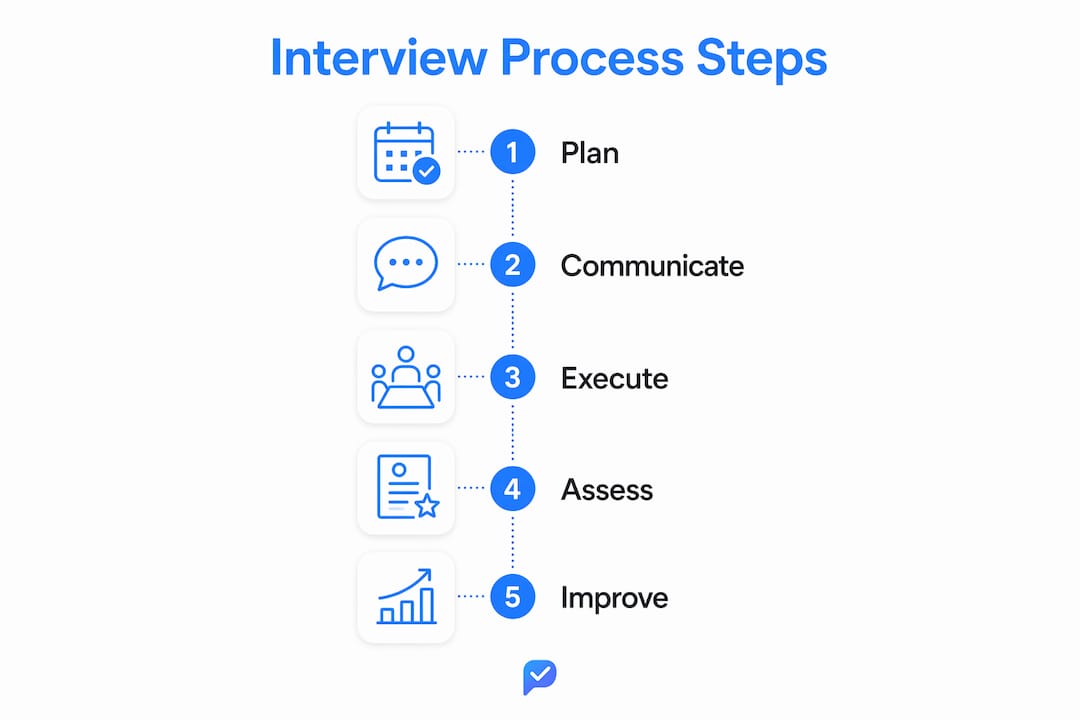
Structured interviews with predetermined questions mapped to competencies consistently outperform unstructured conversations on both fairness and predictive value. The 60/30/10 preparation framework offers a practical allocation: 60% of preparation time on the two or three most critical competencies, 30% on role-specific technical depth, and 10% on logistics and candidate questions.
Practical steps for HR teams include:
- Use structured interview formats with assigned question owners to prevent interviewers from covering the same ground
- Set time boxes for each interview segment and brief interviewers on pacing before the session
- Offer candidates a choice between virtual and in-person formats to reduce scheduling friction
- Run panel interviews to consolidate multiple assessments into a single session rather than sequential rounds
- Parallelize hiring stages such as recruiter screens, technical assessments, and manager interviews, which can cut 8–15 days from an engineering loop without adding new technology
Pro Tip: State the expected interview duration in the calendar invite and the confirmation email. Candidates who know the format in advance arrive better prepared, which raises the quality of answers and reduces the time you spend on clarifying tangents.
Emerson College recommends planning most interviews to run 45–60 minutes, with a structure of 2–5 minutes for introductions, 20–35 minutes for questions, and 5–15 minutes for candidate questions. Anything beyond an hour is rarely necessary for a single session.

Common pitfalls in interview length and how to avoid them
The most common mistake is equating length with rigor. A 90-minute interview without a clear structure produces less usable signal than a focused 45-minute session with competency-mapped questions. Length without structure rewards candidates who are comfortable talking, not necessarily those who are most qualified.
Other pitfalls hiring teams encounter regularly:
- Failing to brief interviewers on their specific role, leading to repeated questions across rounds
- Scheduling all interview stages sequentially when several could run in parallel
- Allowing conversations to drift without time-boxed segments, which dilutes the quality of insights gathered
- Ignoring scheduling overhead: manual scheduling can consume 30–60 minutes of recruiter time per session before the interview even begins
- Applying identical interview lengths across all roles regardless of seniority or complexity
- Skipping candidate communication about timing, which increases no-show rates and last-minute rescheduling
Diversity in candidate stamina and readiness is also a factor. A one-size-fits-all duration disadvantages candidates who perform better in focused, shorter formats, and it can introduce unintentional bias into the evaluation.
How AI and technology support interview efficiency
AI-powered scheduling tools address the largest hidden time cost in the hiring process: calendar coordination across multiple interviewers and time zones. Automating availability matching and confirmation reminders moves teams from a 7.8-day average to a 24–48 hour booking window, as noted earlier.
Beyond scheduling, AI interview platforms provide real-time analytics on pacing, question effectiveness, and candidate engagement. Recorded and asynchronous video interviews allow additional reviewers to evaluate responses without adding live interview rounds, which shortens the overall process without reducing the number of perspectives gathered. For HR teams managing interview data at scale, these analytics create a feedback loop that continuously improves question quality and time allocation.
Evy takes this further with real-time eye tracking that monitors attention patterns during AI-assisted interviews, flagging behavior inconsistent with genuine, independent responses. This matters for interview efficiency because it allows hiring teams to trust the data they collect in shorter sessions. When assessment integrity is confirmed, there is no need to add interview rounds as a verification layer. Evy's anti-cheat AI features make it possible to screen at scale, 24/7, while surfacing candidates whose responses reflect honest, unassisted thinking.
Benchmark data on optimal interview lengths by role
Interview duration norms vary meaningfully by seniority and role type. Entry-level positions typically run 30–45 minutes, covering basic skills and cultural fit across one or two rounds. Mid-level roles warrant 45–60 minutes per session, with additional rounds for technical depth and scenario-based questions. Senior and executive roles often involve three to five rounds of 30–60 minutes each, addressing leadership style, strategic thinking, and stakeholder alignment.
Role complexity adds another variable. Technical roles in engineering or data science frequently include coding assessments or problem-solving exercises that extend individual sessions. A standard coding interview runs 45 minutes for one to two problems, with a structured time split across problem identification, coding, and verification. Consulting roles may include case study components that push sessions toward 90 minutes. Customer-facing roles often incorporate role-play simulations. In each case, the benchmark duration reflects the minimum time needed to gather reliable signal, not a default to fill.
What happens when organizations actually optimize interview length
The evidence from process changes is consistent. Teams that parallelize hiring stages rather than running them sequentially reduce total time-to-hire by 8–15 days without adding technology or changing evaluation criteria. That reduction directly lowers the probability of losing a candidate to a faster-moving competitor.
Communicating expected interview duration upfront produces measurable gains in completion rates of 5–15%, as candidates who know what to expect prepare more thoroughly and are less likely to withdraw mid-process. For B2B SaaS and engineering teams operating in competitive talent markets, where top candidates often hold multiple offers simultaneously, these gains translate directly into hiring outcomes.
Organizations that track metrics such as time-to-hire, interview-to-offer ratio, and candidate satisfaction after each hiring cycle create the data foundation needed to identify which stages are adding friction without adding value. Removing one redundant interview round, tightening question sets to core competencies, and automating scheduling confirmation together produce a process that is faster, fairer, and more predictive than the one it replaces.
Key Takeaways
Interview length optimization improves hiring outcomes by focusing each minute on specific competencies, not by extending sessions to signal thoroughness.
| Point | Details |
|---|---|
| Length does not equal quality | Meta-analytic research confirms interview length is unrelated to reliability or validity. |
| Communicate duration upfront | Stating expected length increases candidate completion rates by 5–15%. |
| Parallelize stages to save time | Restructuring hiring loops can cut 8–15 days from time-to-hire without new technology. |
| Match duration to role complexity | Entry-level interviews run 30–45 minutes; senior roles warrant 45–60 minutes per round. |
| Use AI to protect assessment integrity | Platforms like Evy use real-time eye tracking to confirm honest responses, reducing the need for extra verification rounds. |
Evy helps HR teams run faster, fairer interviews without adding rounds or losing signal. Real-time eye tracking confirms assessment integrity so you can trust shorter sessions. See Evy's features and start screening at scale.