
 By Adrian Pascual•Hiring insight•Published
What Is Interview Question Effectiveness for HR Teams
Most interviewers believe that asking thoughtful questions naturally leads to better hires. The research tells a more sobering story. Understanding what is interview question effectiveness matters because unstructured interviews predict success only about 57% of the time, barely better than flipping a coin. That single statistic should stop any HR professional in their tracks. The real drivers of interview quality have less to do with clever question wording and far more to do with structure, scoring consistency, and measurement. This article walks you through the core concepts, proven metrics, common mistakes, and best practices that turn interviews from guesswork into a reliable hiring tool.
Table of Contents
- Key Takeaways
- What is interview question effectiveness and why it matters
- How to measure interview effectiveness with precision
- Common pitfalls that undermine interview question effectiveness
- Best practices for designing effective interview questions
- Integrating effectiveness into your hiring workflow
- My perspective on building a culture of interview rigor
- How Evy helps you measure and improve interview quality
- FAQ
Key Takeaways
| Point | Details |
|---|---|
| Define effectiveness clearly | Interview question effectiveness measures a question's ability to predict job fit and future performance. |
| Structure beats wording | Consistent order, fixed questions, and scoring rubrics matter more than how a question is phrased. |
| Measure at multiple intervals | Correlate interview scores with performance data at 3 and 12 months to validate question quality. |
| Calibrate your interviewers | Uncalibrated interviewers introduce scoring bias that undermines even the best-designed questions. |
| Screen before you interview | Pre-interview skill screening focuses your interview questions on higher-value evaluation areas. |
What is interview question effectiveness and why it matters
Interview question effectiveness refers to a question's demonstrated ability to predict whether a candidate will succeed in a role. Not whether the question feels rigorous. Not whether it impresses the hiring manager. Whether it actually correlates with job performance, retention, and team contribution after hire.
This definition has real business consequences. A question that fails to predict performance contributes to bad hires, and the cost of a bad hire is substantial. Beyond direct costs like recruiting fees and onboarding time, poor hiring decisions drain manager attention, damage team morale, and push up voluntary turnover. The importance of interview questions is not philosophical. It shows up in quarterly budgets.
There are two technical properties that determine whether a question is effective:
- Predictive validity measures how strongly interview scores for a given question correlate with actual job performance metrics after hire. A correlation of 0.5 or above is considered strong in hiring research.
- Reliability measures whether different interviewers score the same candidate response consistently. Low reliability means the question is producing noise, not signal.
A question can be perfectly crafted in terms of language and still have low predictive validity if it is asked inconsistently, scored subjectively, or disconnected from the actual demands of the role. Interview effectiveness depends more on consistent structure, fixed order, and scoring rubrics than on question wording alone. That distinction is the foundation of everything that follows.
How to measure interview effectiveness with precision
Most teams rely on gut feel to evaluate whether their interview questions are working. A rigorous approach uses data collected before, during, and after the hiring process. Here are the core measurement methods HR teams should know.
- Predictive validity analysis. After hire, compare interview scores with manager performance ratings. Do high interview scores predict strong performance reviews at 3 and 12 months? Correlating scores with retention outcomes at those intervals is the most direct way to measure whether your questions are doing their job.
- Inter-rater reliability tracking. When two interviewers assess the same response independently, how often do they agree? You can calculate inter-rater reliability using statistical tools built into most modern ATS platforms. Low agreement signals that your scoring rubric is too vague or that interviewers need calibration.
- Interviewer effect analysis. Pass rates and scoring averages vary widely by interviewer, often reflecting personal bias rather than candidate differences. Tracking each interviewer's average score distribution and pass rate reveals who is grading leniently or harshly relative to the group. This is the "interviewer effect," and ignoring it will skew your effectiveness data.
- Candidate experience surveys. Candidate NPS and bias variance metrics add fairness indicators to your quality picture. A question that produces strong predictive validity but consistently makes candidates feel disrespected creates legal and reputational risk.
- ATS data and downstream outcomes. Track offer acceptance rates, 90-day turnover, and manager satisfaction scores by the interview question set used. Over time, this builds a clear picture of which question batteries translate into successful hires and which do not.
| Metric | What it measures | Review frequency |
|---|---|---|
| Predictive validity | Correlation between interview score and performance | Every 12 months |
| Inter-rater reliability | Consistency of scoring across interviewers | Every 6 months |
| Interviewer effect | Score distribution variance by interviewer | Quarterly |
| Candidate NPS | Fairness and experience perception | Per hiring cycle |
| 90-day turnover rate | Early failure linked to interview quality | Quarterly |
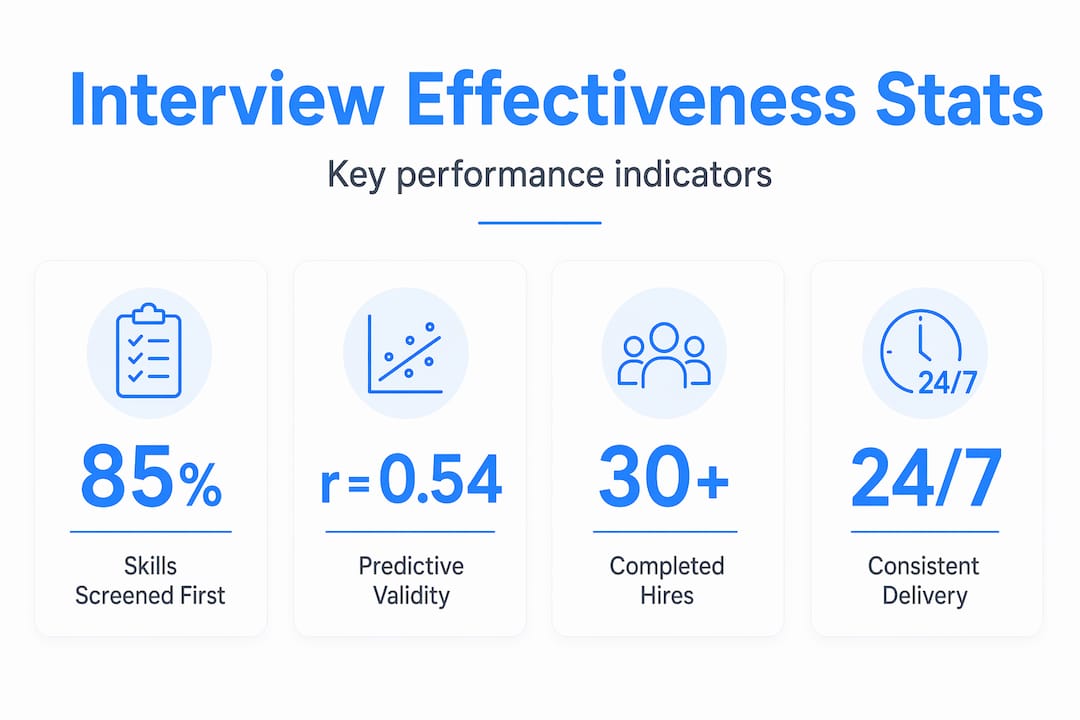
Pro Tip: Run your first predictive validity analysis on your highest-volume role first. Even 20 to 30 completed hires with documented interview scores and 3-month performance data will give you statistically meaningful patterns to act on.
Common pitfalls that undermine interview question effectiveness
Understanding how to measure interview effectiveness is only half the work. You also need to know where effectiveness breaks down in practice.
The most common mistake is improvisation. When interviewers go off-script, add follow-up questions not in the rubric, or reorder the question sequence, they introduce noise that makes scoring incomparable across candidates. You cannot measure the effectiveness of a question that is never asked the same way twice.
A second major pitfall is over-relying on generic behavioral prompts. Questions like "Tell me about a time you worked in a team" have become so familiar that candidates can deliver rehearsed answers that bear no relationship to how they actually perform under pressure. Past behavior questions tied to critical incidents specific to the role produce significantly better predictive power than broad behavioral prompts.
Several other pitfalls show up regularly across hiring teams:
- Using candidate reactions as the only quality signal. If an interview feels friendly and comfortable, interviewers often assume it went well. Candidate experience matters, but it is not a proxy for question effectiveness.
- Ignoring scoring rubric vagueness. A rubric that labels a response "good" without defining what a good answer looks like invites subjective interpretation.
- Failing to track interviewer calibration over time. Even well-trained interviewers drift in their scoring standards without ongoing calibration sessions.
- Treating interview quality as fixed. Questions that worked for a role two years ago may no longer reflect the job's current demands, especially in fast-changing functions like technology or operations.
Pro Tip: Schedule a quarterly calibration session where interviewers score the same recorded response independently, then compare and discuss discrepancies. Research confirms that calibration using recorded interviews significantly improves scoring agreement and reduces subjective noise.
Best practices for designing effective interview questions
Building questions that actually work requires a deliberate design process, not intuition. Here is a framework grounded in research and practical application.
- Anchor every question to a critical job incident. Start with job analysis. Identify the two or three situations where performance differences matter most in the role. Then write questions that put candidates directly into those scenarios. This approach produces far stronger predictive validity than questions written from a generic competency library.
- Develop behaviorally anchored rating scales for each question. A behaviorally anchored rating scale, often called a BARS, defines what a 1, 3, and 5 response looks like for a specific question. This removes ambiguity from scoring and makes inter-rater reliability measurable.
- Keep your question set focused. Limiting questions to 8 to 12 well-designed items balances signal quality and interview length. More questions do not necessarily mean better data, particularly if the extra questions are weakly designed.
- Add work sample tasks where possible. Work sample tests show the highest predictive validity among all hiring methods, with correlations around 0.54. A short practical task embedded in the hiring process validates what interview questions can only estimate.
- Run structured interviews with consistent delivery. Every candidate should receive the same questions in the same order. Structured interviews have a predictive validity between 0.42 and 0.51, compared to 0.38 for unstructured formats. The difference in hiring quality over hundreds of decisions is significant.
- Build in continuous review cycles. Connect interview scores to performance data, flag questions with weak predictive correlations, and revise or replace them. Evaluating interview questions is not a one-time design event. It is an ongoing process that improves over time as you accumulate data.
| Approach | Predictive validity | Practical complexity |
|---|---|---|
| Unstructured interview | r ≈ 0.38 | Low |
| Structured interview | r = 0.42 to 0.51 | Medium |
| Work sample task | r ≈ 0.54 | Medium to high |
| Structured interview + work sample | Highest combined | High |
Integrating effectiveness into your hiring workflow
Measuring and improving interview question effectiveness does not happen in isolation. It requires connecting your interview process to the broader hiring system.

The screen-first model is a meaningful shift. 85% of employers now screen skills before interviews, focusing interview time on candidates who have already demonstrated baseline capability. This raises the quality of interview interactions and allows your questions to focus on communication, judgment, and cultural alignment rather than basic qualification checks. Understanding AI candidate screening can help you see where pre-interview assessment fits into your process.
Alignment between interview questions and job descriptions is often neglected. When questions are written independently from the role's competency framework, there is no logical basis for expecting them to predict success. Mapping every question to a specific competency, and every competency to a measurable job outcome, creates the chain of validity your measurement efforts depend on.
Other integrations that improve effectiveness over time include:
- Using ATS analytics to track scoring trends by interviewer, question, and role type.
- Sharing performance outcome data with recruiting teams so they understand which interview signals led to strong hires.
- Running regular feedback loops between hiring managers and recruiters to surface questions that feel disconnected from actual job demands.
- Using AI-powered screening platforms to collect consistent, structured scores that feed directly into your validity analysis.
For teams wondering why traditional interviews make comparison hard, the answer almost always comes back to inconsistent structure and the absence of data-connected review cycles.
My perspective on building a culture of interview rigor
I've spent years watching hiring teams invest enormous energy in crafting clever interview questions while skipping the step that actually drives results: measurement. In my experience, the organizations that hire best are not the ones with the most creative question banks. They are the ones that treat the interview as a data collection instrument and hold it to the same standards they would apply to any other business process.
What I've seen consistently is that bias doesn't arrive loudly. It creeps in through small deviations: an interviewer who rephrases a question, a scoring rubric that is too vague to apply consistently, a calibration session that was skipped for three consecutive quarters. Each deviation seems minor. Collectively, they erode the validity of your entire process.
The hardest shift I've observed teams make is accepting that interviewer performance is as important as question design. A great question administered by an uncalibrated interviewer produces unreliable data. Accepting that insight, and acting on it through regular calibration and performance tracking, is what separates teams that improve over time from those that repeat the same hiring mistakes.
My honest take: if you do not have data connecting your interview scores to performance outcomes, you do not yet know whether your interview questions are effective. You have beliefs. The work is to turn those beliefs into evidence.
— Hudson
How Evy helps you measure and improve interview quality
If you are ready to move from belief to evidence in your interview process, Evy is built for exactly that challenge.
Evy's AI interview platform gives HR teams structured, consistent interview delivery at scale, available 24/7. With real-time eye tracking to detect AI-assisted cheating and built-in scoring rubrics, every candidate interaction produces comparable, reliable data. Evy also surfaces interviewer variance patterns so your team can identify calibration gaps before they corrupt your validity metrics. For teams serious about connecting interview data to hiring outcomes, explore Evy's full feature set and see how structured AI interviews support fairer, faster, and measurably better hiring decisions.
FAQ
What is interview question effectiveness?
Interview question effectiveness is the degree to which a question predicts candidate job performance and retention. It is measured through predictive validity, inter-rater reliability, and downstream performance outcomes.
How do you measure interview effectiveness?
You measure interview effectiveness by correlating interview scores with manager performance ratings at 3 and 12 months, tracking inter-rater reliability, and monitoring interviewer score variance across candidates.
Why do unstructured interviews perform poorly?
Unstructured interviews rely on improvisation and subjective judgment, which introduces inconsistency and bias. Research shows they predict job performance only about 57% of the time, close to chance level.
What makes interview questions more predictive?
Questions tied to critical job incidents, delivered in a fixed order with behaviorally anchored scoring rubrics, produce significantly higher predictive validity than generic behavioral prompts asked informally.
How many interview questions should a structured interview include?
Research supports limiting structured interviews to 8 to 12 well-designed questions. Fewer, higher-quality questions with clear scoring criteria outperform longer question sets with weaker design.