
 By Adrian Pascual•Hiring insight•Published
Types of Pre-Employment Assessments: A 2026 HR Guide
The core types of pre-employment assessments HR teams should consider are cognitive/aptitude tests, skills and work-sample tests, structured interviews, personality assessments (using the Big Five model), situational judgment tests (SJTs), integrity tests, language proficiency tests, and background/reference checks. No single test predicts job success reliably on its own. The most effective approach is a multi-hurdle strategy: run high-volume, low-cost screens early in the funnel (application review, short cognitive or SJT screens), then reserve resource-intensive simulations and structured interviews for finalists. Two federal frameworks govern how you deploy these tools in the United States: EEOC guidance requires that every test be job-related and non-discriminatory, and the ADA requires reasonable accommodations when candidates request them. Evy supports the structured interview layer of this flow with real-time proctoring and scoring rubrics at scale. As an immediate action, map your open role to two or three complementary assessment types, then pilot them with a small cohort of 15–20 candidates before full rollout.
Pro Tip: Start with one cognitive screen and one work-sample test for any new role. That pairing covers both capacity and demonstrated skill without overwhelming candidates or your team.
Table of Contents
- What are pre-employment assessments and why do employers use them?
- What are the main types of pre-employment assessments?
- How do you choose the right assessments for a role?
- How do administration and predictive validity work in practice?
- What U.S. legal and accessibility requirements apply to pre-employment assessments?
- Which assessments work best for common roles?
- Key Takeaways
- Why most assessment programs fail before they start
- Evy helps you run structured, secure interviews at scale
- Useful sources and further reading
What are pre-employment assessments and why do employers use them?
A pre-employment assessment is any standardized tool used before a hiring decision to measure whether a candidate can do the job and whether they are likely to do it consistently. Those two axes, ability/skill and disposition/fit, map to different test types and answer different hiring questions. Cognitive tests address capacity; personality and integrity tests address motivation and character; work samples address demonstrated performance.
Employers use these tools for several practical reasons. Resumes are self-reported and notoriously unreliable for predicting performance. Assessments add an objective data layer that validates claims, scales screening across hundreds of applicants without proportionally increasing interviewer time, and, when well-designed, reduce the influence of unconscious bias in early shortlisting.
High-performing organizations typically combine two to three different assessment types to capture distinct performance signals, because each test measures a different dimension of future job behavior. The practical payoff is a shorter, better-calibrated shortlist and, over time, lower turnover among new hires.
What are the main types of pre-employment assessments?
The eight main assessment types most employers use each measure something different. Understanding what each one captures, and where it fits in a hiring flow, is the foundation of a sound candidate evaluation method.
Cognitive and aptitude tests
These measure reasoning, memory, numerical ability, verbal comprehension, and problem-solving speed. They are among the strongest single predictors of job performance across a wide range of roles, particularly those requiring learning agility or complex decision-making. Administration is typically online and timed, usually within a moderate duration. Scoring is automated, which keeps interpretation complexity low. The main accessibility consideration is extra time for candidates with documented processing or reading disabilities.

Skills and job-knowledge tests
Skills tests verify whether a candidate already possesses the technical knowledge a role requires, such as accounting principles, coding languages, or regulatory compliance rules. They are most useful as a verification step for mid-to-senior roles where claimed expertise is hard to assess from a resume alone. Work-sample tests and simulations take this further by asking candidates to complete an actual task, such as drafting a memo, debugging code, or handling a mock customer call. Predictive strength is high for roles where the simulation closely mirrors real job tasks.

Structured interviews
A structured interview uses identical questions for every candidate, scored against pre-defined behavioral anchors. Google's structured interview guidance recommends identical questions, defined rating rubrics, and pre-scored answers to reduce subjective bias. Predictive strength is high when rubrics are used consistently and interviewers are trained. Scoring complexity is moderate because rater calibration requires upfront investment. Evy supports this format with structured templates and real-time proctoring to maintain integrity at scale.
Personality assessments (Big Five)
The Big Five model measures Openness, Conscientiousness, Extraversion, Agreeableness, and Neuroticism. Conscientiousness is the trait most consistently linked to job performance across industries. These assessments are typically self-reported, online, and take 15–30 minutes. Predictive strength is moderate on its own but improves meaningfully when combined with cognitive or skills measures. Scoring is automated; interpretation requires some HR or I/O psychology familiarity to avoid over-weighting any single trait.
Situational judgment tests (SJTs)
SJTs present candidates with realistic workplace scenarios and ask them to choose the most effective response. They measure judgment, interpersonal skills, and role-specific decision-making. They work well for customer-facing, supervisory, and public-safety roles. Administration is online, typically 20–35 minutes, and scoring is standardized. Accessibility accommodations are straightforward since most SJTs are text-based and can be offered with extended time.
Integrity tests
Integrity tests assess honesty, reliability, and counterproductive work behavior tendencies. They come in two forms: overt tests that ask directly about attitudes toward theft or rule-breaking, and personality-based tests that infer integrity from broader trait profiles. Predictive strength for counterproductive behavior is moderate to high. They are most commonly used in retail, financial services, and roles with access to sensitive assets. Administration is online and usually takes a moderate amount of time.
Assessment centers and role-specific simulations
Assessment centers combine multiple exercises, such as in-basket tasks, group discussions, and role-plays, observed and scored by trained assessors. They are resource-intensive but offer high predictive validity for leadership and management roles. Administration is typically conducted over several hours, either in person or via video. Scoring complexity is high; assessor calibration and inter-rater reliability training are required.
Language proficiency, background checks, and physical tests
Language proficiency tests confirm a candidate meets the communication requirements of a role; their duration varies. Background and reference checks verify employment history, credentials, and, where legally permissible, criminal records. Physical agility tests are used for public-safety and physically demanding roles; under the ADA, they must be job-related and administered consistently. These are generally lower in predictive validity for cognitive performance but serve important compliance and safety functions.
Comparison of assessment types
| Assessment type | What it measures | Best for / typical roles | Predictive strength | Format and administration time | Scoring complexity | Accessibility considerations |
|---|---|---|---|---|---|---|
| Cognitive/aptitude | Reasoning, memory, problem-solving | Analyst, manager, engineer | High | Online, timed; typically within a moderate time range | Low (automated) | Extended time for processing disabilities |
| Skills/job-knowledge | Technical knowledge, domain expertise | Accountant, developer, compliance | High (role-specific) | Online or written; typically completed within a moderate duration | Low to moderate | Alternate formats on request |
| Work-sample/simulation | Actual task performance | Any role with defined deliverables | High | Task-based; usually completed within a typical assessment duration | Moderate | Task format adjustments |
| Structured interview | Behavioral competencies, judgment | All roles | High (with rubrics) | Live or async video; usually completed within a typical assessment duration | Moderate | Captioning, interpreter, extra time |
| Situational judgment (SJT) | Workplace judgment, interpersonal skill | Customer service, supervisory, safety | Moderate to high | Online; typically takes a moderate amount of time | Low (automated) | Extended time, screen reader |
| Personality (Big Five) | Traits, motivation, work style | All roles; strongest for leadership | Moderate | Online; usually completed within a reasonable time frame | Moderate | Minimal barriers |
| Integrity | Honesty, reliability, counterproductive behavior | Retail, finance, sensitive-access roles | Moderate to high | Online; typically conducted within a moderate timeframe | Low | Minimal barriers |
| Assessment center | Leadership, complex judgment | Management, senior specialist | High | Several hours | High | Assessor accommodations required |
| Language proficiency | Communication competency | Customer-facing, bilingual roles | Role-dependent | Online or oral; duration varies | Low to moderate | Oral format alternatives |
| Background/reference check | History, credentials, character | All roles | Low (predictive) | Vendor-managed | Low | N/A |
| Physical agility | Physical capability | Public safety, trades, operations | Role-dependent | In-person; duration varies | Low | Must be job-related per ADA |
Pro Tip: Never rely on a single assessment type. Candidate skills inflation on resumes is common, and a work-sample verification step is the most reliable way to catch overstated claims before you invest in a full interview round.
How do you choose the right assessments for a role?
Start by mapping the role's critical competencies. A customer service representative needs judgment under pressure, communication skill, and patience. A software engineer needs technical problem-solving, attention to detail, and the ability to learn new frameworks. Once you have two or three core competencies identified, choose measures that directly sample those competencies rather than proxies.
From there, weigh predictive strength against cost and volume constraints. A multi-hurdle process keeps early screens short and inexpensive, reserving work samples and structured interviews for candidates who pass the initial filter. For a high-volume entry-level role, a 20-minute SJT or cognitive screen at the application stage can cut your shortlist significantly before any human time is invested. For a senior specialist role, a technical work sample followed by a structured interview with a scoring rubric is a more appropriate sequence.
When evaluating vendors, ask for validation studies and adverse impact analyses specific to your industry and job family. Ask what accommodations the platform supports and how candidate data is stored and secured. Red flags include no published validation evidence, opaque scoring algorithms, and candidate time burdens exceeding 90 minutes for early-funnel screens. Vendor transparency on validation, accessibility, and data security is a baseline requirement, not a differentiator.
Operationally, consider where each assessment sits in your ATS workflow, how candidates receive instructions, and what your completion rate target is. Candidate drop-off rises sharply when early-stage assessments exceed 30 minutes or feel disconnected from the role. Piloting a new assessment with a small cohort before full deployment lets you catch these friction points before they affect your pipeline.
How do administration and predictive validity work in practice?
Consistent administration is what separates a defensible assessment program from an informal one. Every candidate for the same role should receive the same instructions, the same time limits, and the same scoring criteria. Varying any of those elements introduces measurement error and legal exposure.
Predictive validity refers to how well a test score correlates with actual job performance. Cognitive tests are widely cited as strong predictors across many roles because they measure the capacity to learn and solve job-related problems. Work-sample tests have similarly strong validity when the simulation closely mirrors real tasks. Structured interviews with rubrics outperform unstructured interviews substantially because they reduce the influence of interviewer bias and irrelevant conversational dynamics.
Combining measures improves prediction further. Mixing ability, personality/motivation, and skills measures into a single performance model helps hiring managers assess both capacity and likely on-the-job behavior. A cognitive test tells you whether someone can learn the role; a work sample tells you whether they can perform it today; a structured interview tells you how they handle the interpersonal and situational demands.
For scoring, use standardized rubrics for every structured interview, train all raters before the process begins, and document score aggregation rules in advance. A weighted scoring plan, where cognitive and work-sample scores carry more weight than personality for technical roles, should be set before candidates are evaluated, not after. Tracking hire outcomes against assessment scores over a period of several months allows you to recalibrate weights and cutoffs based on real performance data rather than assumptions.
Pro Tip: Log your assessment scores alongside 90-day performance ratings for every new hire. Even a modest dataset of new hires can show you which tests are actually predicting the outcomes you care about, and that data is your best defense if a selection decision is ever challenged.
What U.S. legal and accessibility requirements apply to pre-employment assessments?
EEOC guidance is clear: pre-employment tests must be job-related and non-discriminatory. If a test disproportionately excludes candidates from a protected group, the employer must demonstrate business necessity and show that no equally valid, less discriminatory alternative exists. This applies to cognitive tests, personality assessments, physical agility tests, and any other standardized selection procedure.
Under the ADA, employers must provide reasonable accommodations for pre-employment tests when a candidate requests them and provides supporting documentation. Examples include extended time, screen readers, oral administration, a sign language interpreter, or a private testing room. Failure to accommodate can result in enforcement action; the EEOC v. Daimler Chrysler Corp. case is a documented example where reading accommodations were required for an hourly manufacturing test and remediation followed.
Physical agility tests for public-safety roles are not automatically classified as medical examinations under the ADA, but they must still be job-related and administered consistently. If they disproportionately exclude applicants with disabilities, the employer must show business necessity.
A practical legal risk checklist for HR teams:
- Validate every assessment for the specific job family before deployment.
- Apply the same assessment at the same funnel stage for all candidates in a job category.
- Document vendor validation studies and keep them on file.
- Track disparate-impact metrics by protected group after each hiring cycle.
- Offer accommodations on request and log every accommodation provided.
- Partner with legal counsel or an EEO specialist before rolling out any high-stakes new assessment.
This article provides general information about U.S. employment testing law. Confirm current requirements with the EEOC, your legal counsel, or a qualified HR compliance professional for your specific situation.
Which assessments work best for common roles?
The right combination depends on the role's core competencies and the volume of candidates you are managing. The estimates below are typical ranges; confirm exact timing with your chosen vendor before communicating expectations to candidates.
Customer service representative
- Situational judgment test (20–30 minutes) at the application stage to screen for judgment and interpersonal skill.
- Short language proficiency check (15–20 minutes) if the role requires bilingual communication.
- Structured interview with behavioral rubric (30–45 minutes) for finalists.
- Total candidate time: roughly between one and one and a half hours over two funnel stages.
Software engineer
- Cognitive ability screen (25–35 minutes) early in the funnel.
- Coding work sample or technical simulation (45–90 minutes) for candidates who pass the cognitive screen.
- Structured technical interview with a scoring rubric (45–60 minutes) for finalists.
- Total candidate time: roughly between two and three hours over three stages.
Frontline operations or warehouse role
- Short cognitive or reading comprehension screen (15–20 minutes) at application.
- Physical agility test (30–60 minutes, in-person) for finalists, administered consistently with documented job-relatedness.
- Structured interview (20–30 minutes) for final candidates.
- Total candidate time: roughly between one and nearly two hours.
Senior manager or director
- Personality assessment using the Big Five model (20–30 minutes) early in the process.
- In-basket or leadership simulation exercise (60–90 minutes) for shortlisted candidates.
- Structured behavioral interview with competency-based rubric (60 minutes) for finalists.
- Total candidate time: roughly between two and three hours across two to three stages.
| Role | Early-funnel screen | Mid-funnel assessment | Finalist stage | Est. total candidate time |
|---|---|---|---|---|
| Customer service rep | SJT (short duration) | Language check (brief duration) | Structured interview (moderate duration) | approximately one to one and a half hours |
| Software engineer | Cognitive screen (short to moderate duration) | Coding work sample (medium duration) | Structured interview (moderate duration) | approximately two to three hours |
| Frontline operations | Cognitive/reading screen (brief duration) | Physical agility test (30–60 min) | Structured interview (moderate duration) | approximately one to nearly two hours |
| Senior manager | Personality assessment (moderate duration) | Leadership simulation (extended duration) | Behavioral interview (moderate duration) | approximately two to three hours |
For high-volume roles, keep early-funnel screens under 30 minutes and offer asynchronous options where possible. Candidate drop-off at the assessment stage is a real pipeline risk, and a shorter, well-targeted screen loses fewer qualified applicants than a long, broad battery.
Key Takeaways
A multi-hurdle assessment strategy, combining cognitive screens, work-sample tests, and structured interviews with scoring rubrics, gives U.S. hiring teams the strongest, most defensible prediction of job performance.
| Point | Details |
|---|---|
| Use a multi-hurdle approach | Run short, low-cost screens early; reserve work samples and structured interviews for finalists. |
| Match tests to competencies | Map each assessment to a documented job requirement before deployment, not after. |
| Legal compliance is non-negotiable | EEOC job-relatedness, ADA accommodations, and disparate-impact tracking are baseline requirements for every U.S. employer. |
| Combine measures for better prediction | Mixing cognitive, skills, and personality data captures both capacity and likely on-the-job behavior more accurately than any single test. |
| Evy for structured interview integrity | Evy's real-time eye tracking and structured interview templates support fair, scalable screening while reducing AI-assisted cheating risk. |
Why most assessment programs fail before they start
The conventional wisdom in HR is that adding more assessments improves hiring. It usually does not. The problem is not the number of tests; it is the absence of a documented link between what each test measures and what the job actually requires. Organizations that run candidates through five assessments without a clear competency map are collecting data they cannot interpret and cannot defend.
What actually works is a tighter loop: fewer, better-chosen assessments, applied consistently, with outcomes tracked against real job performance. The structured interview is the most underused tool in this loop. Most organizations conduct interviews, but very few use identical questions, pre-defined rubrics, and trained raters. That gap is where the most prediction is lost, because unstructured interviews introduce interviewer bias at exactly the stage where decisions carry the most weight.
There is also a fairness dimension that gets underweighted in practice. Assessments that are not validated for your specific job family and candidate population can disadvantage protected groups in ways that are both legally risky and genuinely unfair. The answer is not to avoid assessments; it is to validate them, accommodate candidates who need it, and track disparate-impact metrics after every hiring cycle. That discipline is what separates a defensible program from a liability.
The rise of AI-assisted interviews adds a new layer of integrity risk. When candidates can use generative AI to answer questions in real time, the structured interview loses its predictive value unless the platform can detect and flag that behavior. That is a problem worth taking seriously before it affects your data.
Evy helps you run structured, secure interviews at scale
Most assessment programs get the early-funnel right, then lose integrity at the interview stage. Evy is built specifically for that gap. As the only AI interview platform with real-time eye tracking, Evy detects when candidates are using AI assistance during a live interview, so your structured interview data reflects genuine candidate performance rather than AI-generated responses.
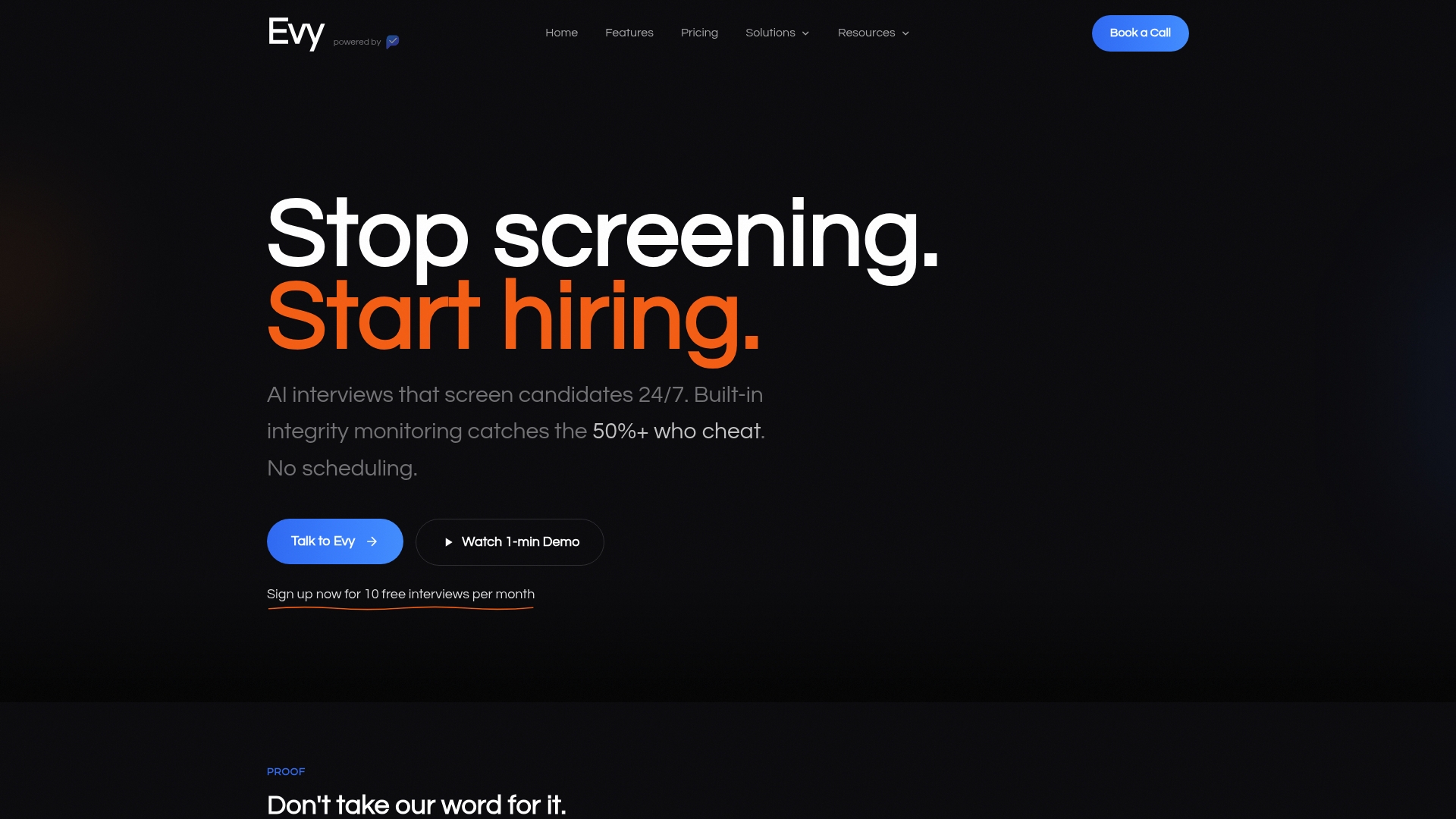
Evy's platform includes structured interview templates with pre-built scoring rubrics, making it straightforward to apply consistent questions and behavioral anchors across every candidate in a role. Interviews run asynchronously, 24/7, which reduces scheduling friction for high-volume hiring without sacrificing the standardization that makes structured interviews predictive. The platform integrates with your existing ATS, and captured interview data feeds directly into your outcome-tracking workflow. For HR teams building or auditing a multi-hurdle assessment flow, Evy handles the structured interview layer with the security and consistency that layer requires. See the full capability set on the Evy features page.
Useful sources and further reading
The sources below were used in building this guide and are worth bookmarking for ongoing reference.
- EEOC: Employment Tests and Selection Procedures — The primary U.S. federal guidance on job-relatedness, validation, and disparate-impact requirements for pre-employment tests.
- DoD Hiring Assessment and Selection Guide — A detailed practitioner guide covering multi-hurdle design, assessment sequencing, and outcome tracking; applicable well beyond federal hiring.
- Texas Workforce Commission: Pre-Employment Tests and Examinations — Practical overview of ADA accommodation requirements and enforcement examples for pre-employment testing.
- SHRM: Screening by Means of Pre-Employment Testing — SHRM's toolkit covering test types, legal considerations, and implementation guidance for HR practitioners.
- SHRM: Screening and Evaluating Job Candidates — Broader candidate evaluation framework covering assessment integration with the full selection process.
- Google Re:Work: Structured Interviewing Guide — Google's practical guidance on identical questions, rating rubrics, and pre-scored answers for structured interviews.
- Paylocity: Pre-Employment Testing Overview — Practitioner-level overview of vendor selection criteria, including validation evidence, accommodation policies, and data security questions.
For any high-stakes assessment rollout, review your vendor's validation documentation and consult internal legal counsel or an EEO specialist before deployment.