
 By Adrian Pascual•Hiring insight•Published
The Role of Job Requirements in Screening Design
Job requirements are the defined, role-derived criteria that determine which candidates advance through a hiring process. The role of job requirements in screening design is foundational: without them, every screening decision becomes subjective, inconsistent, and legally exposed. Well-built requirements give your screening process a clear target. They reduce noise in large applicant pools, protect against discrimination claims, and tell automated tools exactly what to look for. HR professionals who treat job requirements as a formality rather than a design input consistently produce slower, less defensible hiring outcomes.
How job requirements shape the screening process in recruitment
Job requirements translate a business need into measurable candidate criteria. That translation is what makes the screening process in recruitment work at all. Without it, recruiters evaluate candidates against an unspoken, shifting standard that changes with each reviewer.
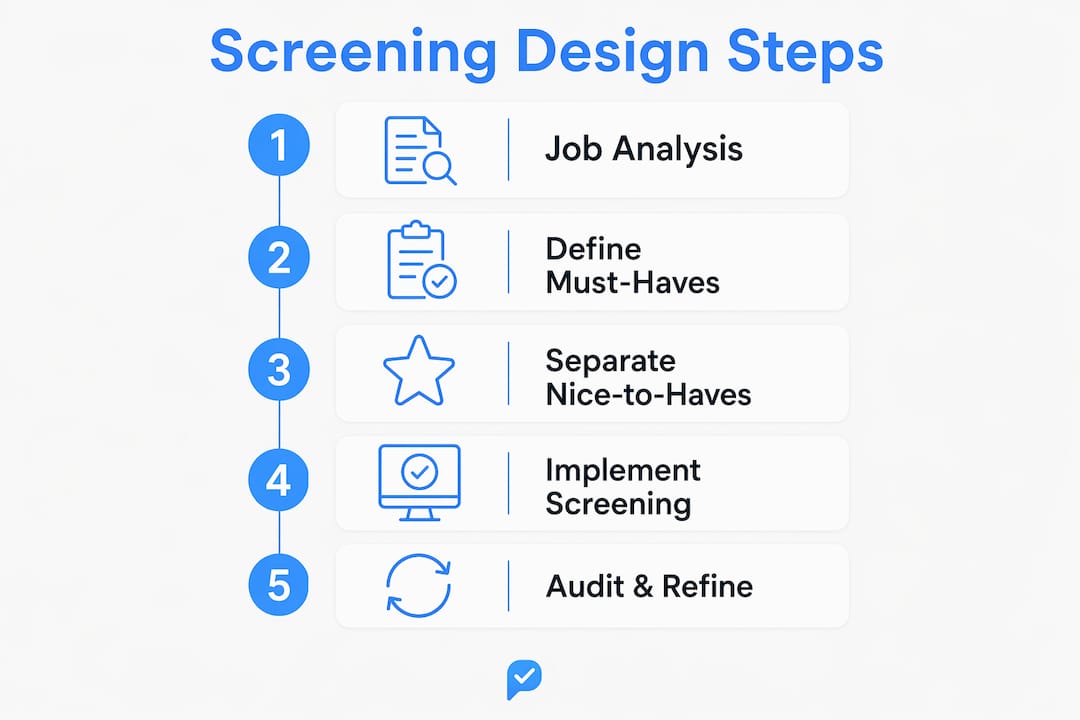
The foundation of any sound requirement set is a job analysis. A job analysis examines what the role actually demands: tasks performed, decisions made, tools used, and outcomes expected. Requirements derived from this analysis are defensible because they connect directly to job performance, not to assumptions about what a "good" candidate looks like.

Once requirements exist, the most important structural decision is separating must-haves from nice-to-haves. Vague or inflated criteria produce high-volume, low-quality applicant pools and extend time-to-hire. Precise criteria speed decision-making and produce selections that hold up under scrutiny. The practical difference is significant: a must-have is something a candidate cannot do the job without, while a nice-to-have is something that adds value but can be trained or developed.
Effective selection criteria typically number between six and ten items, with essential qualifications listed before desirable ones. That ordering matters because it signals priority to both human reviewers and automated screening tools.
Here is what well-structured requirements accomplish in practice:
- They reduce the volume of unqualified applicants who self-select in
- They give every reviewer the same evaluation standard, cutting inter-rater variability
- They create a documented basis for every pass or reject decision
- They feed automated tools with clear signals rather than ambiguous proxies
Pro Tip: Run a quick audit after each hiring cycle. Compare the must-haves you listed at the start against the profile of your final hire. If they don't match, your requirements need recalibration before the next search.
What are the legal and compliance implications of setting job requirements?
Job requirements are not just operational tools. They are legal instruments. Minimum qualifications are derived from job analysis and help avoid negligent hiring or adverse impact liability by aligning with federal employment laws and EEOC guidance. That alignment is not optional for organizations subject to federal contracting rules or OFCCP oversight.
The EEOC's Uniform Guidelines on Employee Selection Procedures require that any selection criterion that produces adverse impact must be validated as job-related. A requirement that disproportionately screens out a protected group, and cannot be tied to actual job performance, creates legal exposure. This is why the job analysis step is not bureaucratic overhead. It is the documentation that defends your criteria if they are ever challenged.
Setting requirements too high is just as risky as setting them too low. Inflated credentials exclude qualified candidates and can trigger disparate impact claims. Requirements set too low expose the organization to negligent hiring liability if an unqualified hire causes harm.
The practical compliance checklist for any requirement set includes:
- Every criterion must trace back to a documented job analysis
- Minimum qualifications must reflect actual performance requirements, not credential preferences
- Requirements must apply consistently to all applicants for the same role
- Documentation of the requirement-setting process must be retained
Balancing minimum qualifications properly reduces legal risk and improves candidate pool quality at the same time. These two goals are not in conflict. A well-calibrated requirement set does both simultaneously. HR professionals who treat compliance as separate from quality are solving the same problem twice.
The importance of job criteria extends to how you communicate requirements in job postings. Listing a credential that is not truly required, such as a four-year degree for a role that a skilled non-degree holder could perform, may constitute a barrier that regulators scrutinize. Skills-based language tied to outcomes is both more defensible and more inclusive.
How to design effective job requirements for AI-powered screening tools
AI screening tools do not interpret intent. They process the criteria you provide and rank candidates against them. AI screening is only as good as the input criteria: skills and outcome-based requirements improve filtering, while credential proxies or inflated requirements may exclude top talent before a human ever reviews the application.
Designing effective job requirements for automated screening follows a specific logic. The goal is to write criteria that are both machine-parseable and human-meaningful.
- Separate required and preferred qualifications explicitly. Use clear labels in the job description. Structured job descriptions with outcome-oriented responsibilities and specific skill requirements yield better candidate ranking in automated systems. Ambiguity in this section directly degrades AI output quality.
- Use outcome-based language, not credential proxies. "Managed a team of five engineers through two product launches" is more useful to an AI parser than "strong leadership skills." The first is verifiable and specific. The second is subjective and unstructured.
- Limit required qualifications to genuine non-negotiables. Every item on the required list becomes a filter. Each unnecessary filter narrows the pool and increases the risk of excluding qualified candidates.
- Avoid jargon and acronyms without context. AI tools trained on broad datasets may not recognize internal terminology. Write requirements in the language candidates actually use.
- Test your requirements against past successful hires. If your top performers from the last two years would not pass your current required criteria, the criteria are miscalibrated.
| Requirement type | Example | AI screening impact |
|---|---|---|
| Credential proxy | "Bachelor's degree required" | Narrows pool; may exclude qualified candidates |
| Outcome-based | "Delivered $2M+ in annual sales" | Specific, verifiable, improves ranking accuracy |
| Skill-based | "Proficient in Python and SQL" | Clear signal; parses well across most platforms |
| Vague qualifier | "Excellent communicator" | Low signal; inconsistent AI interpretation |
Pro Tip: Before publishing a job description, paste the requirements section into your AI screening tool's test mode. Review which candidates it surfaces. If the output surprises you, the criteria need revision before the role goes live.
The role of AI in technical screening is growing, and the quality of your job requirements determines whether that technology helps or hurts your hiring outcomes.
What are the most common pitfalls in defining job requirements?
The most damaging mistakes in requirements analysis in hiring are not dramatic. They are quiet and structural, and they compound over time.
Recruiters often fail to distinguish must-haves from nice-to-haves, creating screening inefficiencies and defensibility problems. This failure typically starts in the intake call, or the absence of one. When a recruiter builds a job description without a structured conversation with the hiring manager, the resulting requirements reflect assumptions rather than actual role needs.
The most common pitfalls include:
- Conflating qualifications: Listing a nice-to-have as required because it sounds impressive, then screening out candidates who could do the job without it
- Credential inflation: Requiring a degree or years of experience beyond what the role genuinely demands, which reduces diversity and widens the gap between posted requirements and actual job needs
- Skipping the intake call: Building requirements from a previous job description rather than from a current conversation with the hiring manager
- Inconsistent application: Applying requirements differently across candidates, which creates both legal exposure and poor hiring outcomes
The highest-yield improvement in screening design is agreeing on 3 to 5 non-negotiable must-haves with hiring managers before applicants arrive. That single practice aligns all evaluators, reduces subjective bias, and gives automated tools a reliable signal to work from.
Overly rigid requirements also carry a diversity cost that many hiring teams underestimate. Skills-based recruitment outperforms credential-based hiring in both pool quality and long-term retention. When requirements focus on what a candidate can do rather than what credentials they hold, the applicant pool widens and the signal-to-noise ratio improves. The types of candidate screening methods you use downstream are only as effective as the criteria you feed them at the start.
Mobile-enabled HR platforms are also changing how HR technology supports requirement-setting workflows, giving hiring managers faster ways to review and approve criteria before a role goes live.
Key Takeaways
Well-defined job requirements are the single most controllable variable in screening design, and getting them right before applicants arrive determines the quality of every hiring decision that follows.
| Point | Details |
|---|---|
| Job analysis is the starting point | Every requirement must trace back to documented job tasks and performance outcomes. |
| Separate must-haves from nice-to-haves | Conflating the two inflates criteria, shrinks pools, and creates defensibility problems. |
| Legal compliance depends on job-relatedness | EEOC and OFCCP guidance requires that all screening criteria connect to actual job performance. |
| AI tools amplify input quality | Outcome-based and skill-based criteria produce better AI screening results than credential proxies. |
| Intake calls prevent downstream errors | Agreeing on 3 to 5 non-negotiables with hiring managers before review begins aligns all evaluators. |
Why I think most teams underestimate the intake call
The most consistent pattern I've seen across hiring teams is this: the intake call gets treated as a scheduling formality rather than a design session. A recruiter spends 10 minutes confirming the job title and salary band, then copies last year's job description and calls it done. The screening process that follows is built on a foundation that nobody actually agreed to.
The best hiring outcomes I've observed share one common trait. Someone sat down with the hiring manager before a single application arrived and asked a specific question: "If a candidate had only these three things, would you interview them?" That question forces a real answer. It separates what the manager wants from what the role actually requires. It also gives the screening process a defensible core that holds up when a hiring decision is questioned later.
AI tools make this discipline more urgent, not less. AI screening platforms remove manual triage by sorting incoming applications using agreed must-haves. If those must-haves are wrong, the automation runs at scale in the wrong direction. You don't get a bad hire. You get a systematically filtered pool that excludes your best candidates before any human sees them.
The teams that get this right treat requirement-setting as a recurring practice, not a one-time task. They review criteria after each hire, compare requirements against the profiles of successful hires, and adjust before the next search. That feedback loop is what separates a screening process that improves over time from one that repeats the same mistakes at higher volume.
— Hudson
Evy's approach to requirement-driven screening
Hiring teams that invest in precise job requirements deserve a screening platform that actually uses them. Evy is built to do exactly that.
Evy's AI interview features let you embed your agreed must-haves directly into the screening workflow. Candidates complete structured AI interviews 24/7, and Evy sorts results against your defined criteria automatically. The platform's real-time eye tracking adds a layer of integrity that other tools don't offer, catching candidates who rely on AI assistance during interviews. That means the candidates who surface at the top of your queue are both qualified and honest. For teams managing high-volume hiring, Evy reduces manual triage and gives recruiters more time to focus on the candidates who genuinely fit the role.
FAQ
What is the role of job requirements in screening design?
Job requirements define the criteria that screening tools and reviewers use to evaluate candidates. They determine which applicants advance and provide the legal and operational foundation for every screening decision.
How many selection criteria should a job posting include?
Effective selection criteria typically number between six and ten items, with essential qualifications listed before desirable ones to signal priority to both reviewers and automated systems.
Why do vague job requirements hurt AI screening outcomes?
AI screening tools rank candidates against the criteria provided. Vague or credential-based requirements produce inconsistent rankings and may exclude qualified candidates who meet the actual job demands but not the stated proxies.
What is the EEOC's standard for job requirements?
The EEOC's Uniform Guidelines on Employee Selection Procedures require that any criterion producing adverse impact must be validated as job-related through documented job analysis.
How do intake calls improve screening consistency?
An intake call that identifies 3 to 5 non-negotiable must-haves before applicants arrive aligns all evaluators on the same standard, reducing subjective bias and improving the defensibility of screening decisions.