
 By Adrian Pascual•Hiring insight•Published
Interview Scorecard Best Practices for HR Teams
An interview scorecard is a structured evaluation tool that defines specific competencies, rating scales, and behavioral anchors to assess candidates consistently and fairly. Without one, hiring decisions rely on gut instinct rather than evidence. Structured hiring processes improve hire quality by 26% compared to unstructured ones, with a predictive validity coefficient of 0.51 versus 0.38. That gap is the difference between a repeatable hiring process and one that produces unpredictable results. Following interview scorecard best practices closes that gap.
1. What are the core components of an effective interview scorecard?
An effective interview scorecard contains four non-negotiable elements: role-specific competencies, a clear rating scale, behavioral anchors, and written evidence fields. Generic scorecards that list vague traits like "communication" or "culture fit" produce inconsistent data. Each component must connect directly to the job.
Role-specific competencies define what success looks like in the role. A scorecard for a sales manager should assess pipeline forecasting and stakeholder influence, not generic "teamwork." Competencies must be observable and measurable.

Behavioral anchors describe what each rating level looks like in practice. A score of 4 on "stakeholder influence" should specify the behavior that earns that score, such as "candidate described a situation where they changed a senior leader's decision using data." Without anchors, two interviewers will score the same answer differently.
Rating scales work best when they are simple and defined. A 1–5 scale with clear labels (1 = does not meet expectations, 3 = meets expectations, 5 = exceeds expectations) reduces ambiguity. Scales with too many levels invite inconsistency.
Written evidence fields require interviewers to record the specific behaviors or statements that justify each score. This creates an audit trail and forces interviewers to ground scores in observation rather than impression.
Assigning competencies to specific interviewers prevents overlap and gaps. If three interviewers all assess "problem-solving" but nobody assesses "technical depth," the scorecard fails the role.
Pro Tip: Design your scorecard template so the evidence field appears directly below each competency score box. Interviewers who see the blank field immediately after scoring are far more likely to fill it in.
2. How to write a job-specific interview scorecard
Limiting scorecards to 4–6 core competencies encourages depth of evidence and reduces rushed, low-quality scoring. More competencies spread interviewer attention too thin and produce shallow ratings across the board. Fewer competencies produce richer, more defensible data.
Group roles into families to avoid building scorecards from scratch every time. An "individual contributor" family might share competencies like "learning agility" and "execution," while a "people manager" family adds "coaching" and "team development." Role families let you reuse anchors and scale definitions while swapping out the two or three competencies that are truly role-specific.
Map every interview question directly to a scorecard competency. If a question does not connect to a rated competency, cut it. This discipline keeps interviews focused and prevents interviewers from asking favorite questions that generate no usable data. A well-designed scorecard and a well-designed question set are the same document viewed from two angles.
Avoid overly long scorecards. A scorecard with 10 or more competencies signals that the hiring team has not made hard choices about what actually predicts success. Interviewers rush through long scorecards, and completion quality drops sharply. Keep it tight.
Pro Tip: Run a pilot with one role family before rolling out a new scorecard template. Collect completed scorecards from three to five interviews, then review whether the evidence fields are substantive or superficial. Adjust anchors before scaling.
Here is a quick comparison of strong versus weak scorecard design:
| Design element | Weak approach | Strong approach |
|---|---|---|
| Competency definition | "Communication skills" | "Executive-level written communication" |
| Rating anchor | "Good" | "Candidate provided a clear written example with measurable outcomes" |
| Number of competencies | 10+ | 4–6 |
| Evidence field | Optional comment box | Required field tied to each score |
| Question alignment | Generic interview questions | Questions mapped to each competency |
3. Interviewer disciplines that protect scorecard quality
Scoring during the interview, not afterward, reduces rating drift and post-interview administrative burden. Memory degrades quickly after a conversation ends. Interviewers who wait until the end of the day to complete scorecards fill in scores from impression rather than evidence.
The following disciplines keep scorecard data accurate and fair:
- Score in real time. Record scores and evidence notes as the interview progresses, not after it ends. Brief notes during the conversation are more accurate than detailed notes written an hour later.
- Capture behavioral evidence, not impressions. Write what the candidate said or did, not how you felt about it. "Candidate described reducing churn by 18% through a proactive outreach program" is evidence. "Candidate seemed confident" is not.
- Submit scorecards before the debrief. Completing scorecards before group discussion prevents social influence from distorting individual ratings. Once a senior interviewer shares their view, others anchor to it.
- Complete competency scores before entering an overall recommendation. Delaying the overall recommendation until all competency scores are filled in prevents the halo effect, where one strong answer inflates every other score.
- Attend calibration sessions at least quarterly. Regular calibration keeps rubric interpretations aligned across the team and prevents individual interviewers from drifting toward their own private scoring standards.
Pro Tip: Use the first five minutes after an interview ends to complete evidence notes while memory is fresh. Even rough notes captured immediately are more accurate than polished notes written later.
4. How to analyze scorecard data to improve hiring decisions
Scorecard data is only useful if you analyze it. Raw scores sitting in a spreadsheet do not improve hiring quality. The goal is to turn scorecard data into signals that reveal process problems and interviewer inconsistencies.
Inter-rater reliability measures how consistently different interviewers score the same competency. Low agreement on a specific competency usually means the behavioral anchor is unclear, not that interviewers are careless. Fixing the anchor resolves the inconsistency faster than retraining the team.
Score completion rates and latency reveal whether interviewers are treating scorecards seriously. A completion rate below 80% or an average submission time of more than 24 hours after the interview signals a process problem. Both metrics are easy to track in most applicant tracking systems.
Debrief discussions that focus on score divergence rather than consensus produce better hiring decisions. When two interviewers score the same competency very differently, that gap contains information. One interviewer may have uncovered something the other missed. Forcing consensus erases that signal.
Score distribution monitoring catches scoring drift over time. If one interviewer consistently scores candidates 4–5 while another consistently scores 2–3, the problem is calibration, not candidate quality. Tracking distributions by interviewer surfaces this pattern before it distorts hiring decisions.
Centralizing scorecard data in your applicant tracking system lets you connect interview data to hiring outcomes over time. You can then identify which competencies actually predict performance and which ones add noise.
5. Common pitfalls in interview scorecard use and how to fix them
41% of job roles have highly inconsistent interview processes, and 23% of hiring manager interviews lack structured data capture. Those numbers reflect how often scorecards fail in practice, not in design. The problems are predictable and fixable.
Common pitfalls include:
- Scorecard drift. Interviewers gradually reinterpret anchors to match their own standards. Quarterly calibration sessions using exemplar candidates reset shared understanding before drift becomes entrenched.
- Late or superficial completion. Interviewers who complete scorecards after the debrief or in bulk at week's end produce low-quality data. In-call scoring is the most effective structural fix.
- Overly complex templates. A scorecard with 12 competencies and a 10-point scale discourages careful completion. Simplify the template and completion quality rises.
- Halo effect bias. One impressive answer inflates all other scores. A system that requires completing all competency scores before entering an overall recommendation prevents halo effect bias structurally, not just through willpower.
- Interviewer resistance. Interviewers often see scorecards as extra work. In practice, in-call capture reduces administrative burden by concentrating evaluation during the interview rather than spreading it across follow-up emails and debrief prep.
"The scorecard is not a form to fill out after the interview. It is the interview. When interviewers treat it that way, the quality of every downstream decision improves."
Resistance fades when interviewers experience the time savings firsthand. Frame scorecards as decision-enabling tools, not compliance requirements. Teams that adopt this framing complete scorecards faster and with better evidence quality. You can also reduce hiring bias at the screening stage by pairing scorecard discipline with structured screening criteria from the start.
Key takeaways
Effective interview scorecards require role-specific competencies, behavioral anchors, in-call scoring discipline, and regular calibration to produce fair, consistent, and data-driven hiring decisions.
| Point | Details |
|---|---|
| Limit competencies to 4–6 | Fewer competencies produce deeper evidence and higher-quality scoring data. |
| Score during the interview | In-call scoring reduces rating drift and post-interview administrative work. |
| Submit before the debrief | Pre-debrief submission prevents social influence from distorting individual scores. |
| Calibrate at least quarterly | Regular calibration sessions keep rubric interpretations aligned across all interviewers. |
| Analyze score divergence | Gaps between interviewers reveal missing evidence or bias, not just disagreement. |
Why simplicity is the most underrated scorecard discipline
Most scorecard failures I have seen come down to one thing: the template was built to impress stakeholders, not to help interviewers do their job. A 12-competency scorecard with a 7-point scale looks thorough in a slide deck. In practice, it produces rushed scores and empty evidence fields.
The teams I have seen get the most out of scorecards share one habit. They treat the scorecard as the primary output of the interview, not a form to complete afterward. When interviewers internalize that framing, everything else follows. Notes get captured in real time. Evidence fields get filled in. Debrief discussions become sharper because everyone arrives with documented observations rather than impressions.
The other thing I have learned is that calibration is not a one-time event. Rubric interpretations drift within weeks of a new hire or a new interviewer joining the panel. Quarterly calibration sessions using real candidate examples are the only reliable way to keep a team scoring consistently. Pairing that discipline with a structured interview preparation checklist makes the whole process more repeatable.
Technology helps, but it does not replace discipline. The best scorecard system in the world produces bad data if interviewers complete it carelessly. Start with the simplest template that covers the role's true success criteria, then build from there.
— Hudson
How Evy supports structured, evidence-based interview scoring
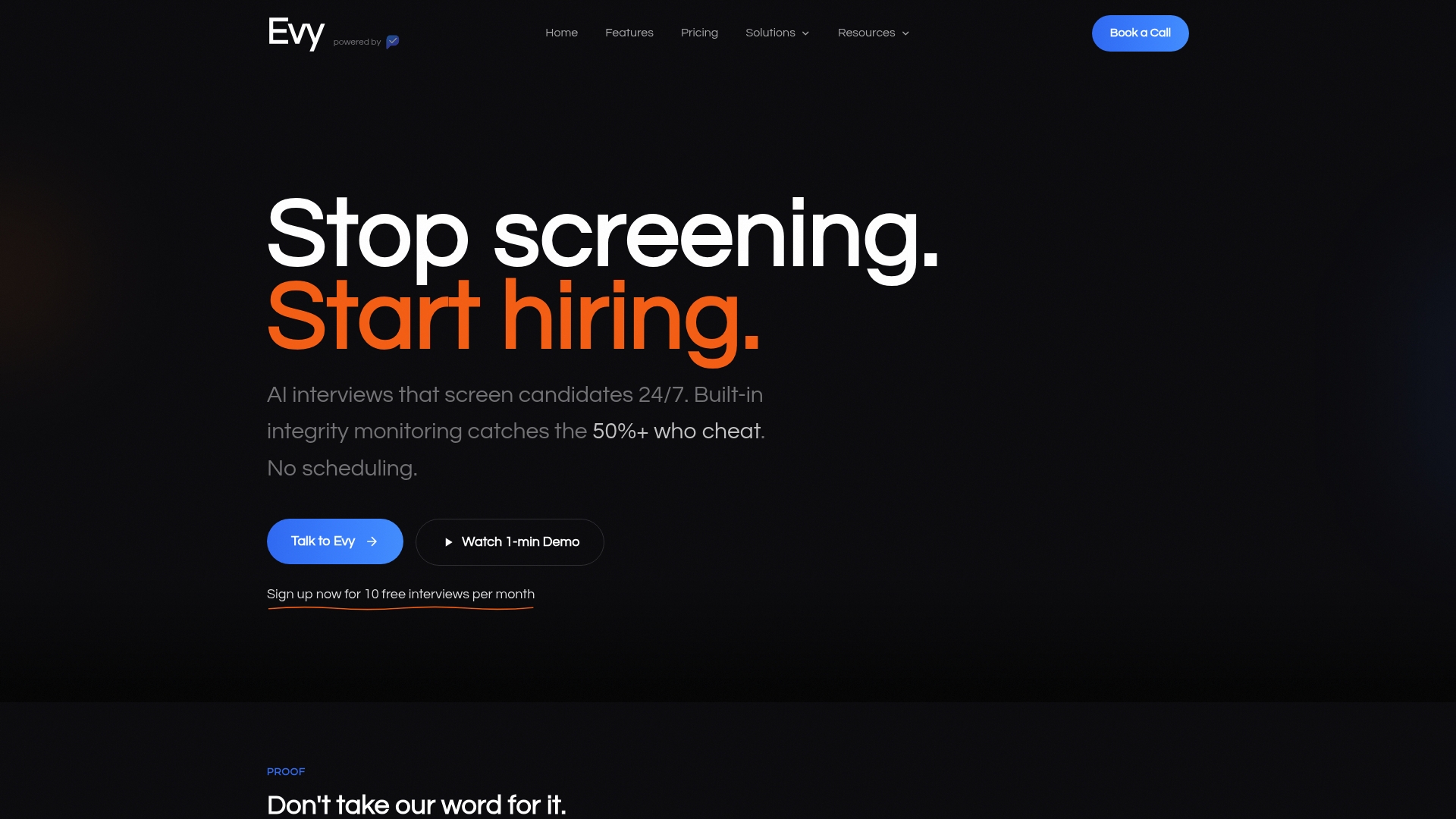
Evy is built for hiring teams that take scorecard quality seriously. The platform maps candidate responses to competencies in real time, so interviewers capture evidence during the conversation rather than reconstructing it afterward. Rubrics and prompts load automatically per role, which removes setup friction and keeps every panel aligned on the same criteria. Evy's dashboard tracks scorecard completion rates, submission timing, and score distributions across interviewers, giving recruiting operations teams the data they need to spot calibration gaps early. For teams running high-volume screening, Evy's AI interview features combine structured scorecard discipline with the scale and consistency that manual processes cannot match.
FAQ
What is an interview scorecard?
An interview scorecard is a structured evaluation tool that lists specific competencies, a defined rating scale, and behavioral anchors to assess candidates consistently. It replaces subjective impressions with documented, evidence-based scores.
How many competencies should an interview scorecard include?
Scorecards work best with 4–6 core competencies. More than six spreads interviewer attention too thin and reduces the quality of evidence captured for each criterion.
How do you prevent bias in interview scoring?
Requiring interviewers to complete all competency scores with written evidence before entering an overall recommendation structurally prevents the halo effect. Regular calibration sessions further reduce individual scoring drift.
When should interviewers complete their scorecards?
Interviewers should complete scorecards during the interview or immediately after, and always before the debrief discussion. Submitting scores before the group debrief prevents social influence from distorting individual ratings.
How do you measure whether your interview scorecard is working?
Track inter-rater reliability, scorecard completion rates, and submission latency. Low agreement on a specific competency usually signals an unclear behavioral anchor, while low completion rates signal a process or template problem.