
 By Adrian Pascual•Hiring insight•Published
Interview Fatigue for Managers: Signs, Causes, and Fixes
Interview fatigue for managers is defined as the mental and emotional exhaustion that builds when the volume, frequency, and structure of interviews exceed a manager's capacity to evaluate candidates objectively. This is not a personal failing. It is a systemic condition with measurable consequences. U.S. workforce burnout sits at 55%, and hiring managers report burnout rates well above that average due to high-stakes evaluation and the emotional labor of hiring. The operational signs are concrete: missed interview slots, open requisitions past 60 days, and bloated interview loops that consume calendar time without improving hire quality. Left unaddressed, manager interview exhaustion degrades objectivity, increases bias, and produces hires that teams later regret.
What is interview fatigue for managers?
Interview fatigue for managers is the cumulative cognitive and emotional strain that results from conducting too many interviews, too frequently, with too little structural support. The industry term for the broader condition is "hiring manager burnout," but interview fatigue specifically describes the impairment that occurs during and after the evaluation process itself. Both terms apply here, and understanding the distinction matters.
The fatigue is not caused by any single long interview. It builds across days and weeks as managers stack candidate evaluations on top of their full-time responsibilities. A team leader running three to five interviews per week while managing deliverables, one-on-ones, and project reviews is operating at a cognitive deficit by thursday afternoon. That deficit shows up directly in how candidates get assessed.
Mental and emotional exhaustion impairs objectivity, leading to decreased efficiency, inconsistent evaluations, and biased judgments. The impairment is not always visible. A fatigued manager may complete every scheduled interview and still produce unreliable hiring decisions because their capacity for careful, fair assessment has been depleted.

What causes interview fatigue in managers?
The root causes of manager interview exhaustion are structural, not motivational. Managers do not burn out because they dislike hiring. They burn out because hiring is layered on top of a full workload without adequate process support.
The primary causes include:
- Volume and frequency. Managers conducting multiple interviews per week, across several open roles simultaneously, face compounding cognitive load with no recovery time built in.
- Bloated interview loops. Multi-stage loops can double a manager's calendar time per candidate. When each role requires four to six interview rounds, the time cost becomes unsustainable.
- Invisible labor. Hiring managers often underestimate the hidden work involved: preparing to interrupt bias, synthesizing feedback, communicating with candidates, and coordinating with recruiting teams. This labor is real and exhausting.
- Unresolved requisitions. Open roles that stay unfilled past 60 days create sustained pressure. The longer a role stays open, the more urgency builds, and urgency without clarity accelerates fatigue.
- Urgency without structure. When managers are pushed to hire fast without clear criteria or a defined process, every interview feels like a high-stakes gamble. That pressure compounds exhaustion.
Pro Tip: Before opening a new requisition, map out the full interview process on paper. If you cannot define the stages, the decision criteria, and who owns each step in under ten minutes, the process is not ready. A vague process is a direct path to manager fatigue.
Fatigue is not simple lack of motivation. It is overload from invisible labor and competing job demands, making hiring feel like an unbearable addition to an already full role. Recognizing this framing is the first step toward fixing it.
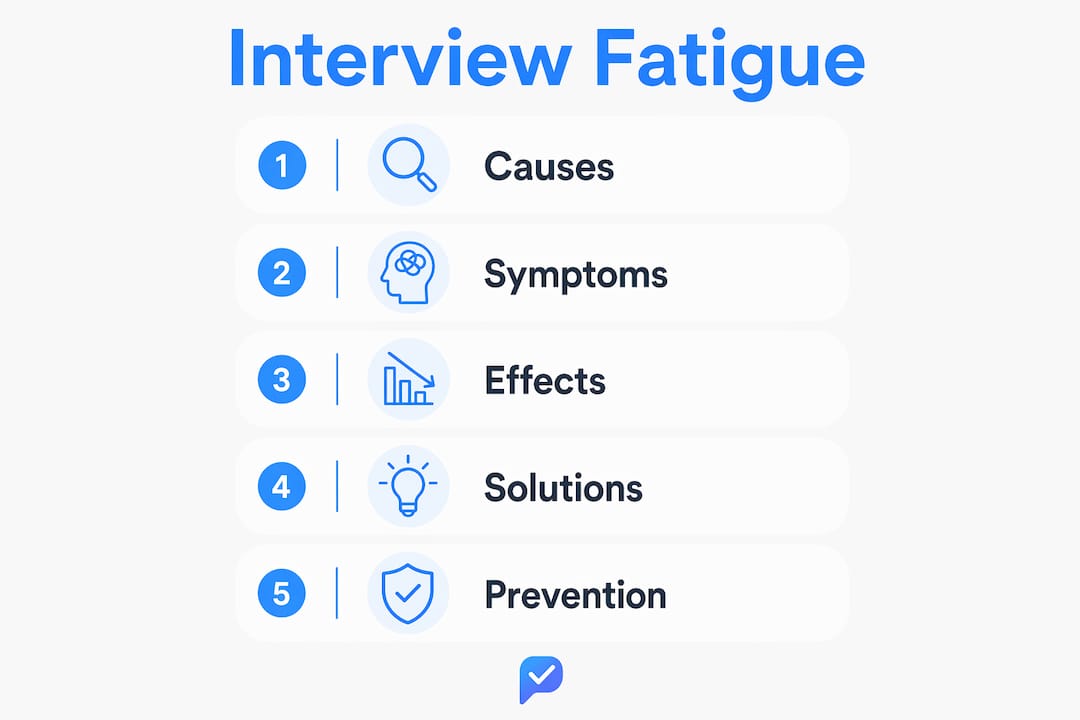
What are the symptoms of interview fatigue in hiring managers?
The symptoms of interview fatigue fall into two categories: behavioral and operational. Both are observable, and both signal that the hiring process needs structural intervention.
Behavioral symptoms include:
- Rescheduling or declining interview slots without a clear reason
- Conducting interviews with minimal preparation or engagement
- Giving vague, inconsistent feedback after candidate meetings
- Shifting role specifications mid-search, often without explanation
- Expressing frustration or disengagement about the hiring process generally
Operational symptoms are equally telling. Missed or declined interview slots, shifting role specs, and disengaged hiring behavior are direct indicators that a manager has crossed into fatigue territory. These behaviors slow the entire hiring pipeline and signal to candidates that the organization is disorganized.
The impact on decision-making is significant. Cognitive overload leads to decision fatigue, which reduces a manager's patience and capacity for nuanced evaluation. Interviews become checkbox exercises rather than genuine assessments. Candidates who are "good enough" get advanced not because they are the right fit, but because the manager lacks the mental energy to keep evaluating.
The candidate experience suffers as well. A disengaged interviewer sends a clear signal about the organization's culture and seriousness. Strong candidates notice. They withdraw, decline offers, or share negative impressions that affect employer brand over time.
How does interview fatigue affect hiring quality and fairness?
Interview fatigue directly undermines the fairness and quality of hiring decisions. Fatigue erodes bias interruption practices, turning hiring into a checkbox exercise and producing "good enough" hires that teams later regret. This is one of the most underappreciated consequences of the condition.
Bias interruption requires active cognitive effort. A manager must consciously notice when a snap judgment is forming, pause, and apply a more deliberate evaluation framework. Fatigued managers cannot sustain that effort. They default to heuristics: familiarity, likability, and surface-level pattern matching. These shortcuts amplify systemic biases rather than counteracting them.
The result is a compounding problem. Fatigued managers make faster, less careful decisions. Those decisions produce weaker hires. Weaker hires create more work for the team, which increases pressure on the manager, which deepens fatigue. The cycle is self-reinforcing unless the process is redesigned.
Structured interviews reduce cognitive load and increase fairness and consistency in evaluation. This is the clearest evidence-based intervention available. When managers evaluate candidates against a fixed set of criteria using consistent questions, the mental effort required per interview drops significantly. That reduction in cognitive load preserves the capacity for fair judgment.
Pro Tip: Build a one-page scorecard for every role before interviews begin. List four to six specific competencies with behavioral anchors for each rating level. Managers who use scorecards consistently report faster decisions and greater confidence in their choices.
What practical strategies can managers use to reduce interview fatigue?
Reducing interview fatigue requires process redesign, not just personal discipline. The following steps address the structural causes directly.
- Limit concurrent open requisitions. Running three or more active searches simultaneously is a primary driver of calendar overload. Prioritize roles by business impact and sequence them where possible.
- Tighten the interview loop. Fewer stages with clear decision criteria produce better outcomes than extended loops. A three-stage process with defined evaluation criteria outperforms a six-stage process with vague expectations.
- Schedule dedicated hiring blocks. Pre-scheduling hiring blocks with the option to release unused time helps managers avoid constant interruptions and maintain focus. Treat hiring time like a meeting with a deliverable, not an open-ended obligation.
- Use phone or video screens to narrow the pool. Recruiting partners should conduct initial screens so managers only meet candidates who have already cleared a baseline threshold. This reduces the total number of interviews a manager conducts per hire.
- Delegate administrative and preparatory tasks. Empowering recruiters to handle administrative tasks significantly reduces hiring manager emotional exhaustion. Managers who are relieved of tactical burdens show up more present and engaged.
- Build in recovery time. Back-to-back interviews with no buffer are a direct cause of fatigue. Schedule at least 15 minutes between interviews for notes, mental reset, and preparation for the next candidate.
- Use technology to support evaluation consistency. Technology tools that automate scheduling and data tracking ease the operational burden on managers. Platforms that centralize candidate data and evaluation notes reduce the mental overhead of tracking multiple candidates across multiple roles.
For managers who want a structured starting point, an interview preparation checklist can help establish consistent habits before each session. Consistency at the preparation stage reduces the cognitive effort required during the interview itself.
How can organizations support managers to prevent fatigue systemically?
Individual managers cannot solve interview fatigue alone. Organizations must build the structural conditions that make sustainable hiring possible.
Effective organizational interventions include:
- Capacity planning for hiring managers. Recruiting teams should track how many active requisitions each manager carries and flag overload before it becomes burnout.
- Recruiting operational redesign. Limiting open requisitions, tightening interview loops, and redelegating admin tasks is the most effective antidote to manager burnout. This requires deliberate process design, not ad hoc fixes.
- Training on fatigue recognition. Managers who can identify their own fatigue symptoms are better positioned to ask for support before quality degrades. Organizations should normalize this conversation.
- Strong recruiter-manager partnerships. Recruiter-manager partnerships transform hiring from a draining burden into a shared process with clear ownership. When recruiters own the pipeline and managers own the evaluation, both parties perform better.
- Investment in interview technology. Platforms that handle scheduling, candidate communication, and evaluation data collection reduce the invisible labor that drives fatigue. The impact of interview platform choice on hiring outcomes is measurable and often underestimated.
Experienced managers recognize that hiring fatigue reflects broader structural flaws. The right response is a pause and a process debrief, not simply pushing through to the next interview slot.
Key takeaways
Interview fatigue for managers is a systemic condition caused by invisible labor, bloated processes, and volume overload, and it requires structural fixes, not just personal effort.
| Point | Details |
|---|---|
| Define the condition clearly | Interview fatigue is mental and emotional exhaustion that impairs objective candidate evaluation. |
| Recognize operational symptoms | Missed slots, open reqs past 60 days, and shifting role specs are concrete warning signs. |
| Fatigue distorts fairness | Exhausted managers default to bias and snap judgments, producing hires teams later regret. |
| Fix the process, not the person | Tighter loops, dedicated hiring blocks, and recruiter delegation address root causes directly. |
| Organizations share responsibility | Capacity planning, recruiter partnerships, and interview technology are organizational duties. |
The real problem with interview fatigue nobody talks about
Most advice on manager interview exhaustion focuses on personal habits: take breaks, prepare better, manage your calendar. That advice is not wrong, but it misses the point. The managers I have seen struggle most with hiring fatigue are not disorganized or unmotivated. They are carrying a full operational workload while being asked to run a parallel hiring process with no structural support.
The invisible labor is the part that breaks people. Preparing to interrupt your own bias takes real cognitive effort. Synthesizing feedback across five candidates after a full day of project reviews is genuinely hard. When organizations treat hiring as something managers should just absorb into their existing schedule, they are setting up both the manager and the process to fail.
What actually works is treating hiring as a distinct workstream with its own capacity limits. That means limiting how many open roles a manager carries at once, giving recruiters real authority over the pipeline, and building interview loops that are tight enough to respect everyone's time. The multi-stage interview process is not inherently bad. A poorly designed one, with no clear decision criteria and no defined ownership, is what creates fatigue.
The managers who hire well consistently are not the ones who push through exhaustion. They are the ones who have built a process that does not require heroic effort to execute. That is the standard worth aiming for.
— Hudson
How Evy helps managers hire without burning out
Evy is built for hiring teams that need to evaluate candidates at scale without sacrificing accuracy or fairness. Its AI-powered interview features include real-time eye tracking to detect AI-assisted cheating, automated scheduling, and structured evaluation tools that reduce the cognitive load on managers. By handling the administrative and monitoring work that typically falls on hiring teams, Evy frees managers to focus on what only they can do: making sound, informed hiring decisions. For HR teams managing high-volume pipelines, Evy's platform supports faster, compliant hiring without adding to manager workload.
FAQ
What is interview fatigue for managers?
Interview fatigue for managers is the mental and emotional exhaustion that builds when the volume and structure of interviews exceed a manager's capacity to evaluate candidates objectively. It impairs decision-making, increases bias, and reduces hiring quality.
What are the main symptoms of interview fatigue?
Key symptoms include rescheduling or declining interview slots, inconsistent candidate feedback, shifting role specifications, and disengaged interviewing behavior. Operational signs include open requisitions sitting unfilled past 60 days.
How does interview fatigue affect hiring decisions?
Fatigue erodes a manager's ability to interrupt bias and apply consistent evaluation criteria, leading to snap judgments and "good enough" hires that teams later regret. Structured interviews and scorecards are the most effective countermeasures.
How can managers reduce interview fatigue?
Limiting concurrent open requisitions, tightening interview loops to three or fewer stages, scheduling dedicated hiring blocks, and delegating administrative tasks to recruiting partners are the most effective steps.
What role does technology play in reducing interview fatigue?
Technology tools that automate scheduling, candidate communication, and evaluation data collection reduce the invisible labor that drives fatigue. Platforms with structured evaluation features also improve consistency and reduce the cognitive effort required per interview.