
 By Adrian Pascual•Hiring insight•Published
How to Evaluate Interview Platform ROI in 2026
Interview platform ROI is defined as the measurable return your organization gains from an AI interview tool relative to every dollar spent on licensing, integration, compliance, and ongoing maintenance. Most HR teams underestimate this calculation. They focus on speed gains while ignoring bias audit liabilities, quality-of-hire outcomes, and the true cost of a bad hire. Platforms like HireVue and Evy influence metrics far beyond scheduling efficiency. To evaluate interview platform ROI accurately, you need a complete picture of costs, a clear set of performance benchmarks, and a structured process for comparing the two.
What does it really cost to own an interview platform?
Total cost of ownership (TCO) is the correct framework for assessing what an interview platform actually costs your organization. TCO goes beyond the subscription line item and captures every dollar required to deploy, run, and maintain the tool over time.
Here is what belongs in your cost baseline:
- Annual license fees: Enterprise-grade AI interview platforms charge $25,000 to $145,000+ annually. That range reflects platform tier, seat count, and feature depth.
- Integration and setup: Connecting a platform to enterprise ATS systems like Workday, SAP, or Oracle typically costs $15,000 to $40,000. Complexity drives that number up fast.
- Bias audit compliance: Jurisdictions like New York City require annual independent bias audits under NYC Local Law 144. Those audits cost $15,000 to $50,000 per year and are non-negotiable recurring expenses.
- Training and change management: Onboarding recruiters and hiring managers adds internal labor hours and sometimes external consulting fees.
- Overage and maintenance fees: Many vendors charge per-interview or per-seat overages that compound quickly during high-volume hiring periods.
The bias audit line item surprises most HR teams. It is not a one-time cost. It recurs annually and carries legal exposure if skipped. Any ROI model that omits it is incomplete.
Pro Tip: Build your TCO spreadsheet before you request vendor demos. Vendors will quote you the license fee. You need to ask specifically about integration complexity, audit requirements, and overage structures before you can compare platforms fairly.
Which interview platform performance metrics best predict ROI?
The metrics that best predict ROI for an interview platform fall into two categories: efficiency metrics and outcome metrics. Most teams track efficiency. Far fewer track outcomes. Both are required for an honest return calculation.

Efficiency metrics
AI recruitment tools reduce time-to-hire by 30%, freeing 10–15 recruiter hours per role. That productivity gain is real and quantifiable. Multiply freed hours by average recruiter hourly cost and you have a concrete dollar figure. Scheduling automation and AI pre-screening drive most of that gain, particularly in the pre-screen phase where recruiter productivity improvements reach 85–90%.
Outcome metrics
Outcome metrics are where most ROI calculations fall short. The metrics that matter most include:
- 90-day retention rate: New hires who leave within 90 days represent a full cost-per-hire loss. Platforms that improve screening quality reduce this rate directly.
- Hiring manager satisfaction scores: Low satisfaction signals misalignment between candidate quality and role requirements. Track this quarterly.
- New hire performance ratings at 6 months: This is the clearest signal of whether your screening process is identifying the right people.
- Interview-to-offer ratio: A high ratio means your process is generating noise. A well-calibrated platform tightens this ratio over time.
"Focusing only on time-to-hire is insufficient. Integrating outcome metrics like retention and performance yields a superior understanding of ROI."
Interview rigor analytics add another layer. High-rigor interview processes improve interviewer alignment by 26% and reduce candidates sent to onsite interviews by 31%. Fewer onsite interviews means lower cost per hire and less time burden on hiring managers. That is ROI beyond speed.
Candidate experience also matters, though it is harder to quantify. A poor interview experience damages your employer brand and increases offer decline rates. Platforms that deliver structured, fair, and responsive candidate interactions protect that brand value.
How to calculate interview tool ROI: a step-by-step framework
The standard ROI formula for interview platforms is straightforward: (Annualized Benefits − Annualized Costs) ÷ Annualized Costs. The challenge is populating it accurately. Here is a structured process.
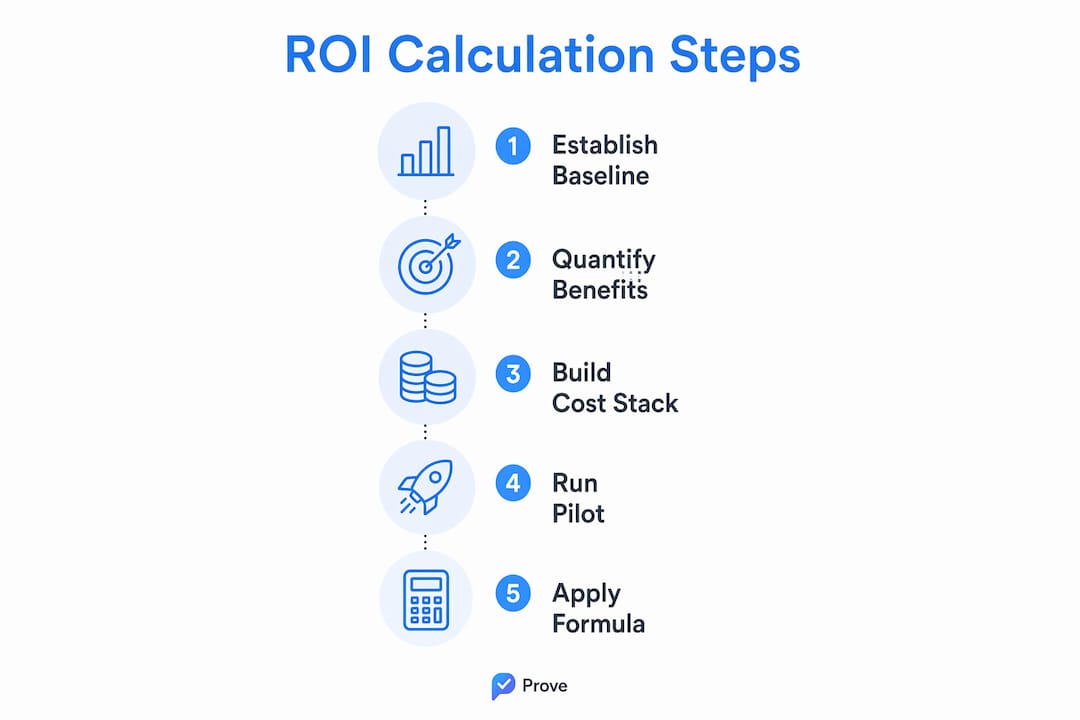
Step 1: Establish your baseline. Before you launch any platform, record your current time-to-schedule, time-to-hire, cost-per-hire, interview-to-offer ratio, and 90-day retention rate. Without this data, you cannot measure improvement.
Step 2: Quantify your benefits. Calculate hours saved per role by multiplying freed recruiter time by hourly cost. Calculate days reduced in time-to-hire and multiply by the daily revenue impact of an open role. The opportunity cost of open roles is a critical but often overlooked component. A sales role sitting open for 30 extra days has a direct revenue cost.
Step 3: Build your full cost stack. Use your TCO analysis from the previous section. Include license fees, integration costs, bias audit fees, training hours, and any overage charges.
Step 4: Run a 6–8 week pilot. Measure leading indicators weekly: scheduling speed, candidate completion rates, recruiter hours per role. Measure lagging indicators at 90 days: retention, performance ratings, hiring manager satisfaction.
Step 5: Apply the formula. Plug your annualized benefit and cost figures into the ROI formula. Compare against the benchmark.
| Metric | Pre-Platform Baseline | Post-Platform Result |
|---|---|---|
| Time-to-hire | 42 days | 29 days |
| Recruiter hours per role | 18 hours | 7 hours |
| Cost-per-hire | $4,800 | $3,200 |
| 90-day retention rate | 71% | 84% |
| Interview-to-offer ratio | 8:1 | 5:1 |
Organizations that run structured pilots achieve 3x to 10x ROI within 60–90 days. That range is wide because it depends heavily on hiring volume, baseline inefficiency, and how well the platform is configured to your internal data.
Pro Tip: Calibrate the platform's scoring model against your internal top-performer data before the pilot ends. AI models trained on internal data improve new hire performance by up to 20% compared to off-the-shelf configurations. That lift changes your ROI calculation significantly.
Common mistakes when benchmarking interview platforms
Avoiding evaluation errors is as important as running the calculation correctly. These are the mistakes that most commonly produce inaccurate ROI conclusions.
- Skipping baseline data collection. Most HR leaders underestimate the importance of clean pre-launch metrics. Without a documented baseline, you cannot prove improvement to a CFO or justify renewal.
- Measuring speed only. Time-to-hire is easy to track. Quality-of-hire is harder. Teams that optimize for speed alone often find that faster hiring produces worse outcomes, which erodes ROI over time.
- Ignoring bias audit costs. Treating the platform subscription as the total cost is the most common financial error in this category. Audit fees and legal exposure belong in every model.
- Treating the platform as a standalone tool. AI interview tools work best when integrated with your ATS, your historical hiring data, and your structured interview process. Deploying a platform in isolation limits its impact and inflates your effective cost-per-benefit.
- Underestimating adoption challenges. A platform that recruiters do not use consistently produces inconsistent data. Inconsistent data produces unreliable ROI signals. Change management is not optional.
CFOs prefer conservative ROI estimates grounded in verifiable cost-per-hire reductions and reclaimed recruiter time. Vendor-supplied ROI projections tend to be optimistic. Build your business case on your own numbers, not theirs.
Key Takeaways
Accurate interview platform ROI requires combining total cost of ownership with outcome metrics, not just efficiency gains, to build a credible and defensible business case.
| Point | Details |
|---|---|
| Total cost of ownership | Include license fees, integration, bias audits, training, and overages before comparing platforms. |
| Outcome metrics matter | Track 90-day retention, performance ratings, and hiring manager satisfaction alongside time-to-hire. |
| Baseline data is non-negotiable | Document current metrics before launch or you cannot prove improvement post-deployment. |
| Pilot before committing | Run a 6–8 week structured pilot to capture both leading and lagging ROI indicators. |
| Calibrate to internal data | AI models trained on your top-performer data outperform generic configurations by up to 20%. |
What I have learned about ROI that vendors will not tell you
After years of working with HR technology decisions, the single most consistent failure I see is organizations that skip the baseline measurement step. They deploy a platform, see faster scheduling, and declare success. Six months later, retention numbers have not moved and the CFO is asking hard questions. The ROI case collapses because there is no before-and-after comparison.
The second lesson is about vendor hype. Every platform vendor will show you a case study with a 5x or 8x ROI figure. Those numbers are real for someone. They are probably not real for you at launch. Build your business case on conservative estimates tied to verifiable metrics: cost-per-hire reduction, hours saved per role, and offer acceptance rate. Those numbers hold up in a budget review. Projected quality-of-hire improvements do not, until you have 90-day retention data to back them.
The third lesson is the multiplier effect. AI interview tools are not magic. They are multipliers of the data you feed them. If you connect a platform like Evy to your historical top-performer profiles and calibrate its scoring model accordingly, you get meaningfully better candidate quality signals. If you deploy it out of the box with no customization, you get modest efficiency gains and little else. The difference between a 3x and a 10x return often comes down to that configuration step. Most teams rush past it.
— Hudson
How Evy helps you get more from your interview platform investment
Evy is built for HR teams that need both efficiency and integrity in their interview process. As the only AI interview platform with real-time eye tracking to detect AI-assisted cheating, Evy addresses a risk that directly affects your quality-of-hire metrics and the reliability of your ROI data. When candidates use AI tools to answer interview questions, your screening data is compromised. Evy surfaces honest, qualified talent by catching that behavior before it distorts your hiring decisions. The platform also supports ATS integration and 24/7 automated screening, which reduces recruiter hours per role and accelerates time-to-hire. Explore Evy's anti-cheat interview features to see how the platform supports both compliance requirements and measurable hiring outcomes. You can also learn more about how AI interview platforms work before your next evaluation cycle.
FAQ
What is a good ROI benchmark for an interview platform?
Organizations that run structured implementations typically achieve 3x to 10x ROI within 60–90 days. The range depends on hiring volume, baseline inefficiency, and how well the platform is configured to internal data.
What costs are most commonly missed in interview platform ROI calculations?
Bias audit fees are the most frequently overlooked cost. Annual independent audits required under laws like NYC Local Law 144 cost $15,000 to $50,000 per year and must be included in any accurate total cost of ownership model.
How do I measure quality-of-hire improvement from an interview platform?
Track 90-day retention rates, new hire performance ratings at six months, and hiring manager satisfaction scores before and after deployment. These outcome metrics provide the clearest signal of whether your screening process is improving.
Why does baseline data matter so much for ROI evaluation?
Without pre-launch metrics on time-to-hire, cost-per-hire, and retention, you have no reference point to measure improvement against. Clean baseline data is the foundation of any credible ROI business case and is critical for gaining executive approval.
How does AI model calibration affect interview platform ROI?
AI models trained on your internal top-performer data improve new hire performance by up to 20% compared to generic off-the-shelf configurations. That lift directly increases quality-of-hire ROI and strengthens the long-term business case for the platform.