
 By Adrian Pascual•Hiring insight•Published
Hiring Manager AI Collaboration: A 2026 HR Guide
Hiring manager AI collaboration is defined as the structured partnership where artificial intelligence tools support the workflow and decision-making between hiring managers and recruiters to improve hiring outcomes. This is not about replacing human judgment. AI handles high-volume administrative tasks while humans retain control over final decisions, cultural fit assessments, and candidate relationships. Organizations that build this collaboration correctly see 40% faster time-to-hire and 25% higher quality of hire scores. Those gains come from clear feedback loops, structured intake processes, and post-interview analytics, not from AI acting alone.
What is hiring manager AI collaboration in recruitment?
Hiring manager AI collaboration in recruitment is the deliberate integration of AI tools into the shared workflow between hiring managers and recruiters. Each party brings a distinct function. Hiring managers own the final hiring decision and evaluate candidate fit against team needs and culture. Recruiters manage sourcing, screening, coordination, and the overall process architecture. AI handles the tasks that neither party should spend time on manually.
The three-way division of labor matters more than most HR teams realize. When roles blur, friction follows. A hiring manager who starts screening resumes manually is doing recruiter work. A recruiter who makes final offer decisions without manager input is overstepping. AI creates a clean boundary by absorbing the administrative layer entirely.

AI tools significantly increase recruitment efficiency (β = 0.61, p < 0.001) and candidate experience (β = 0.38, p < 0.01). Those numbers confirm that AI delivers real performance gains. The critical caveat is that trust and transparency improvements remain insignificant without human oversight layered on top.
The most effective framing is to treat AI as a decision-support layer, not a decision-maker. Automating final hiring decisions removes the human accountability that candidates, regulators, and hiring teams all require.
- Hiring managers own candidate evaluation, final decisions, and team fit assessment.
- Recruiters own sourcing strategy, process design, candidate communication, and coordination.
- AI owns resume screening, scheduling, note-taking, pipeline tracking, and data aggregation.
Pro Tip: Document role boundaries in writing before deploying any AI tool. A one-page RACI chart covering who reviews AI outputs, who can override them, and who owns final decisions prevents most collaboration breakdowns before they start.
How does AI enhance collaboration workflows between hiring managers and recruiters?
AI enhances collaboration by removing the administrative friction that slows communication between hiring managers and recruiters. When both parties spend less time on scheduling and data entry, they spend more time on the decisions that actually require human judgment.
Automation that creates shared context
AI-generated candidate summaries give hiring managers a consistent view of each applicant before interviews begin. Structured interview notes and AI summaries increase alignment and speed by ensuring both the recruiter and the hiring manager are working from the same information. Without this, managers often form impressions based on incomplete data, and recruiters spend time re-explaining candidate backgrounds.
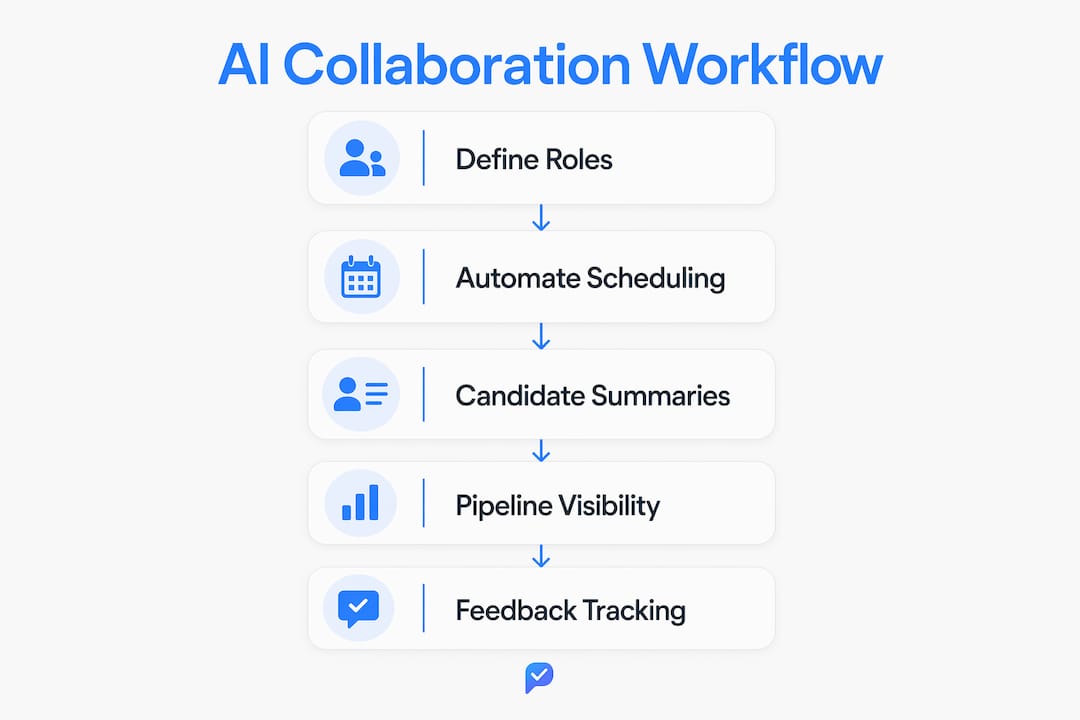
Automated scheduling removes one of the most common sources of delay in recruitment. When AI coordinates calendar availability and sends confirmations, the recruiter focuses on candidate relationships rather than logistics.
Pipeline visibility and proactive alerts
Real-time pipeline dashboards show hiring managers exactly where each candidate stands without requiring a status call. Post-interview analytics track manager engagement and feedback timeliness, which creates accountability without confrontation. If a manager has not submitted feedback within 24 hours, the system flags it automatically.
| AI feature | Collaboration benefit | Human role retained |
|---|---|---|
| Resume screening | Reduces recruiter review time | Recruiter reviews shortlist |
| Interview note-taking | Creates shared candidate record | Manager adds qualitative context |
| Scheduling automation | Eliminates coordination delays | Both parties confirm availability |
| Pipeline analytics | Tracks feedback timeliness | Manager accountable for decisions |
| Candidate summaries | Aligns manager and recruiter view | Manager evaluates fit |
Pro Tip: Integrate AI pipeline alerts directly into Slack or Microsoft Teams rather than requiring hiring managers to log into a separate platform. Managers who receive stalled-candidate notifications in tools they already use act on them faster.
What challenges do hiring teams face when implementing AI collaboration?
The most common barrier is not technical. It is trust. Hiring managers resist AI recommendations when they cannot see the reasoning behind them. A shortlist generated by an algorithm feels arbitrary without an explanation of which criteria drove the ranking.
The goodwill paradox
90% of recruiting teams rate their collaboration with hiring managers as good or excellent. Yet 58% would rather work around their counterpart due to misalignment. That gap reveals a critical truth: surface goodwill does not replace documented workflows and agreed accountability.
Angela Milca describes this as a paradox where strong collaboration ratings coexist with significant misalignment. The fix is not better relationships. It is structured service level agreements that define response times, feedback formats, and escalation paths.
"The trust gap between hiring managers and recruiters is rarely about personality. It is about unclear expectations. When both parties know exactly what they owe each other and when, collaboration becomes a system rather than a favor."
Explainability as a trust mechanism
Explainable AI with traceable rationales turns AI recommendations into evidence-based partnership tools. When a recruiter can show a hiring manager exactly why a candidate ranked highly, including which skills matched, which experience thresholds were met, and which flags were raised, the manager can engage with the recommendation rather than dismiss it.
Audit trails also protect hiring teams legally. If a candidate challenges a screening decision, a traceable rationale provides documentation that the process was fair and consistent.
- Resistance to black-box AI: Solve with explainable AI that links every recommendation to specific criteria.
- Misalignment despite goodwill: Solve with documented SLAs covering feedback timing and format.
- Recruiter-manager friction: Solve with shared dashboards that make pipeline status visible to both parties.
- Over-reliance on AI outputs: Solve with mandatory human review checkpoints before any candidate advances.
What best practices maximize hiring manager AI collaboration?
Building effective AI collaboration requires deliberate process design, not just tool adoption. The following steps reflect what high-performing hiring teams do differently.
- Run structured intake meetings before every role opens. Document the success profile, required competencies, deal-breakers, and timeline. This gives AI screening tools accurate parameters and gives hiring managers a clear benchmark for evaluation.
- Require mandatory "license to hire" training for all hiring managers. License-to-hire programs cover structured interviewing, employer branding, SMART feedback, and AI tool literacy. Renita Käsper frames hiring as a core leadership responsibility requiring cultural integration, not an add-on task. Training reinforces that framing.
- Adopt a collaborative applicant tracking system with built-in AI features. The platform should surface AI-generated summaries, track feedback deadlines, and alert both parties when action is needed. Platforms that require manual data entry defeat the purpose of AI collaboration.
- Establish service level agreements on feedback timing. A standard SLA requires hiring managers to submit interview feedback within 24 hours and respond to recruiter questions within one business day. Without written agreements, delays compound and candidates disengage.
- Share KPIs with both parties monthly. Time-to-hire, quality of hire, offer acceptance rate, and candidate satisfaction scores should be visible to hiring managers, not just recruiters. When managers see their own impact on hiring speed, behavior changes.
- Use AI to improve the candidate experience, not just internal efficiency. Automated status updates, personalized outreach, and faster scheduling all signal respect for candidates' time. The role of AI in talent acquisition extends beyond internal workflows to the impression candidates form of your organization.
Pro Tip: Treat the first 90 days of AI tool deployment as a calibration period. Review AI shortlists alongside human shortlists weekly to identify where the algorithm's criteria need adjustment. This builds manager confidence in AI outputs faster than any training session.
What future trends are shaping hiring manager and AI collaboration?
The next phase of AI in recruitment moves from individual features to coordinated systems. Current AI tools require a human to press a button. Emerging AI assistants run sequences end-to-end without manual handoffs.
Proactive AI assistants integrated into daily communication tools surface stalled candidates and missing feedback for immediate action. This shift from reactive tools to working colleagues changes how hiring managers experience AI. Instead of logging into a platform to check status, the AI comes to them.
Key trends shaping this evolution include:
- Orchestrated AI workflows that coordinate sourcing, screening, scheduling, and follow-up without manual intervention at each step.
- Greater AI explainability replacing black-box models with evidence-based decision support that hiring managers can review and challenge.
- AI embedded in Slack and Microsoft Teams, making recruitment activity visible inside the tools managers already use daily.
- Human oversight layers becoming a formal part of AI governance, with documented review checkpoints required before AI recommendations advance candidates.
The direction is clear. AI becomes a working colleague rather than a background tool. Human accountability does not decrease. It becomes more structured and more visible.
Key Takeaways
Effective hiring manager AI collaboration requires clear role boundaries, explainable AI outputs, and documented accountability structures, not just technology adoption.
| Point | Details |
|---|---|
| Define role boundaries first | Assign AI, recruiter, and manager responsibilities in writing before deploying any tool. |
| Explainability builds trust | AI recommendations with traceable rationales reduce manager resistance and support fair hiring. |
| Goodwill is not enough | 58% of recruiters work around managers despite high collaboration ratings; SLAs fix this. |
| Training is non-negotiable | License-to-hire programs improve hiring quality by aligning all stakeholders on process and expectations. |
| Measure shared KPIs | Sharing time-to-hire and quality of hire data with hiring managers drives faster feedback and better decisions. |
Where human judgment still defines the outcome
I have watched hiring teams adopt AI tools with genuine enthusiasm, then quietly revert to old habits within three months. The pattern is consistent. The technology was fine. The collaboration structure was not.
What separates teams that succeed from those that struggle is not the sophistication of their AI platform. It is whether hiring managers feel like partners in the process or passengers. When AI outputs arrive without explanation, managers override them on instinct. When AI outputs come with clear rationale and shared context, managers engage with them seriously.
The uncomfortable truth is that most AI collaboration failures are culture problems wearing a technology mask. A hiring manager who does not trust the recruiter will not trust the recruiter's AI tools either. Fixing that requires documented expectations, shared data, and consistent follow-through, not a better algorithm.
AI genuinely reduces the administrative burden that makes hiring feel like a second job for managers. Recruiting AI for HR teams works best when it removes friction rather than adding a new system to learn. The teams I respect most treat AI as infrastructure, the way they treat email or calendar tools, present, reliable, and not worth arguing about.
The goal is not to make hiring managers love AI. It is to make the process work well enough that they stop noticing the AI at all. That is when the collaboration is actually working.
— Hudson
How Evy supports structured hiring manager collaboration
Hiring teams that want AI collaboration to work in practice need tools built for accountability, not just automation.
Evy is the only AI interview platform with real-time eye tracking to detect candidates using AI assistance during interviews. Beyond integrity, Evy's AI-powered screening features automate candidate evaluation, generate structured interview summaries, and surface honest, qualified talent at scale. Hiring managers get consistent candidate data before every interview. Recruiters get a shared record they can act on immediately. The result is faster decisions, cleaner handoffs, and a hiring process both parties can trust. For teams building or refining their AI collaboration workflow, Evy provides the structure that makes it work.
FAQ
What is hiring manager AI collaboration?
Hiring manager AI collaboration is the structured use of AI tools to support the shared workflow between hiring managers and recruiters, automating administrative tasks while preserving human judgment in final hiring decisions.
How does AI improve hiring manager and recruiter collaboration?
AI generates candidate summaries, automates scheduling, and tracks feedback deadlines, giving both parties a shared, real-time view of the pipeline without requiring manual status updates.
What is the biggest challenge in AI hiring collaboration?
The biggest challenge is trust. Research shows 58% of recruiters work around hiring managers despite rating collaboration highly, which means surface goodwill must be replaced with documented SLAs and explainable AI outputs.
What is a license-to-hire training program?
A license-to-hire program is mandatory training for hiring managers and recruiters covering structured interviewing, SMART feedback, employer branding, and AI tool literacy to build shared accountability across the hiring process.
How does explainable AI reduce resistance from hiring managers?
Explainable AI links every recommendation to specific criteria and audit trails, allowing hiring managers to review the rationale behind shortlists rather than treating AI outputs as opaque or arbitrary.