
 By Adrian Pascual•Hiring insight•Published
How to Create a Compliant AI Hiring Policy in 2026
To create a compliant AI hiring policy, you need six components in place before deploying any automated employment decision tool: a written policy scoped to your hiring stages, pre-deployment impact assessments, vendor validation and audit rights, candidate disclosure where required by law, a human-in-the-loop override mechanism, and a recurring monitoring cadence. That is the minimum viable framework. Everything below shows you how to build it.
This week's highest-priority actions:
- Inventory every AI tool currently used in hiring (resume screeners, chatbots, video analysis, scoring engines) and record the vendor, use case, and jurisdictions where candidates are located
- Assign a named policy owner with cross-functional authority over HR, legal, and IT
- Request vendor validation studies, bias-testing methodology, and data-retention documentation before your next renewal or new purchase
- Check whether any of your hiring locations fall under NYC Local Law 144, Illinois, Connecticut, or New Jersey requirements and confirm current compliance status
TL;DR for executive readers: AI hiring tools create real legal exposure under Title VII, the ADA, and a growing patchwork of state and local laws. A written policy, pre-deployment testing, vendor controls, and candidate disclosure are not optional best practices. They are the documented evidence you will need if the EEOC or a state agency comes knocking.
Table of Contents
- What does the current U.S. legal landscape require for AI in hiring?
- What core sections must every compliant AI hiring policy include?
- How do you run pre-deployment impact assessments and ongoing bias testing?
- What vendor due diligence should you require before purchasing an AI hiring tool?
- How should you handle candidate privacy and data retention for AI hiring tools?
- How do you build a governance model and roll out the policy across your organization?
- How should you monitor AI hiring tools and respond when something goes wrong?
- Copy-ready templates: policy language, checklist, and vendor questionnaire
- How does Evy satisfy model-integrity and interview-integrity policy requirements?
- Key Takeaways
- The gap between policy and practice is where employers get hurt
- Evy gives you the audit trail and integrity controls your policy requires
- Useful sources and authoritative resources
What does the current U.S. legal landscape require for AI in hiring?
The federal baseline is clear, even if no single federal AI hiring statute exists yet. Title VII of the Civil Rights Act, the Americans with Disabilities Act, and the Age Discrimination in Employment Act all apply to AI-assisted hiring decisions through the doctrine of disparate impact. If your AI tool produces selection rates that disadvantage a protected class, the employer carries the liability, regardless of whether the vendor built the model. The EEOC has been explicit: using an AI tool does not transfer your legal obligation to the vendor.
The U.S. Department of Labor's AI & Inclusive Hiring Framework recommends that employers align their governance to the NIST AI Risk Management Framework and assign shared accountability across HR, legal, and IT for vendor due diligence, approved use cases, and transparency. That recommendation carries practical weight because it signals how federal agencies expect employers to demonstrate good-faith compliance.
State and local law is where the real patchwork begins. NYC Local Law 144 requires employers using automated employment decision tools to conduct independent bias audits before deployment and publish a summary on their website. Illinois requires written notice and consent before analyzing video interviews using AI. Connecticut's SB 5 creates pre-use disclosure obligations for automated decision tools affecting employment. Colorado, New Jersey, and Virginia have each introduced or enacted legislation requiring varying combinations of impact assessments, candidate notice, and opt-out mechanisms.
"Employers should not assume that because a tool is sold as 'bias-free' or 'validated,' they are insulated from liability. The EEOC's position is that the employer remains responsible for the discriminatory effect of any selection procedure, automated or not." Synthesized from EEOC guidance and New Jersey disparate-impact discrimination regulations
For employers with candidates in multiple states, a 50-state chart resource (such as those maintained by Brightmine or LexisNexis) is the most practical way to track which jurisdictions require disclosure, audit, or consent at each hiring stage. The Future of Privacy Forum's best practices guidance also recommends maintaining a jurisdictional compliance matrix updated at least annually, given how quickly state legislatures are moving.
For U.S. employers who hire internationally, the EU AI Act classifies employment AI as high-risk and mandates conformity assessments, bias testing, and human oversight before deployment. While that law does not bind U.S.-only operations, its documentation mechanics, particularly the requirement for a technical file and ongoing monitoring logs, represent the direction that rigorous compliance programs are heading globally.
What core sections must every compliant AI hiring policy include?
A written AI hiring policy does not need to be long. It needs to be specific, testable, and role-mapped. A policy that says "we use AI responsibly" is not a policy. The following sections are the minimum required structure.
Scope and definitions. Define what counts as "AI" for purposes of the policy: any tool that uses machine learning, natural language processing, computer vision, or algorithmic scoring to assist in resume screening, candidate ranking, interview analysis, or selection recommendations. Define "automated employment decision tool" (AEDT) consistent with NYC Local Law 144 language, and specify which hiring stages the policy covers (sourcing, screening, assessment, interview, offer).
Decision authority and human-in-the-loop rules. Name the human approver for each consequential stage. No AI output should result in a final rejection or advancement without a documented human review. Specify that any hiring manager may override an AI recommendation and that the override, along with the reason, must be logged. This is not just good practice; it is the control that regulators look for first.
Vendor requirements. Before any AI hiring tool is deployed, the vendor must provide: a validation study demonstrating predictive validity for the role type, bias-testing results broken down by race, sex, age, and disability status, a data-retention and deletion schedule, and a model-change notification commitment. Contracts must include audit rights and a remediation SLA.
Candidate transparency requirements. Disclose AI use at the point of first contact where required by law, and as a general best practice everywhere else. Job postings should note that AI tools are used in screening. Interview invitations should specify if video or voice analysis will occur. Accommodation requests must be handled before the AI assessment begins, not after. The EEOC's guidance on AI and the ADA is explicit that employers must provide alternative selection procedures for candidates whose disabilities may affect AI-scored performance.
Recordkeeping and audit trail requirements. Log every AI-assisted decision: the tool used, the version, the candidate identifier (anonymized where possible), the output score or recommendation, the human reviewer's name, and the final decision. Retain these records for a minimum of four years, or longer where state law requires. The audit trail is your primary defense in an EEOC charge or state agency investigation.
Required policy elements, in priority order:
- Scope and definitions (what tools, what stages, what jurisdictions)
- Human-in-the-loop rules and override documentation
- Vendor procurement requirements and contract controls
- Candidate disclosure and accommodation procedures
- Recordkeeping standards and retention schedule
- Monitoring cadence and incident-response trigger
Pro Tip: Map every policy requirement to a named role and a specific process step. A policy that says "HR will review AI outputs" is unenforceable. A policy that says "the hiring manager of record reviews the AI score before advancing any candidate to a phone screen, and logs the review in the ATS" is auditable.
How do you run pre-deployment impact assessments and ongoing bias testing?
Impact assessment is not a one-time checkbox. It is a structured process you run before deployment and repeat on a defined schedule. The FPF best practices guidance recommends testing for bias, requiring human oversight, and not relying on vendor "bias-free" claims as a substitute for independent verification.
Step 1: Build your tool inventory. For each AI tool, record the vendor name, tool version, use case (resume screening, video interview scoring, etc.), hiring stage, and all jurisdictions where candidates are located. This inventory is the foundation of your compliance framework.
Step 2: Classify each tool by risk level. Tools that produce a score or ranking that directly affects advancement decisions are high-risk. Tools that only assist with scheduling or job description drafting are lower-risk. High-risk tools require full impact assessments; lower-risk tools require at minimum a documented review.
Step 3: Run a pre-deployment impact assessment. Document the tool's purpose, the data inputs it uses, the candidate populations it will affect, and the potential adverse impacts by protected class. Identify mitigation steps for each identified risk. This document becomes part of your audit file.
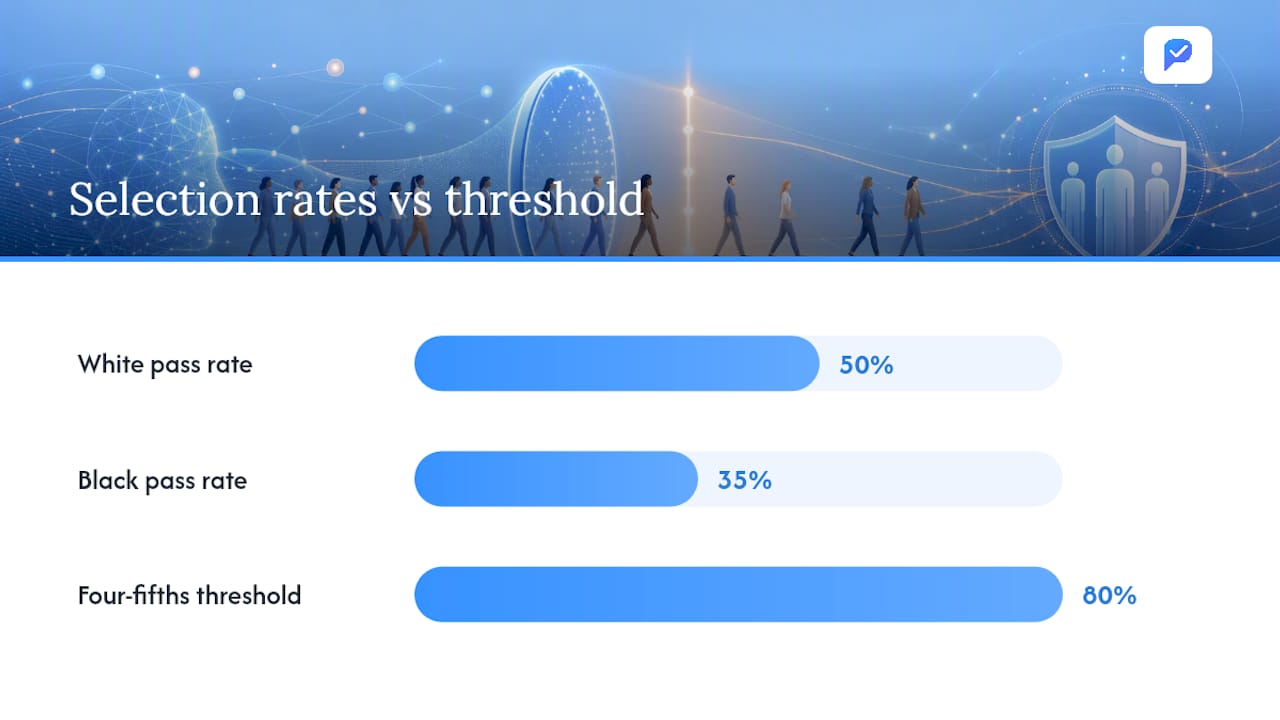
Step 4: Apply the four-fifths rule. The four-fifths (or 80%) rule, established in the EEOC's Uniform Guidelines on Employee Selection Procedures, is the standard disparate-impact test. Calculate the selection rate for each protected group. If any group's selection rate is less than four-fifths of the highest-performing group's rate, that is a flag requiring investigation. For example, if 50% of white applicants pass a screening stage but only 35% of Black applicants do, the ratio is 0.70, which falls below the 0.80 threshold.
Step 5: Assess statistical reliability. Small sample sizes produce unreliable ratios. As a general rule, you need at least 30 candidates per group to draw meaningful conclusions. Document your sample sizes alongside every test result so reviewers understand the confidence level.
Step 6: Set an ongoing testing cadence. Policy analysts recommend quarterly quick checks and annual independent audits for tools used in consequential hiring decisions. Re-test immediately after any model update, data-source change, or significant shift in your applicant pool demographics.
Bias testing log template:
| Test Date | Tool and Version | Hiring Stage | Sample Size (Total) | Selection Rate: Group A | Selection Rate: Group B | Four-Fifths Ratio | Action Taken |
|---|---|---|---|---|---|---|---|
| [Date] | [Tool name v.X] | Resume screen | [N] | [%] | [%] | [ratio] | [Pass / Flag / Investigate] |
| [Date] | [Tool name v.X] | Video interview | [N] | [%] | [%] | [ratio] | [Pass / Flag / Investigate] |
The EU AI Act's classification of employment AI as high-risk offers a useful documentation benchmark: its mandatory conformity assessment requires documenting data provenance, testing methodology, and human oversight mechanisms in a technical file. U.S. employers building rigorous programs are increasingly adopting similar documentation standards, particularly those with international operations.
What vendor due diligence should you require before purchasing an AI hiring tool?
Vendor claims are not evidence. "Our tool is validated and bias-tested" is a marketing statement until you see the methodology, the sample sizes, and the protected-class breakdowns. The FPF guidance is direct on this point: do not accept a vendor's self-certification as sufficient.
Documents to request before purchase:
- Validation study demonstrating predictive validity for the specific job type and level you are hiring for (not just a generic study)
- Bias-testing results broken down by race, sex, age, and disability status, with sample sizes and methodology disclosed
- Data provenance documentation: where training data came from, how it was labeled, and what steps were taken to remove protected-class proxies
- Data-retention and deletion schedule: how long candidate data is stored, who has access, and how deletion requests are handled
- Security certifications: SOC 2 Type II and ISO 27001 are the minimum acceptable standards for tools processing candidate data
- Model-change notification commitment: written agreement that the vendor will notify you before deploying material updates to the model
Procurement questions to send vendors:
- What version of the model is currently in production, and how are version changes communicated to customers?
- What were the sample sizes for your most recent bias-testing study, broken down by protected class?
- Can you provide the principal reasons your tool generates a particular score or recommendation for a given candidate?
- What audit logs does your platform produce, and can we export them in a machine-readable format?
- Have you ever been the subject of a regulatory inquiry or enforcement action related to discriminatory outcomes? If so, describe the outcome.
- What is your remediation SLA if a bias audit reveals adverse impact attributable to your model?
- Do you maintain a model card or equivalent technical documentation that we can share with our legal team?
- What alternative assessment pathways can you support for candidates who request an accommodation?
Contract clauses to require:
- Audit rights: the right to commission an independent third-party audit of the tool's outputs at your expense, with vendor cooperation
- Data access and export: the right to export all candidate data and audit logs in a structured format at any time
- Model-change notice: minimum 30-day advance notice before any material model update affecting scoring logic
- Remediation SLA: vendor commits to a defined timeline for investigating and remediating identified bias issues
- Liability allocation: clear language on who bears regulatory fines or remediation costs if the tool produces discriminatory outcomes
- Indemnification: vendor indemnifies you for losses arising from defects in their validation methodology
Red flags that require escalation to legal or procurement:
- Vendor refuses to disclose sample sizes or protected-class breakdowns in bias-testing results
- Validation study was conducted on a population that does not match your candidate pool
- No written model-change notification commitment
- SOC 2 report is more than 12 months old or covers only Type I (design, not operating effectiveness)
- Vendor claims the tool is "bias-free" without providing independent third-party verification
How should you handle candidate privacy and data retention for AI hiring tools?
AI hiring tools process some of the most sensitive candidate data an employer touches: resumes containing demographic signals, video recordings, voice patterns, behavioral signals derived from response timing, and in some cases biometric inferences from facial movement or eye tracking. Each data type carries a different risk profile and requires a different handling standard.
Data types and their sensitivity levels:
- Resumes and application data: moderate sensitivity; may contain age, address, and educational history that function as protected-class proxies
- Video and audio recordings: high sensitivity; subject to state biometric privacy laws (Illinois BIPA, for example) and require explicit consent in many jurisdictions
- AI-generated scores and rankings: high sensitivity; these are the outputs that create legal exposure and must be retained as part of the audit trail
- Behavioral signals (response latency, attention patterns, eye movement): high sensitivity; may constitute biometric data under some state laws
- Vendor-processed data: the vendor's data-handling practices become your compliance obligation; document them contractually
The core principles are data minimization (collect only what the tool needs to function), purpose limitation (do not use interview recordings for any purpose other than the stated hiring decision), and security-in-depth (encrypt data in transit and at rest, restrict access to named roles, and log all access events).
Retention schedule:
| Data Type | Minimum Retention | Recommended Retention | Reason |
|---|---|---|---|
| AI selection-rate testing outputs | 2 years | 4 years | EEOC charge window; litigation defense |
| Audit logs (tool version, scores, decisions) | 2 years | 4 years | Regulatory inquiry; disparate-impact defense |
| Vendor validation studies | Duration of contract + 2 years | Duration of contract + 4 years | Procurement accountability |
| Video/audio recordings | 1 year post-decision | 2 years | State law variation; litigation hold |
| Candidate accommodation requests and responses | 3 years | 4 years | ADA compliance documentation |
| Rejected candidate application data | 1 year (EEOC minimum) | 2 years | EEOC record-retention rule |
Access to AI hiring data should be restricted to the hiring manager of record, the HR compliance lead, and legal counsel. Audit logs should be read-only for all roles except the system administrator. When a candidate requests deletion of their data, honor the request within the timeframe required by applicable state law and document the deletion. Historical logs used for aggregate bias testing may be anonymized rather than deleted, provided the anonymization is irreversible.
How do you build a governance model and roll out the policy across your organization?
Governance is where most AI hiring policies fail in practice. A policy document that lives in a shared drive but has no named owner, no approval workflow, and no training program is not a governance model. It is a liability.
Cross-functional responsibilities:
- HR (policy owner): Maintains the written policy, owns the tool inventory, coordinates candidate disclosure, and manages accommodation requests
- Legal: Reviews vendor contracts, approves new tool deployments, monitors regulatory changes, and leads incident response
- IT/Security: Manages data access controls, encryption standards, SOC 2 compliance verification, and audit log infrastructure
- Procurement: Enforces vendor documentation requirements, manages contract clauses, and maintains vendor risk ratings
- Business-unit hiring managers: Follow the policy for every hiring decision, log human reviews, and escalate anomalies to HR
Roles matrix:
| Responsibility | Owner | Approver | Auditor | Operator |
|---|---|---|---|---|
| Tool inventory maintenance | HR Compliance Lead | CHRO | Legal | HR Ops |
| New tool approval | HR Compliance Lead | Legal + CHRO | IT Security | Procurement |
| Bias testing execution | HR Analytics | Legal | External auditor | HR Ops |
| Candidate disclosure | HR Ops | HR Compliance Lead | Legal | Recruiting team |
| Incident response | Legal | CHRO | HR Compliance Lead | IT Security |
Approval workflow for new tools:
- Intake: hiring manager or recruiter submits a tool request with use case, vendor name, and hiring stages affected
- Risk classification: HR compliance lead classifies the tool as high-risk or lower-risk based on decision impact
- Vendor due diligence: procurement sends the vendor questionnaire and collects required documentation
- Legal review: legal reviews vendor contract and confirms required clauses are present
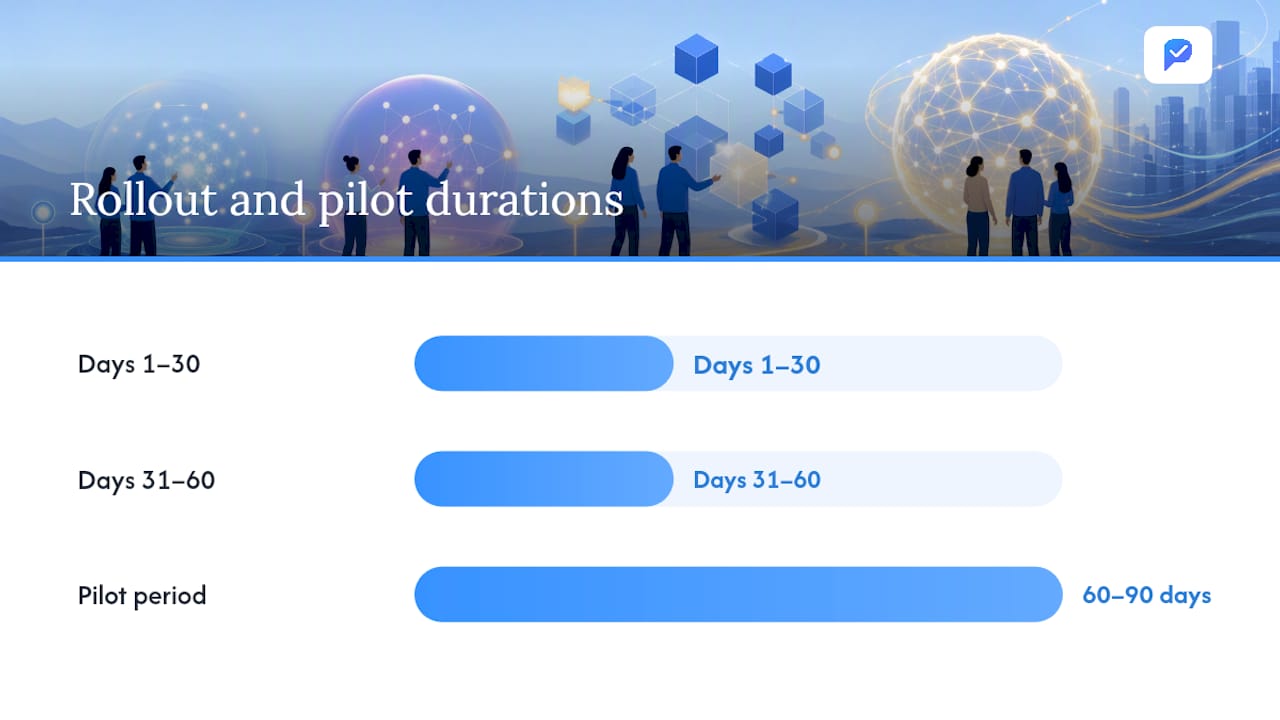
- Pilot: tool is deployed for a defined pilot period (typically 60–90 days) with enhanced monitoring
- Sign-off: HR compliance lead and legal sign off on full deployment based on pilot data
- Production deployment: tool is added to the tool inventory with version, approval date, and next review date
Training requirements. Hiring managers and recruiters need training on three topics: how to interpret AI outputs without over-relying on them, how to request and document a human review override, and how to handle accommodation requests before an AI assessment begins. Training should occur at onboarding and annually thereafter, with a brief refresher whenever a new tool is deployed.
Rollout milestone checklist:
- Days 1–30: Complete tool inventory, assign policy owner, draft written policy, send vendor questionnaires
- Days 31–60: Legal review of vendor contracts, complete pre-deployment impact assessments for high-risk tools, finalize candidate disclosure language
- Days 61–90: Train hiring managers and recruiters, deploy audit log infrastructure, publish candidate-facing disclosure on career site
- Days 91–120: First quarterly monitoring check, review pilot data, finalize policy and obtain executive sign-off
How should you monitor AI hiring tools and respond when something goes wrong?
Monitoring is not a passive activity. It requires scheduled checks, defined thresholds, and a clear escalation path when a tool's outputs suggest a problem. The EEOC's 8-step employer checklist frames ongoing monitoring as a core employer obligation, not an optional quality-assurance step.
Periodic monitoring metrics to track:
- Selection rates by protected class at each AI-assisted hiring stage (monthly or quarterly, depending on volume)
- False positive and false negative rates: candidates the AI advanced who were later rejected by human reviewers, and candidates the AI rejected who were later reconsidered
- Model drift indicators: changes in score distributions over time that may signal the model is behaving differently than during validation
- Accommodation request volume and resolution time: a spike in requests may indicate the tool is creating barriers for candidates with disabilities
- Override rates: if hiring managers are overriding AI recommendations at a high rate, that is a signal the tool's outputs are not trusted or are not aligned with actual job requirements
Incident response flow:
- Detection: A monitoring check, a candidate complaint, or a regulatory inquiry surfaces a potential adverse-impact issue
- Triage: HR compliance lead and legal assess severity within 48 hours. Is this a statistical anomaly or a pattern? Does it affect a protected class?
- Pause/containment: If the pattern is credible, pause the tool for the affected hiring stage and implement an interim alternative selection mechanism (structured human review, a different validated assessment)
- Vendor engagement: Notify the vendor in writing, invoke the remediation SLA, and request raw data and model logs
- Candidate remediation: Identify candidates who may have been adversely affected. Depending on severity, this may require re-evaluation under the alternative mechanism or direct outreach
- Documentation: Record every step, every decision, and every communication in a dedicated incident file
- Notification obligations: Assess whether state law requires notifying candidates or a regulatory body. Some state laws have explicit notification timelines once an employer identifies a potential discriminatory outcome
When an AI tool is paused, the interim alternative must be documented as a formal selection procedure. It cannot simply be "the recruiter decides." Structured human review with defined criteria, applied consistently, is the minimum standard. For guidance on how hiring managers can evaluate AI recommendations without over-relying on them, see how hiring managers review AI recommendations.
Copy-ready templates: policy language, checklist, and vendor questionnaire
The following templates are designed to be copied and adapted. Replace bracketed fields with your organization's specific information.
Policy snippet: Scope and definitions
Policy snippet: Human-in-the-loop and override
Policy snippet: Audit trail
One-page executive compliance checklist:
- Written AI hiring policy adopted and signed by CHRO
- Tool inventory complete with vendor, version, use case, and jurisdictions
- Pre-deployment impact assessments completed for all high-risk tools
- Vendor validation studies and bias-testing results on file
- Vendor contracts include audit rights, model-change notice, and remediation SLA
- Candidate disclosure language published on career site and in interview invitations
- Accommodation procedure documented and communicated to recruiting team
- Audit log infrastructure in place and tested
- Hiring manager training completed
- Quarterly monitoring cadence scheduled
- Annual independent bias audit scheduled
Vendor questionnaire (send to procurement and vendors):
- Provide your most recent validation study, including sample sizes and job types covered.
- Provide bias-testing results broken down by race, sex, age, and disability status, with methodology disclosed.
- Describe your data-retention and deletion practices for candidate data.
- Provide your current SOC 2 Type II report and ISO 27001 certificate.
- Describe your model-change notification process and the minimum notice period.
- Confirm whether your platform can produce exportable audit logs in a machine-readable format.
- Describe the accommodation pathways available for candidates who cannot complete the standard AI assessment.
- Have you been subject to any regulatory inquiry or enforcement action related to discriminatory outcomes? If yes, describe the outcome.
90–120 day implementation timeline:
| Phase | Days | Key Milestones |
|---|---|---|
| Foundation | 1–30 | Tool inventory, policy owner assigned, vendor questionnaires sent |
| Legal and vendor review | 31–60 | Impact assessments complete, contracts reviewed, disclosure language finalized |
| Training and infrastructure | 61–90 | Hiring manager training, audit logs live, career site disclosure published |
| First audit cycle | 91–120 | Quarterly monitoring check, pilot review, executive sign-off on policy |
How does Evy satisfy model-integrity and interview-integrity policy requirements?
When evaluating any AI hiring vendor against your policy requirements, the documentation standard matters as much as the feature set. The following sample clauses and checklist illustrate what a vendor should be able to provide, using Evy as the reference example.
Sample model-integrity clause (adapt for your vendor contracts):
Sample interview-integrity clause:
Vendor evaluation checklist mapped to policy requirements:
- Audit logs: Platform produces exportable, timestamped logs of every interview session, score, and decision event
- Structured interview flow: Questions are standardized across candidates to reduce interviewer subjectivity and support disparate-impact testing
- Anti-cheating signals: Real-time detection of attention pattern anomalies (such as eye tracking deviations) that may indicate external AI assistance, with session-level documentation
- Human-review workflow: Platform supports a named human reviewer step before any score is used in a hiring decision
- Accommodation pathways: Alternative assessment options are available for candidates who cannot complete the standard format
- SOC 2 Type II: Current certification available for review
- Model-change notification: Written commitment to advance notice before scoring-logic updates
- Bias-testing documentation: Validation study and protected-class breakdowns available on request
Evy's platform is built around these requirements. Its real-time eye tracking captures attention patterns during AI-assisted interviews, generating session-level logs that feed directly into your audit trail. The structured, adaptive interview flow applies consistent criteria across candidates, which is the foundation of defensible disparate-impact testing. For a closer look at how AI can reduce interviewer subjectivity while maintaining a documented decision record, see how AI reduces interviewer subjectivity.
Pro Tip: Never accept a vendor's model card or bias-testing summary as final. Ask for the raw data behind the summary. A vendor that cannot or will not provide sample sizes, group-level selection rates, and methodology details is a vendor whose documentation will not hold up in a regulatory review.
Key Takeaways
A compliant AI hiring policy requires written documentation, pre-deployment testing, vendor controls, candidate disclosure, and a recurring audit cadence — none of these elements is optional under current U.S. federal and state law.
| Point | Details |
|---|---|
| Federal baseline is non-negotiable | Title VII, ADA, and ADEA disparate-impact doctrine applies to every AI hiring tool you deploy, regardless of vendor claims. |
| State law varies significantly | NYC, Illinois, Connecticut, and New Jersey each impose distinct requirements; use a 50-state chart to track your obligations by jurisdiction. |
| Vendor claims need verification | Require validation studies, protected-class bias-testing results, and SOC 2 Type II before signing any AI hiring contract. |
| Impact assessments must be documented | Run the four-fifths rule calculation before deployment and on a quarterly/annual cadence; retain all testing records for at least four years. |
| Evy maps to policy requirements | Evy's audit logs, structured interview flow, and real-time eye tracking directly satisfy the audit trail, human-review, and anti-cheating documentation requirements described in this policy framework. |
The gap between policy and practice is where employers get hurt
Most organizations that face EEOC charges or state agency investigations over AI hiring tools did not lack a policy. They lacked a policy that was actually followed. The written document existed; the audit logs did not. The vendor contract had the right language; nobody had ever invoked the audit-rights clause. The training was scheduled; it was never delivered.
Two implementation challenges come up repeatedly. The first is vendor documentation delay. When HR teams send the vendor questionnaire for the first time, many vendors take weeks to respond, and some respond with marketing materials rather than technical documentation. The teams that resolve this fastest treat the questionnaire as a procurement gate, not a post-purchase request. If the vendor cannot produce a validation study and bias-testing results before the contract is signed, that is a red flag, not a negotiating point.
The second challenge is interpreting vendor bias-testing results. A vendor may provide a table showing selection rates by demographic group, but without knowing the sample sizes, the confidence intervals, or whether the study population matches your candidate pool, the table is nearly meaningless. HR teams that have resolved this well bring in an external I/O psychologist or data analyst for a one-time review of vendor documentation before deployment. That review typically costs far less than the remediation work that follows a poorly vetted tool.
Cross-functional coordination is the third friction point, and it is the one that most decision-makers underestimate. Legal, IT, and HR each have a piece of the compliance picture, but they rarely sit in the same room until something goes wrong. The governance model described in this article is designed to force that coordination before deployment, not after.
On budgeting: the major cost categories for AI hiring compliance are external legal review of vendor contracts, independent bias audits (typically commissioned annually for high-risk tools), IT infrastructure for audit logging, and staff time for training and monitoring. None of these are trivial, but all of them are predictable. The unpredictable cost is remediation after an adverse finding, which is why front-loading the documentation and testing work is the more defensible financial decision.
Evy gives you the audit trail and integrity controls your policy requires
Building a compliant AI hiring program means choosing vendors whose documentation, logging, and oversight features actually match your policy requirements. Evy is the AI interview platform built for exactly that accountability. Where most screening tools produce a score and little else, Evy generates a complete, exportable audit trail for every session: timestamped transcripts, structured scoring, and real-time eye tracking logs that document attention patterns and flag potential AI-assistance signals during the interview itself.
That combination directly satisfies the audit-trail, human-review, and anti-cheating documentation requirements described throughout this framework. Evy's structured interview flow applies consistent criteria across every candidate, giving your HR analytics team the standardized data needed for defensible four-fifths rule calculations. ATS integration means your audit records live where your hiring decisions are made, not in a separate system your legal team cannot access.
If you are building or updating your AI hiring compliance program and need a vendor whose documentation will hold up to regulatory scrutiny, request a demo at evy.io to see how Evy's audit features map to your specific policy requirements.
Useful sources and authoritative resources
Every HR team building an AI hiring compliance program should bookmark the following resources. They are the primary authorities behind the guidance in this article.
Regulatory and framework resources:
- U.S. Department of Labor announces framework to help employers promote inclusive hiring as AI-powered recruitment tools’ use grows | U.S. Department of Labor
- FPF best practices for AI and workforce-adjacent technology (PDF)
- Title VII, Civil Rights Act of 1964 | U.S. Equal Employment Opportunity Commission
- Artificial intelligence and ADA | EEOC
- HR AI Governance: What EU AI Act and EEOC R… · AI Policy Desk
- EEOC AI Hiring Guidance 2026: 8-Step Employer Checklist · AI Policy Desk
- New Jersey disparate impact discrimination guidance (PDF) | Office of the Attorney General
- Connecticut SB 5 (PDF)
Policy analysis and employer checklists:
- AI Policy Desk: HR AI Governance and EU AI Act: Analysis of how EU AI Act high-risk classification mechanics inform documentation standards for U.S. employers.
- AI Policy Desk: EEOC AI Hiring Guidance 2026 Employer Checklist: An 8-step employer checklist for auditing and monitoring AI hiring tools, grounded in EEOC disparate-impact doctrine.
For jurisdictional tracking:
A 50-state chart resource (such as those maintained by Brightmine or LexisNexis) is the most practical tool for tracking which states and localities require disclosure, independent audits, or candidate consent for AI hiring tools. The patchwork is moving fast: Illinois, Colorado, Virginia, and New Jersey have all introduced or enacted requirements within the past two years, and more states are expected to follow.
For additional guidance on reducing bias at the screening stage and building structured interview flows that support compliance documentation, see AI's role in reducing interview bias and risks, fairness, and fitting AI screening into your process.