
 By Adrian Pascual•Hiring insight•Published
How Hiring Managers Review AI Recommendations in 2026
AI recommendations in hiring are inputs that require human verification, not verdicts that replace human judgment. Understanding how hiring managers review AI recommendations means grasping a structured, human-in-the-loop process where every AI output gets checked against real job criteria before any candidate advances. The EU AI Act now mandates human oversight for high-risk AI systems, including hiring tools, making this review process both an ethical obligation and a legal requirement. Platforms like Evy are built around this principle: AI surfaces candidates, but humans confirm the decision.
How hiring managers review AI recommendations: the core criteria
The most common mistake hiring managers make is treating AI rankings as final answers. Reviewing AI rationale rather than just accepting candidate rankings is the single most effective way to catch model failures before they affect real people. A ranking tells you who scored highest. The rationale tells you why, and that distinction matters enormously.
When evaluating AI hiring tools, focus on these specific elements within each AI output:
- Per-criterion scores with evidence. Every score should cite specific resume language or response content. If the AI rates a candidate highly on "project management" but cannot point to a concrete example in the resume, that score is unsupported.
- Alignment with current job requirements. AI models trained on historical data often reflect outdated role templates. Compare the AI's scoring rubric against the actual job description you posted, not the one from two years ago.
- Shortlist diversity signals. A shortlist dominated by candidates from the same university, city, or professional background is a red flag. Narrow shortlists often indicate the model is overweighting proxies for quality rather than actual qualifications.
- Confidence levels. AI outputs that show high confidence scores on thin evidence deserve more scrutiny, not less. Confidence is a model's self-assessment, not a guarantee of accuracy.
- Structured rubric consistency. The criteria the AI uses should match the structured rubric documented in your job description. Any mismatch means the AI is scoring against criteria you did not intend.
Pro Tip: Before reviewing any AI output, pull up the job description and keep it open side by side. Every AI score you read should map directly to a requirement you wrote.
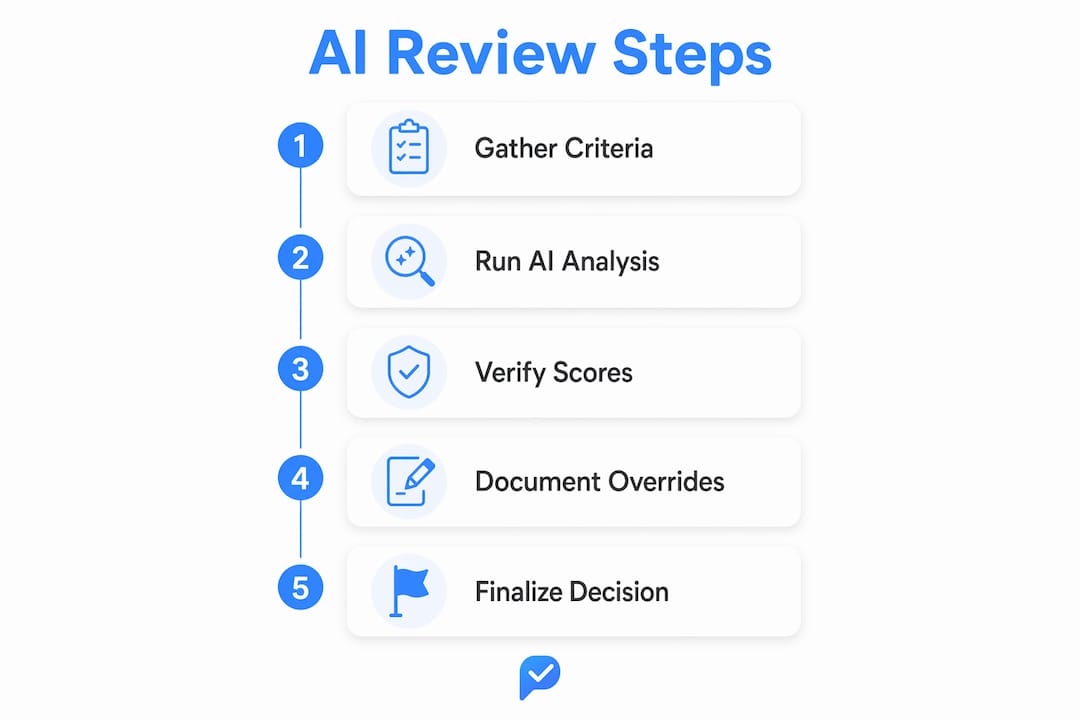
The AI recommendation assessment process works best when you treat the AI as a first-pass analyst. It narrows the field. You determine whether the narrowing was done correctly.

Best practices for human oversight and decision documentation
Effective human oversight is not a one-time check. It is a repeatable workflow with documented steps that hold up under legal scrutiny.
- Apply a three-minute review checklist per candidate. Spending about three minutes on each AI screening output to verify qualification alignment is the recommended practice. Use that time to confirm the AI's rationale matches the job criteria, check for missing context, and flag anything that looks off.
- Require documented overrides. When you disagree with an AI recommendation, log the reason using a standardized template tied to specific job criteria. Documenting why you override is more important than the override itself. That record protects your organization if a hiring decision is ever challenged.
- Flag 10% of recommendations for mandatory manual audit. Effective hiring teams flag roughly 10% of AI recommendations for manual review regardless of whether they agree with the output. This randomized check catches systematic errors that would otherwise go unnoticed.
- Maintain a full decision trail. Decision trail documentation from AI tool configuration through final hire is the foundation of legal defensibility. Every stage, from how the AI was set up to who approved the final offer, should be recorded.
- Complete bias awareness training. The EU AI Act requires 30 minutes of mandatory training on automation bias for hiring managers using AI tools. That training is not optional for organizations operating under EU jurisdiction, and it is good practice everywhere else.
Pro Tip: Build your override template into whatever ATS or hiring platform you use. A friction-free logging process gets used. A cumbersome one gets skipped.
The table below shows how oversight actions map to their primary purpose:
| Oversight action | Primary purpose | Frequency |
|---|---|---|
| Three-minute rationale review | Verify AI scoring against job criteria | Every candidate |
| Documented override with rationale | Legal defensibility and accountability | Every disagreement |
| Randomized manual audit | Detect systematic model errors | 10% of recommendations |
| Full decision trail record | Compliance and audit readiness | Every hiring decision |
| Bias awareness training | Reduce automation bias risk | Annually or per regulation |
How to identify and mitigate bias in AI recommendations
AI bias in hiring does not always look obvious. It often appears as a pattern across many decisions rather than a single glaring error.
- Watch for homogeneous shortlists. If your top-ranked candidates consistently share the same alma mater, zip code, or career path, the model may be overweighting brand-name signals rather than actual competency.
- Run systematic drift checks. Sampling top and bottom candidates to detect bias and adjust screening rules is a proven method. Pull the top 20 and bottom 20 scored candidates and read their profiles manually. If the bottom group contains clearly qualified people, the model has drifted from your actual requirements.
- Adjust rubrics proactively. When you find drift, update the screening parameters before the next hiring cycle. Do not wait for a formal audit to correct a known problem.
- Add human-generated interview questions. AI screening measures what it can measure. Judgment, adaptability, and culture fit require questions you write based on your team's specific context. Complement AI candidate screening with interview questions that probe areas the AI cannot assess.
Bias in AI hiring tools rarely announces itself. It accumulates quietly across hundreds of decisions, each one looking reasonable in isolation. The hiring managers who catch it earliest are the ones who review patterns across the full candidate pool, not just individual scores.
Human judgment remains the check that keeps AI screening honest. The goal is not to distrust the AI. The goal is to verify it consistently enough that errors surface before they compound.
What tools and features support effective AI recommendation review
The quality of your review process depends partly on what the AI platform gives you to work with. Not all tools provide the same level of transparency.
Explainability features are the baseline requirement. Feature importance scores and confidence metrics help managers understand what the AI weighted most heavily in each recommendation. Without these, you are reviewing a conclusion without access to the reasoning.
Side-by-side candidate comparison views let you evaluate two or three candidates against the same criteria simultaneously. This format reduces the anchoring effect of reviewing candidates sequentially, where the first profile you read unconsciously sets the standard for all others.
Decision-forcing interfaces require a human sign-off before any candidate advances. Human gatekeeping workflows where overruling AI decisions requires logging the rationale are the standard for effective oversight. Platforms that allow candidates to advance without a human approval step create compliance gaps.
Digital override logging captures every disagreement between the human reviewer and the AI output. This log becomes your audit trail. Platforms that store override reasons alongside the original AI recommendation give compliance teams exactly what they need during a review.
Training modules built into the platform itself are a meaningful differentiator. When bias awareness content is embedded in the tool rather than delivered separately, managers encounter it at the moment of decision rather than weeks before or after. Evy incorporates this kind of contextual support into its AI interview features, connecting oversight directly to the screening workflow.
Pro Tip: When evaluating any AI hiring platform, ask specifically: "Can I see the feature importance scores for each recommendation?" If the answer is no, you cannot do a meaningful review.
For teams exploring how AI agents fit into hiring workflows, the key question is always the same: where does the human step in, and what information do they have when they do?
Key Takeaways
Effective AI recommendation review requires verifying AI rationale against job criteria, documenting every override, and auditing a random sample of recommendations to catch systematic errors before they affect hiring outcomes.
| Point | Details |
|---|---|
| Review rationale, not just rankings | AI rationale reveals model failures that scores alone will not show. |
| Document every override | Log the reason tied to specific job criteria for legal defensibility. |
| Audit 10% of recommendations | Random manual checks catch systematic bias before it compounds. |
| Maintain a full decision trail | Record every stage from AI configuration to final hire for compliance. |
| Use explainability features | Feature importance scores and confidence metrics make reviews meaningful. |
The part most hiring managers skip
I have reviewed a lot of AI-assisted hiring workflows, and the pattern I see most often is this: managers spend time on the candidates the AI likes and almost no time on the candidates it rejects. That is exactly backwards.
The AI's rejections are where the errors hide. A model that consistently deprioritizes candidates with nonlinear career paths, employment gaps, or non-traditional credentials will look perfectly reasonable on paper. Every candidate it surfaces will seem qualified. The problem is the qualified candidates it never surfaced at all.
The three-minute checklist and the 10% audit requirement exist precisely to force attention onto the full distribution of decisions, not just the top of the list. Compliance with the EU AI Act's human oversight requirements is not just a legal checkbox. It is a structural correction for a very human tendency to trust confident-looking outputs.
AI is genuinely useful in hiring. It processes volume that no human team can match, and it applies criteria consistently in ways that human reviewers often do not. But consistency applied to a flawed rubric produces flawed results at scale. The hiring manager's job is to be the check on that scale, not a passive approver of it.
The best teams I have seen treat AI recommendations the way a good editor treats a first draft. Useful, worth reading carefully, and never published without revision.
— Hudson
Evy's approach to transparent AI hiring review
Hiring teams that want meaningful oversight need more than a score. They need to see the reasoning behind it.
Evy is built for exactly this kind of review. Its AI interview platform gives hiring managers explainability features, override logging, and a full decision trail from screening through final selection. Evy's real-time eye tracking adds a layer of integrity that other platforms cannot offer, catching candidates who use AI assistance during interviews so your recommendations reflect genuine candidate ability. When you review an Evy recommendation, you are reviewing honest data. Explore Evy's interview features to see how the platform supports compliant, bias-aware hiring at scale.
FAQ
What does reviewing AI hiring recommendations actually involve?
Reviewing AI hiring recommendations means verifying the AI's rationale against your job criteria, checking per-criterion scores for supporting evidence, and documenting your agreement or override before any candidate advances.
How long should a hiring manager spend reviewing each AI recommendation?
Recommended practice is approximately three minutes per candidate to verify qualification alignment and check the AI's scoring rationale against the job description.
What is the best way to detect bias in AI candidate recommendations?
Sample the top and bottom candidates in each scored pool and review their profiles manually. Patterns of homogeneity or clearly qualified candidates appearing at the bottom indicate model drift or bias.
Do hiring managers need training to use AI hiring tools?
The EU AI Act requires 30 minutes of bias awareness training for hiring managers using AI tools in jurisdictions where it applies. This training reduces automation bias and improves the quality of human oversight.
Why is documenting AI hiring overrides important?
Logging override rationale tied to specific job requirements creates the audit trail needed for legal defensibility if a hiring decision is ever challenged.