
 By Adrian Pascual•Hiring insight•Published
Candidate Persona in Job Screening: 2026 HR Guide
A candidate persona is defined as a semi-fictional, research-based profile of the ideal job candidate, built to guide every stage of recruitment from sourcing to final selection. Understanding what is candidate persona in job screening is the foundation of any hiring strategy that moves beyond generic job postings and gut-feel decisions. Unlike a job description, a candidate persona captures who the right hire actually is: their motivations, behaviors, values, and decision-making triggers. When built correctly, it aligns your entire hiring team around a shared picture of success before the first resume arrives.
What is a candidate persona in job screening?
A candidate persona is the structured answer to one question: "Who exactly are we trying to hire, and why would they want to work here?" The industry also refers to this concept as a "recruitment persona" or "talent persona," but the underlying definition stays the same across HR best practices. It is a semi-fictional ideal candidate profile grounded in real data, not assumptions. That grounding is what separates a useful persona from a wishful thinking document.
Candidate personas shift hiring from generic messaging to personalized outreach, which produces higher engagement and stronger candidate pipelines. This matters most in sectors like tech and healthcare, where competition for qualified talent is fierce and a poorly targeted job post disappears into noise. A well-built persona tells your team where to find candidates, what language resonates with them, and what concerns they need addressed before accepting an offer.

The persona also serves an internal function that most HR teams underestimate. Building one forces stakeholders, including hiring managers, team leads, and recruiters, to agree on what "good" looks like before screening begins. That consensus prevents the mismatched evaluation standards that derail so many hiring processes downstream.
What are the core components of a candidate persona?
Every effective candidate persona contains five categories of information. Together, they paint a picture of a real person, not a checklist.
- Demographics and background: Education level, years of experience, industry background, and location preferences. These set the baseline for sourcing channels.
- Skills and competencies: Both technical skills and soft skills, with a clear distinction between non-negotiable requirements and teachable ones. Separating hard from soft skills sharpens your screening criteria and prevents evaluators from penalizing candidates for gaps that training can close.
- Personality traits and values: How the candidate approaches collaboration, ambiguity, and feedback. These inform cultural fit assessments without relying on vague instinct.
- Career motivations and decision-making triggers: What the candidate wants from their next role, whether that is growth, compensation, mission, or flexibility. Addressing these motivations is what separates recruiters who close offers from those who lose candidates at the final stage.
- Job search behaviors and communication preferences: Where candidates look for roles, how they prefer to be contacted, and what content influences their decisions.
Pro Tip: Build a separate section in your persona for "deal-breakers." Knowing what will cause a strong candidate to disengage is just as valuable as knowing what attracts them.
How does a candidate persona differ from a job description?
Three hiring documents often get confused: the job description, the ideal candidate profile, and the candidate persona. Each serves a distinct purpose, and using them interchangeably creates gaps in your recruitment strategy.
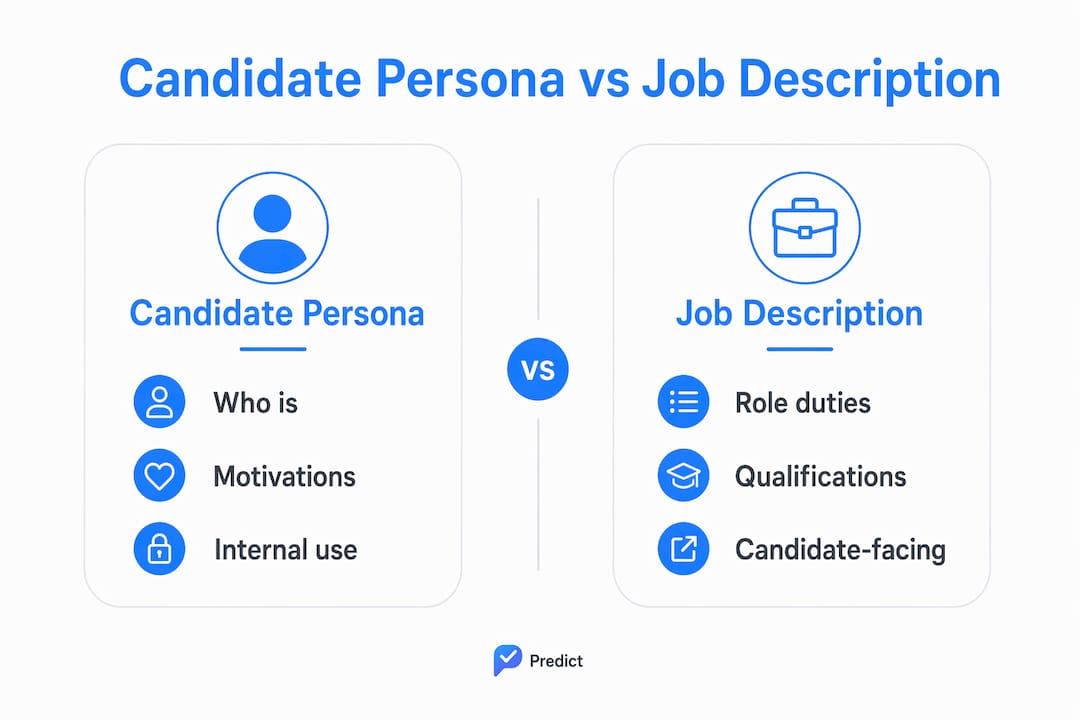
A job description is a candidate-facing document. It lists role responsibilities, required qualifications, and reporting structure. It answers "What is this job?" A job description is written for compliance and clarity, not for persuasion.
An ideal candidate profile, sometimes called an ICP, is an internal qualification checklist. It defines the minimum and preferred requirements a candidate must meet to be considered. It is rigid by design and answers "What must this person have?"
A candidate persona describes the person and their motivations rather than just role requirements. It answers "Who is this person, and what drives them?" Personas guide the language used in job descriptions, the channels chosen for sourcing, and the questions asked in interviews. They do not replace the other two documents. They inform them.
The practical implication is significant. A job description written without a persona tends to use generic language that attracts a broad, poorly matched pool. A job description shaped by a persona uses specific language that resonates with the right candidates and filters out poor fits before they apply.
Pro Tip: Write your job description after finalizing your persona. Use the persona's motivations and values to shape the "Why work here" section. That section is where strong candidates decide whether to apply.
What are best practices for creating candidate personas?
Building a candidate persona that actually improves screening requires a structured process. The following steps reflect current HR best practices for 2026.
- Audit your high performers. Pull data on employees who excel in the target role. Look for patterns in their backgrounds, career paths, and stated motivations. Empirical persona building from real employee data prevents the "super-candidate" trap, where the persona describes someone who does not exist.
- Interview hiring managers and team leads. Ask them to describe the last great hire and the last poor one. The contrast reveals what actually predicts success versus what sounds good in theory.
- Survey current employees in similar roles. Ask what drew them to the company, what almost stopped them from accepting, and what they value most now. These answers shape your messaging directly.
- Separate must-haves from nice-to-haves. Clearly label which skills and traits are non-negotiable and which are teachable. This step alone improves screening consistency across evaluators.
- Align stakeholders on the final document. The persona-building process is as valuable as the finished product. Getting hiring managers and recruiters to agree on the persona prevents conflicting screening standards later.
- Schedule regular reviews. Personas reviewed every 12–18 months stay aligned with shifting candidate motivations and market conditions. A persona built in 2023 may no longer reflect what motivates candidates in 2026.
You can also use structured IT hiring workflows as a reference point for how personas slot into broader application and screening processes, particularly for technical roles.
Pro Tip: Avoid building personas by committee vote. Gather input broadly, but assign one person to synthesize the data and write the final document. Personas written by consensus often end up vague and unusable.
How can candidate personas improve job screening outcomes?
Candidate personas change the quality of every screening decision, not just the sourcing strategy. The benefits show up across the full hiring funnel.
- Targeted outreach replaces broadcast posting. Persona-informed recruiters know which platforms their ideal candidates use, what content they engage with, and what subject lines get responses. Tailoring outreach to specific triggers like company stage, role scope, and growth opportunity produces measurably higher response rates.
- Interview questions align with what actually predicts success. When your persona identifies that the ideal candidate is motivated by autonomy and technical depth, your interview questions can probe for evidence of those traits directly. Generic competency questions miss this entirely.
- Screening criteria become consistent across evaluators. Standardized interview questions and assessment criteria built from persona insights reduce the variation in how different hiring managers score the same candidate. That consistency improves fairness and reduces the influence of unconscious bias. Evy's platform supports this by providing structured interview environments where behavioral data can be captured and reviewed consistently.
- Cultural fit decisions get grounded in data. Rather than relying on a hiring manager's instinct, the persona defines the values and working styles that predict fit. This makes cultural fit a defensible criterion rather than a subjective one. Evy's AI screening tools complement this by surfacing behavioral signals during interviews that align or conflict with persona-defined traits.
- AI matching improves when fed persona criteria. AI-powered tools that apply persona criteria to candidate data speed up sourcing and improve match quality. The persona acts as the input that makes AI screening more accurate rather than just faster.
Reducing hiring bias at the screening stage is one of the most concrete benefits of persona-driven recruitment. When evaluation criteria are defined in advance and tied to real performance data, subjective impressions carry less weight.
Key Takeaways
A candidate persona is the most direct tool HR teams have for aligning recruitment strategy with the reality of who actually succeeds in a role.
| Point | Details |
|---|---|
| Core definition | A candidate persona is a semi-fictional, data-driven profile capturing motivations, behaviors, and values. |
| Distinct from job descriptions | Personas inform recruitment strategy and messaging; job descriptions list role requirements for candidates. |
| Built from real data | Audit high performers and interview hiring managers to avoid unrealistic archetypes. |
| Requires regular updates | Review personas every 12–18 months to stay aligned with shifting candidate motivations. |
| Improves screening consistency | Persona-aligned criteria standardize evaluation across hiring teams and reduce bias. |
Why most HR teams are using personas wrong
The most common mistake I see is treating a candidate persona as a finished artifact rather than a living tool. Teams invest time building one, file it away, and then wonder why their screening still produces inconsistent results. The persona only works if it actively shapes job descriptions, interview questions, sourcing channels, and closing conversations.
The second mistake is building personas from opinion rather than data. When a hiring manager describes their ideal candidate from memory, they describe their best hire from five years ago, filtered through nostalgia. That profile may have nothing to do with what the role requires today. The only way to build a reliable persona is to analyze current high performers and ask them directly what motivated their decisions.
What I find genuinely underappreciated is the internal alignment value of the persona-building process itself. When a recruiter, a hiring manager, and a team lead sit down to define the persona together, they often discover they have completely different pictures of the ideal hire. Surfacing that disagreement before screening starts is far less costly than discovering it after three rounds of interviews.
The talent market in 2026 rewards specificity. Candidates, especially in competitive fields, receive multiple outreach messages weekly. Generic messaging gets ignored. A persona gives your team the specificity to cut through that noise with language that actually resonates. That is not a minor efficiency gain. It is the difference between filling a role in six weeks and filling it in six months.
— Hudson
How Evy supports persona-driven screening
Candidate personas define who you are looking for. Evy helps you verify that the person in front of you is who they claim to be.
Evy is the only AI interview platform with real-time eye tracking designed to catch candidates using AI assistance during interviews. When your screening criteria are built from a well-constructed persona, every interview question has a purpose. Evy's behavioral data, including attention patterns and transcript analysis, gives hiring teams an additional layer of confidence that responses reflect genuine candidate thinking rather than AI-generated answers. You can review Evy's full anti-cheat interview features to see how they complement persona-based evaluation at scale, 24 hours a day, 7 days a week.
FAQ
What is a candidate persona in simple terms?
A candidate persona is a detailed profile of your ideal job candidate, built from real data on skills, motivations, and behaviors. It guides sourcing, messaging, and screening decisions throughout the hiring process.
How is a candidate persona different from a job description?
A job description lists role requirements for candidates to read. A candidate persona is an internal strategy document that describes who the ideal candidate is and what motivates them to accept an offer.
How often should candidate personas be updated?
Personas should be reviewed every 12–18 months to stay current with changing candidate motivations and market conditions. Static personas lose accuracy as talent markets shift.
What data sources work best for building candidate personas?
The most reliable sources are performance data from current high performers, structured interviews with hiring managers, and direct surveys of employees in similar roles. Gut instinct and wish lists produce unrealistic archetypes.
Can candidate personas help reduce hiring bias?
Persona-defined evaluation criteria give hiring teams a consistent, data-grounded standard to apply across all candidates. That consistency reduces the influence of subjective impressions and improves screening fairness at every stage.