
 By Adrian Pascual•Hiring insight•Published
Benefits of AI-Assisted Shortlisting for HR Teams
AI-assisted shortlisting reliably speeds time-to-hire and raises the quality of candidates advancing to final rounds. For HR teams managing high-volume pipelines, the evidence is clear enough to act on now. The primary gains you can expect:
- Faster screening: AI processes hundreds of applications in the time a recruiter reviews a dozen, cutting time-to-hire measurably across the funnel.
- Higher final-stage pass rates: A randomized field experiment found AI-assisted pipelines produced a 20 percentage-point lift in final-stage pass rates (54% vs. 34% for the control group).
- Improved shortlist diversity: AI-generated shortlists have shown a notable increase—more than 10 percentage points for women and more than 7 percentage points for underrepresented minorities—in representation compared to human-only shortlists in controlled studies.
- Reduced recruiter admin burden: Automated resume parsing, note-taking, and scoring free recruiters to focus on relationship-building and final-stage judgment.
- Scalability: Consistent evaluation criteria apply equally to the 10th and the 10,000th applicant, which matters most in high-volume hiring cycles.
Table of Contents
- What does the evidence say about AI shortlisting outcomes?
- How each benefit plays out in practice
- How AI shortlisting actually works inside your ATS
- Where AI shortlisting can go wrong and how to prevent it
- How to pilot AI shortlisting inside your organization
- Which KPIs should you track, and what does ROI look like?
- How Evy addresses shortlisting challenges in practice
- Key Takeaways
- What HR teams often underestimate about AI shortlisting
- Evy screens at scale without sacrificing integrity
- Useful sources
What does the evidence say about AI shortlisting outcomes?
The strongest empirical signal comes from a randomized field experiment that compared AI-assisted recruitment pipelines against traditional human-only screening. The AI-assisted group achieved a 54% final-stage pass rate versus 34% in the control group, a 20 percentage-point difference. Downstream, candidates who moved through the AI pipeline showed roughly a 5.9 percentage-point higher probability of finding new employment. The same study flagged approximately 21% of resumes in sample audits as containing misrepresentation, a detection rate that human screeners rarely match at scale.
Beyond that single experiment, peer-reviewed multi-sector surveys consistently report large time-to-hire reductions from AI adoption, though bias mitigation effects remain modest without active governance. Research on generative AI and process automation shows that organizations with higher baseline automation realize larger efficiency and quality gains, meaning the returns on AI shortlisting compound as your broader HR tech stack matures.
| Metric | Traditional screening | AI-assisted screening | Source |
|---|---|---|---|
| Final-stage pass rate | 34% | 54% | Randomized field experiment |
| Employment probability uplift | Baseline | +5.9 pp | Randomized field experiment |
| Resume misrepresentation flagged | Low detection | ~21% of sample | Randomized field experiment |
| Women in top-of-funnel shortlist | Baseline | +10 pp | CESifo Working Paper |
| Underrepresented minorities shortlisted | Baseline | +7 pp | CESifo Working Paper |
The single clearest number in the literature: a 20 percentage-point increase in final-stage pass rates from AI-assisted shortlisting, documented in a controlled experiment. That gap represents real hiring outcomes, not survey self-reporting.
How each benefit plays out in practice
Efficiency and recruiter time
AI removes the most time-intensive administrative layer of recruiting: reading every resume, filling out scorecards, and scheduling initial screens. Practitioner surveys show high proportions of recruiters reporting meaningful time savings when AI handles note-taking, scorecard auto-fill, and resume parsing. That time compounds across the funnel. When a recruiter who previously spent three hours screening 50 applications now reviews a ranked shortlist in 30 minutes, the hours freed up go toward higher-signal work: building candidate relationships, calibrating with hiring managers, and improving offer acceptance rates.
Candidate quality and predictive validity
AI scoring tends to reduce two problems common in human screening: rating compression (where most candidates cluster at the same score) and time-of-day effects (where a recruiter's judgment shifts between a 9 AM review and a 4 PM one). CESifo Working Paper No. 12573 found that AI scores predict labor-market success better than human raters in controlled comparisons, particularly when the AI evaluates structured, question-level responses rather than unstructured resumes alone. The result is a shortlist where the candidates who advance are genuinely more likely to succeed in the role, not just more likely to have formatted their resume well.
Diversity effects
The diversity signal from AI shortlisting is real but conditional. The same CESifo research that documented the pass-rate and quality gains also found AI-generated shortlists included more than 10 percentage points more women and more than 7 percentage points more underrepresented minorities compared to human-generated shortlists. The mechanism is straightforward: AI evaluates structured responses against defined criteria rather than relying on pattern-matching against a mental model of past hires. That said, participation effects matter. Asynchronous AI assessments can deter some senior or older candidates, so communication and opt-out paths are not optional features.
Scalability and consistency
Human screeners apply different standards on different days. AI applies the same rubric to every candidate, whether you receive 50 applications or 5,000. For high-volume roles, that consistency is the core operational benefit. AI screening at scale also preserves audit trails that human-only processes rarely produce, which matters when a hiring decision is later questioned.
Candidate experience and cost
Automation can improve candidate experience when it speeds up communication and reduces the time candidates wait for a response. It can harm the funnel when assessments are too long or poorly explained. Keeping AI screening assessments under 20 minutes and providing clear instructions on what the AI evaluates are two practical ways to protect completion rates. On cost, the primary saving is recruiter labor: fewer hours per hire translates directly to lower cost-per-hire, with the software cost offset by the reduction in screening time.
How AI shortlisting actually works inside your ATS
Understanding the components helps you evaluate vendors and set realistic expectations. The typical AI shortlisting workflow has five layers:
Resume parsing extracts structured data from unstructured documents, identifying skills, experience, and credentials without requiring a standardized format from candidates.
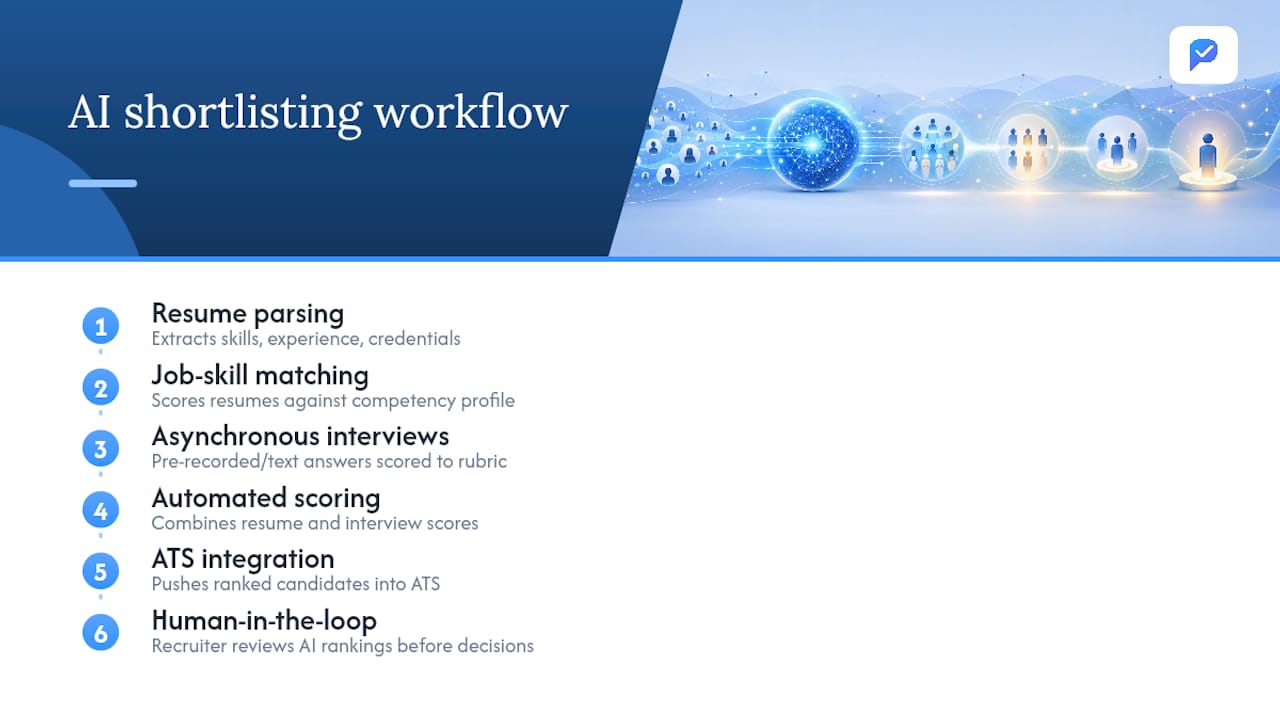
Job-skill matching scores each parsed resume against a defined competency profile for the role. The quality of this step depends heavily on how well the job requirements are specified.
Asynchronous structured interviews are pre-recorded or text-based question sets that candidates complete on their own schedule. Responses are scored against a rubric, removing the scheduling bottleneck of live phone screens. For a fuller explanation of how AI candidate screening works, the mechanics differ meaningfully across platforms.
Automated scoring combines resume match scores with interview response scores into a composite ranking. The best systems make this scoring logic visible to recruiters, a feature called explainability.
ATS integration passes ranked candidates and their scores directly into your existing applicant tracking system, so recruiters work in one interface rather than toggling between tools. Collaboration research consistently shows that hybrid models, where AI ranks and humans decide, outperform fully automated systems on both adoption and fairness outcomes.
Human-in-the-loop means a recruiter or hiring manager reviews AI-ranked candidates before any decision is made. This is not a nice-to-have; it is the governance mechanism that keeps AI shortlisting defensible.
Where AI shortlisting can go wrong and how to prevent it
The efficiency gains are real. So are the risks. HR teams that deploy AI shortlisting without governance structures tend to encounter the same problems.
Bias from training data. If an AI model was trained on historical hiring data from a homogeneous workforce, it can encode those patterns into its scoring. Regular audits comparing pass rates across demographic groups are the primary safeguard. SHRM Labs guidance explicitly warns against allowing AI to replace careful human assessment, particularly for protected-class considerations under Title VII and state-level employment laws.
Participation and deterrence effects. Asynchronous or time-intensive assessments deter some candidate segments, particularly senior professionals and older applicants. This shifts your applicant mix in ways that may not be visible until you audit completion rates by demographic group.
False negatives. AI can screen out qualified candidates whose resumes or responses don't match the model's training patterns. A strong candidate who describes their experience in non-standard language may score lower than a weaker candidate who uses the expected keywords.
Privacy and legal exposure. In the United States, AI-assisted hiring tools intersect with the Equal Employment Opportunity Commission's guidance on algorithmic discrimination, state-level biometric privacy laws (Illinois BIPA being the most stringent), and general data minimization principles under applicable privacy frameworks. Candidate consent to AI assessment and data retention limits are not optional disclosures.
Safeguards checklist for HR teams:
- Require human review of every AI-ranked shortlist before candidates are advanced or rejected.
- Run monthly outcome audits during pilots comparing pass rates by gender, race, and age group.
- Confirm your vendor provides explainability features showing why each candidate scored as they did.
- Build a clear opt-out path for candidates who prefer not to complete an AI assessment.
- Disclose to candidates that AI is used in screening, what data it evaluates, and how long that data is retained.
- Verify ATS integration preserves audit logs for at least the duration required by your state's employment records law.
Pro Tip: Before you sign a vendor contract, ask for a disparate impact analysis on their model's historical output. A vendor who cannot produce one has not run the audit.
How to pilot AI shortlisting inside your organization
A structured pilot protects you from scaling a broken process. Gartner's guidance on AI in HR emphasizes staged deployment and vendor evaluation as the two highest-leverage decisions before any rollout.
- Evaluate your vendor against a checklist. Confirm data sources and training methodology, explainability features, audit log availability, ATS integrations, security certifications, and candidate UX quality. A practical recruiting AI guide for HR teams covers vendor evaluation criteria in detail.
Which KPIs should you track, and what does ROI look like?
The metrics that matter most connect AI shortlisting outputs to business outcomes, not just process efficiency.
Core KPIs to track:
- Time-to-screen (application to shortlist decision)
- First-round pass rate (shortlisted candidates who advance past first interview)
- Interviewer hours per hire
- Cost-per-hire
- Quality-of-hire (hiring manager rating at 90 days and 12-month retention)
- Candidate NPS (completion rate and post-assessment survey score)
Sample ROI calculation:
| Input | Before AI | After AI |
|---|---|---|
| Recruiter hours to screen — applications | 20 hours | 4 hours |
| AI platform cost per role (illustrative) | — | $— |
At 50 hires per year, that net saving reaches $34,000 annually from screening labor alone, before accounting for quality-of-hire improvements that reduce early attrition. The Frontiers research on process automation notes that organizations with higher automation baselines see these gains compound, so the ROI calculation improves as your HR tech stack integrates more deeply.
Dashboard cadence: Review time-to-screen and completion rates weekly during a pilot. Run monthly demographic pass-rate audits. Conduct a full governance review quarterly once you scale.
How Evy addresses shortlisting challenges in practice
Evy is an AI interview platform built specifically for candidate screening at scale, with features designed to address the integrity and governance gaps that generic AI shortlisting tools leave open. The following reflects Evy's own product capabilities.
Before Evy: Recruiters at high-volume organizations typically spent 15–20 hours per week on initial screening calls and resume review, with no systematic way to detect candidates misrepresenting skills or using AI assistance during assessments.
With Evy: Real-time eye tracking monitors candidate attention patterns during asynchronous interviews, flagging behavior consistent with AI-assisted responses or external reference use. Structured interview flows apply consistent scoring rubrics across every candidate, reducing the rating compression and time-of-day variance that human screeners introduce. Automated scoring combines resume signals with live interview responses into a composite score, and ATS integration passes ranked candidates directly into existing workflows.
Key capabilities relevant to shortlisting:
- Real-time eye tracking to detect AI-assisted cheating and external reference use during assessments.
- Adaptive conversational interviewing that adjusts question depth based on candidate responses, producing richer scoring signals than static question sets.
- Audit logs and explainability features that support human-in-the-loop review and compliance documentation.
- Candidate-facing disclosure templates HR teams can customize for consent and transparency notices.
Candidate disclosure template (reusable): "This assessment uses AI to evaluate your responses. The AI scores your answers against defined role criteria. A human recruiter reviews all AI-generated scores before any hiring decision is made. You may request human-only review by contacting [HR contact]. Your data is retained for [X days] and used only for this application."
Key Takeaways
AI-assisted shortlisting delivers measurable gains in pass rates, recruiter efficiency, and shortlist diversity, but only when paired with human oversight, regular audits, and transparent candidate communication.
| Point | Details |
|---|---|
| Pass-rate evidence is strong | A randomized field experiment found a 20 percentage-point lift in final-stage pass rates with AI-assisted screening. |
| Diversity gains are real but conditional | AI shortlists showed 10+ pp more women and 7+ pp more underrepresented minorities, but participation effects require managed opt-out paths. |
| Governance is non-negotiable | Human-in-the-loop review, monthly demographic audits, and explainability features are required safeguards, not optional add-ons. |
| ROI compounds with automation maturity | Organizations with higher process automation see larger efficiency and quality gains from AI shortlisting. |
| Evy adds integrity monitoring | Evy's real-time eye tracking and structured interview scoring address the cheating and misrepresentation risks that standard AI shortlisting tools leave unmanaged. |
What HR teams often underestimate about AI shortlisting
Most articles on AI shortlisting focus on the efficiency story, and the efficiency story is real. But the more consequential shift is what happens to recruiter judgment when the administrative burden lifts.
When recruiters spend less time reading the 150th resume of the week, they make better decisions on the 20 candidates who actually matter. That's not a technology argument; it's a cognitive load argument. AI shortlisting's deepest value isn't the hours saved on screening. It's the quality of attention recruiters can give to the candidates who clear the screen.
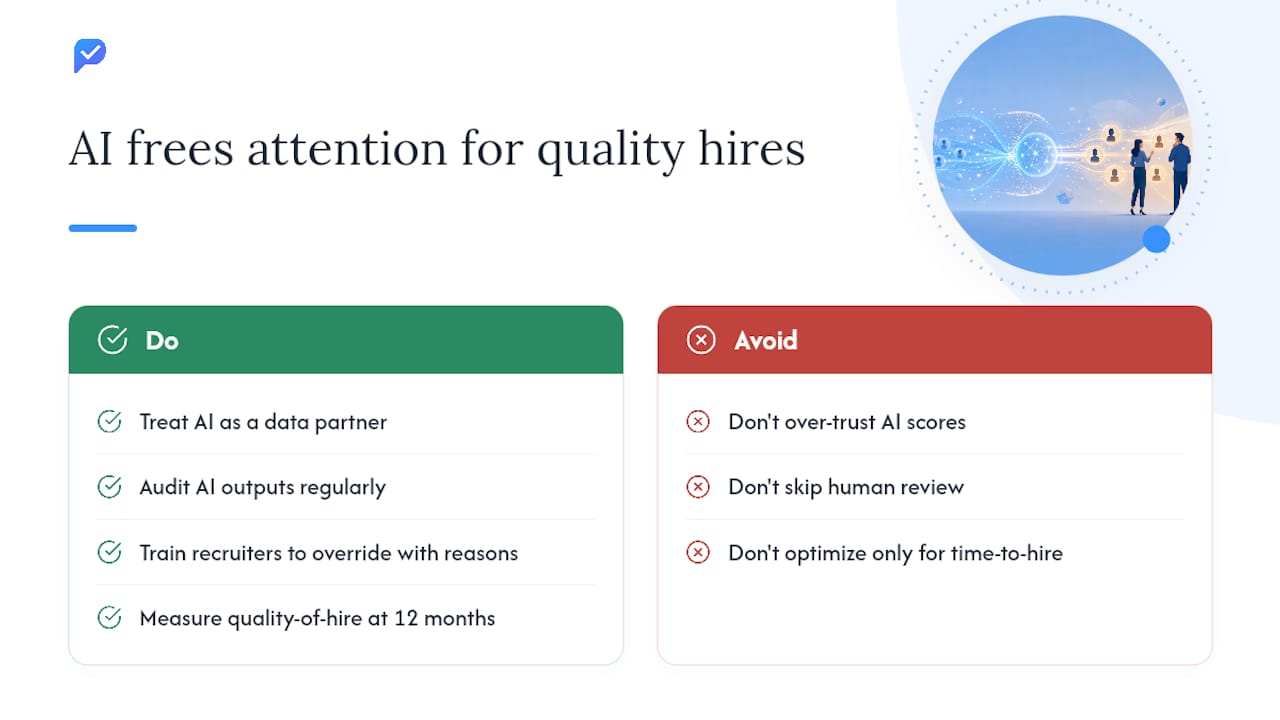
The risk that doesn't get enough attention is the opposite failure mode: over-trusting the AI score and under-investing in the human review layer. Hybrid models outperform fully automated systems not because AI is weak, but because the combination of AI consistency and human judgment catches the errors each makes alone. An AI score that no recruiter ever questions is a governance failure waiting to surface.
The organizations that get the most from AI shortlisting treat it as a data partner, not a decision-maker. They audit the outputs, they train their recruiters to override with documented reasoning, and they measure quality-of-hire at 12 months, not just time-to-hire at day one. That discipline is what separates a successful deployment from a liability.
Evy screens at scale without sacrificing integrity
Most AI screening tools solve the volume problem. Evy solves the integrity problem at the same time. With real-time eye tracking built into every asynchronous interview, Evy catches candidates using AI assistance or external references during assessments, the exact misrepresentation that a pass-rate lift means nothing without. Structured interview flows and automated scoring give your recruiters a ranked shortlist they can trust, and ATS integration means that shortlist lands directly in your existing workflow without manual data entry.
For HR teams running high-volume screening, Evy's pay-per-interview pricing means you pay for what you use, with no seat minimums forcing you to commit before you've validated the ROI. Governance and compliance support, including audit logs, explainability features, and candidate disclosure templates, are built in, not sold as add-ons.
Request a demo at evy.io to see how structured AI interviews with integrity monitoring compare to your current screening process.
Useful sources
The following studies and guidance documents informed this article. Each is worth reading directly if you are building a business case or governance framework for AI shortlisting.
- Better Together: Quantifying the Benefits of AI-Assisted Recruitment
- Generative AI usage, process automation, and recruitment outcomes (Frontiers in Human Dynamics)
- The Evolving Role of AI in Recruitment and Retention (SHRM Labs)
- Collaboration among recruiters and artificial intelligence — PMC
- Gartner: Artificial intelligence in HR