
 By Adrian Pascual•Hiring insight•Published
Why HR Leaders Adopt AI Screening: A Practical Guide
HR leaders adopt AI screening primarily for three reasons: speed at scale, consistent candidate evaluation, and measurable improvements in hire quality. The practical next step is a structured pilot with human oversight, clear success metrics, and documented governance before full deployment.
The three decision triggers that most often move HR leaders from interest to procurement:
- Time-to-hire reduction: AI processes high volumes of applications in hours, not weeks, freeing recruiters for higher-judgment work.
- Consistent scoring: Structured, AI-scored interviews reduce the subjectivity that varies from one interviewer to the next.
- Cheat detection and data auditability: As AI-assisted candidate responses become more common, HR teams need flagging mechanisms and audit logs they can defend to stakeholders.
Table of Contents
- Why HR leaders adopt AI screening: the core benefits
- What concerns HR teams raise — and how to address them
- How to evaluate AI screening tools and run an effective pilot
- Detecting AI-assisted cheating: what the tools can and cannot do
- What implementation timelines and pricing models look like
- Key Takeaways
- A practitioner's view on leading AI screening adoption
- Evy gives HR teams a pilot-ready path to responsible AI screening
- Useful sources for further reading
Why HR leaders adopt AI screening: the core benefits
AI in recruitment delivers measurable operational gains across the hiring funnel. Recruitment as a priority for AI investment is well established: Many companies that have adopted AI for HR identify recruiting as their top use case.
The primary benefits HR leaders consistently report:
- Throughput at scale: AI screens hundreds of candidates simultaneously, 24/7, without proportional increases in recruiter headcount.
- Reduced subjectivity: Structured interview flows and automated scoring apply the same criteria to every candidate, limiting the drift that occurs across multiple human interviewers.
- Deeper resume analysis: AI can surface candidates who lack specific keywords but carry relevant experience, going beyond the keyword scans that miss qualified applicants.
- Candidate experience: Faster screening communications and on-demand interview scheduling reduce candidate drop-off, particularly for passive talent.
- Quality-of-hire gains: Organizations that embrace advanced recruiting technologies often see improvements in quality-of-hire, retention, and time-to-fill compared to laggards.
Statistic: Only 43% of organizations rate their talent-acquisition tech stack as "good" or "excellent." Leaders that invest strategically in AI and analytics consistently outperform laggards on quality-of-hire and time-to-fill.
What concerns HR teams raise — and how to address them
AI-enabled recruitment tools reduce time-to-hire and administrative burden, but they do not automatically guarantee fairness or trust without governance. A research study found significant efficiency gains alongside only modest bias-mitigation improvements and no meaningful increase in perceived trust without additional safeguards.
The concerns HR teams raise most often, and a practical mitigation for each:
- Algorithmic bias: AI trained on historical data can perpetuate past patterns. Mitigation: run periodic demographic pass-rate audits and compare outcomes across protected groups.
- Transparency and explainability: Candidates and regulators expect to understand why a decision was made. Mitigation: require vendors to provide model documentation and explainability features before signing.
- Candidate consent and data privacy: Screening data carries EEOC and state-level privacy obligations. Mitigation: confirm vendor data-retention policies, consent flows, and whether the platform is SOC 2 certified.
- False positives in cheating detection: A flagged candidate is not a confirmed cheater. Mitigation: treat flags as triggers for human review, not automatic disqualification, and maintain a documented appeal path.
- Cultural-fit blind spots: AI scores structured responses well but cannot fully assess interpersonal dynamics. Mitigation: use AI for initial screening and reserve cultural-fit assessment for human-led final rounds.
Pro Tip: Build a lightweight oversight loop from day one: log AI screening decisions, track hiring outcomes for AI-screened cohorts, and review the correlation quarterly. This creates the audit trail you need for EEOC inquiries and gives you real data to defend or adjust the model.
How to evaluate AI screening tools and run an effective pilot

HR teams that lead vendor evaluations — rather than reacting to vendor pitches — align AI features with diversity, speed, and fairness goals from the start. That framing matters: the goal is insight generation as much as filtering.
Vendor evaluation checklist:
- ATS integration compatibility (confirm before negotiating)
- SOC 2 certification and data-handling policy
- Explainability features and model documentation
- Audit logs with exportable records
- Candidate consent flows and appeal process
- SLAs for uptime and support response
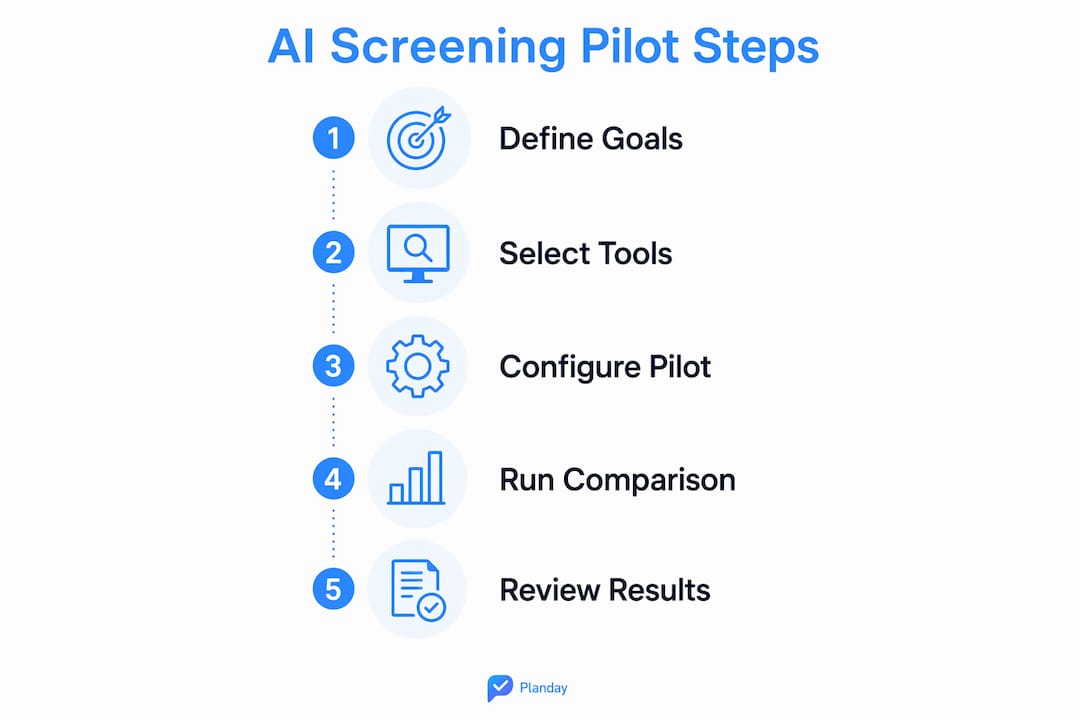
Pilot plan, step by step:
- Define success metrics: time-to-hire, interview-to-offer ratio, quality-of-hire proxies, false-positive rate for cheating flags, and pass rates by demographic group.
- Set a sample size large enough to be directional — typically 50–100 screened candidates per cohort.
- Run a control group screened by your standard human process alongside the AI-screened cohort.
- Assign clear roles: who reviews flagged cases, who owns reporting, and who has authority to pause the pilot.
- Capture data weekly: pass rates, time savings, recruiter feedback, and candidate completion rates.
- At the four-week mark, run a go/no-go review against your predefined thresholds.
Pilots that pair an AI-screened cohort with a control group deliver the cleanest measurement of AI impact on time-to-hire and interview-to-offer ratios. That comparison is what turns a vendor demo into defensible business-case data.
Pro Tip: For technical role screening, add a skill-based evaluation component to the pilot. Structured technical assessments scored by AI give you a second data point beyond interview responses and sharpen your quality-of-hire measurement.
Detecting AI-assisted cheating: what the tools can and cannot do
Cheating-detection features surface suspicious behaviors, but they do not provide definitive proof. They flag cases for human review. That distinction matters operationally and legally.
| Detection signal | Typical reliability | Common false-positive causes |
|---|---|---|
| Eye-tracking anomalies | Moderate to high | Dual monitors, accessibility needs, lighting |
| Audio/text mismatch | Moderate | Accents, background noise, speech patterns |
| Improbable response latency | Moderate | Slow internet, cognitive processing differences |
| Transcript pattern analysis | Moderate | Rehearsed answers, coaching |
The operational workflow should follow this sequence: AI flags a candidate, the flag enters a human review queue, a recruiter or hiring manager reviews the evidence, the candidate receives an opportunity to respond if the flag is sustained, and the decision is logged with supporting documentation.
Pro Tip: Start with a conservative flagging threshold during your pilot. A threshold that flags too many candidates creates reviewer fatigue and erodes trust in the system. Tighten sensitivity gradually as you calibrate against your actual candidate population.
What implementation timelines and pricing models look like
A typical rollout runs 4–12 weeks from pilot configuration to full production, depending on ATS integration complexity and compliance review requirements.
Common pricing models:
- Pay-per-interview: Usage-based, no seat commitment. Best for variable hiring volume or initial pilots.
- Subscription seats: Monthly or annual plans with volume discounts. Better for teams screening at consistent scale.
- Enterprise agreements: Custom pricing with dedicated support, advanced integrations, and SLA guarantees.
| Phase | Typical duration |
|---|---|
| Discovery and vendor selection | 1–2 weeks |
| Pilot configuration and ATS integration | 1–3 weeks |
| Pilot execution | 3–4 weeks |
| Evaluation and go/no-go decision | 1 week |
| Full rollout and change management | 2–4 weeks |
Budget items HR should request upfront: integration engineering time, vendor onboarding support, recruiter training, and change-management communication for hiring managers. Underestimating the last two is the most common reason pilots stall before full deployment.
Key Takeaways
HR leaders who adopt AI screening with clear metrics, human oversight, and a structured pilot consistently outperform those who deploy without governance.
| Point | Details |
|---|---|
| Speed and scale drive adoption | AI screens hundreds of candidates simultaneously, reducing time-to-hire without proportional recruiter cost. |
| Governance is non-optional | Bias audits, SOC 2 attestation, and human review of flagged cases are required for defensible, compliant screening. |
| Pilot before full deployment | Run a 50–100 candidate pilot with a control group to generate real business-case data before scaling. |
| Cheating flags need human review | Detection signals indicate suspicious behavior; they do not confirm cheating. Always pair flags with a documented appeal path. |
| Evy for responsible screening | Evy combines real-time eye tracking, structured interview flows, audit logs, and pay-per-interview pricing for pilot-ready deployment. |
A practitioner's view on leading AI screening adoption
The clearest outcome from teams that have led AI screening adoption is this: reduced time-to-hire and sharper shortlists. But the path to those outcomes required deliberate choices that most vendor pitches skip over.
Three lessons stand out. First, involve legal and data privacy before you select a vendor, not after. The questions they raise about data retention, consent language, and EEOC defensibility will shape your vendor requirements in ways that save significant rework later. Second, communicate transparently with candidates. Telling applicants that AI is part of the screening process, what it evaluates, and how they can raise concerns reduces friction and builds the kind of trust that protects your employer brand. Third, require human sign-off on every flagged case. No AI flag should result in a disqualification without a human reviewer confirming the decision and logging the rationale.
The cultural change piece is often underestimated. Hiring managers who feel that AI is replacing their judgment will resist the process. Frame AI screening as a tool that handles volume and consistency so they can focus on the decisions that actually require human judgment. That framing tends to shift resistance into genuine adoption.
Evy gives HR teams a pilot-ready path to responsible AI screening
Screening at volume without sacrificing integrity is the core problem Evy is built to solve. Unlike platforms that treat cheating detection as an afterthought, Evy's real-time eye tracking monitors attention patterns throughout the interview, flagging anomalies for human review rather than making automated disqualification decisions.
Evy's structured interview flows apply consistent criteria to every candidate, reducing the subjectivity that skews shortlists. ATS integrations, audit logs, and candidate consent flows are built in, so your compliance checklist is covered from day one. Pricing is pay-per-interview for pilots, with seat plans available as volume grows. Before you reach out, prepare three things: your estimated monthly screening volume, your ATS platform name, and the two or three metrics you want to move in the first 60 days.
Start your pilot with Evy and get honest, qualified candidates surfaced at scale.
Useful sources for further reading
- Eightfold / HR.com — Future of Recruitment Technologies 2025–26: Covers AI adoption rates across recruiting tasks, the leader/laggard performance gap, and quality-of-hire benchmarks. Use this for pilot-metrics templates and adoption context. Read the report
- IBM — AI in Recruiting: Explains AI use cases across sourcing, resume screening, chatbots, and structured interviews. Useful for understanding automation scope and candidate-experience expectations. Read the guide
- F1000Research — Transformations in Talent Acquisition: Empirical study measuring efficiency gains, bias-mitigation limits, and the case for hybrid human-machine decision models. Essential reading before any governance conversation. Read the study
- Indeed — Benefits of AI in Recruitment: Practical overview of how AI performs deeper resume analysis beyond keyword matching. Useful for explaining sourcing improvements to skeptical stakeholders. Read the article
- Paycor — AI Recruiting Guide for HR Leaders: Covers proactive evaluation frameworks, diversity and fairness alignment, and the SHRM data on recruiting as the top AI use case in HR. Read the guide
- Springer Nature — Systematic Review of AI in Recruitment and Personnel Selection: Academic review covering machine learning, NLP, and ethical challenges across candidate pre-selection, interview analysis, and soft-skills assessment. Read the review
- Springer Nature — Role of AI in Employee Recruitment: Systematic review of 49 peer-reviewed articles covering efficiency gains, algorithmic bias risks, and legal framework recommendations. Read the review
- Evy — AI Screening Improves Hire Quality: Internal guidance on adopting and integrating AI-based screening tools, with pilot design considerations. Read the guide
- Powitup — AI in Employee Onboarding: Partner resource on AI's role across the employee lifecycle, relevant for teams thinking beyond screening to downstream integration. Read the article