
 By Adrian Pascual•Hiring insight•Published
Async Interview Platform Benefits for Recruiters in 2026
Asynchronous interview platforms let candidates record video responses to preset questions on their own schedule, and the efficiency gains for hiring teams are concrete. Research shows that async interviews reduce scheduling overhead by up to 80%, compressing early-stage screening from several days to under 24 hours. For recruiters managing high-volume pipelines, that kind of time compression changes what's operationally possible.
The core async interview platform benefits that hiring professionals report most consistently include:
- Time savings: Recruiters review recorded responses on their own schedule, eliminating the back-and-forth of live interview coordination.
- Flexibility for candidates: Applicants complete interviews from any location, at any hour, without taking time off or traveling.
- Standardized questions: Every candidate answers the same prompts in the same order, creating a consistent basis for comparison and reducing unconscious bias.
- Improved candidate experience: Reduced pressure, no commute, and the option to re-record answers lead to lower dropout rates and better-quality responses.
- Expanded talent pool: Cross-timezone and global candidate reach becomes practical without logistical overhead.
- Collaborative review: Hiring committees can watch recordings independently and share evaluations asynchronously, distributing the decision-making load.
- Cost reduction: Fewer live scheduling hours and eliminated travel expenses lower the per-hire cost at scale.
Which asynchronous interview platforms are worth considering in the U.S. market?

Six platforms dominate the conversation among U.S. hiring teams in 2026. Pricing and feature sets vary widely across pay-per-use, subscription, and tiered models, so the right fit depends heavily on hiring volume, technical infrastructure, and candidate experience priorities.
| Platform | Key Features | Pricing | Pros | Cons | Best For |
|---|---|---|---|---|---|
| Willo | Re-record options, mobile-friendly, global reach, candidate-paced scheduling | Tiered subscription; free plan available | Easy candidate experience, strong flexibility | Limited AI analytics | Flexible, candidate-centric hiring |
| HireVue | AI-powered scoring, compliance tools, ATS integration, structured evaluation | Enterprise pricing; not publicly listed | Deep analytics, compliance-ready | Higher cost, steeper setup | Large enterprises needing AI insights |
| Hireflix | Simple video questions, fast setup, straightforward interface | Flat monthly pricing; publicly listed tiers | Minimal learning curve, quick deployment | Fewer advanced features | SMBs wanting fast implementation |
| Harver | Pre-employment assessments, async video, skills matching, customizable scoring | Custom pricing | End-to-end screening with assessments | Complex setup for smaller teams | Volume hiring with skill-fit evaluation |
| Avature | CRM integration, configurable workflows, talent relationship tools, async video | Custom enterprise pricing | Highly configurable, strong CRM | Requires significant configuration time | Custom workflows and talent engagement |
| Clovers | ATS integrations, engagement features, structured interview guides, analytics | Tiered pricing; contact for details | Strong data flow, engagement-focused | Newer platform, smaller user base | Recruiters prioritizing ATS integration |
Willo suits organizations that prioritize a low-friction candidate experience. Its re-record functionality and mobile accessibility make it particularly effective for reaching candidates who may be interviewing outside standard business hours or from locations with limited resources.
HireVue is the most established name in AI-powered async interviewing. Its compliance features and structured evaluation tools appeal to enterprise HR teams that need defensible, auditable hiring decisions. The tradeoff is cost and implementation complexity.
Hireflix takes the opposite approach: minimal features, fast setup, and transparent pricing. For a small or mid-sized team that needs async screening running within a day or two, it's hard to beat on simplicity.
Harver goes beyond video by combining async interviews with pre-employment assessments, making it the strongest option for volume hiring roles where skill fit matters as much as communication. Retail, logistics, and customer service organizations use it to screen at scale without sacrificing evaluation depth.
Avature is less a pure async interview tool and more a full talent relationship management platform that includes async video as one capability. Teams that need configurable workflows, CRM-style candidate engagement, and deep integration with existing HR systems will find it worth the setup investment.
Clovers focuses on structured interview consistency and ATS data flow. Its engagement features help recruiters maintain candidate interest through the async process, and its integration depth makes it a practical choice for teams already invested in a specific ATS ecosystem.
How to choose the right async interview platform for your team
Selecting a platform requires more than comparing feature lists. The decision touches candidate experience, legal compliance, and how well the tool fits into your existing HR infrastructure.
- Ease of use for both sides: A platform that confuses candidates creates dropout before the interview even starts. Mobile accessibility and cross-device support directly affect participation rates, so test the candidate-facing interface before committing.
- ATS and HRIS integration: Disconnected tools create manual data entry and compliance gaps, so consider platforms that provide modern recruitment and ATS integration workflows for seamless hiring management. Integration with existing HR systems is a critical selection criterion, not an optional add-on.
- Data privacy and compliance: Platforms handling candidate video data must comply with CCPA in California and, for any cross-border hiring, GDPR. Confirm where data is stored, how long it's retained, and whether the vendor holds relevant security certifications.
- Customization depth: The ability to tailor question formats, time limits, and response types to specific roles determines whether the platform can serve your full range of hiring needs or only a narrow slice.
- Re-record options: Giving candidates the ability to re-record answers reduces stress and improves response quality. This feature signals a candidate-friendly process and affects how applicants perceive your organization.
- Cost relative to hiring volume: A flat monthly fee makes sense for teams with consistent hiring activity. Pay-per-use models suit organizations with seasonal or project-based spikes. Calculate the per-interview cost at your expected volume before signing.
- Vendor support and onboarding: Platforms with poor documentation or slow support create friction during rollout. Ask specifically about implementation timelines, training resources, and ongoing technical support before purchasing.
Pro Tip: Run a pilot with a small cohort of real candidates before full deployment. Candidate feedback on the interface often surfaces usability issues that internal testing misses.
What are the real pros and cons of async interviews in your hiring workflow?
Async interviews solve real problems, but they also introduce trade-offs that hiring teams need to plan around rather than ignore.
Pros:
- Efficient pre-screening at scale: Reviewing recorded responses is faster than scheduling and conducting live phone screens. Recruiters can assess more candidates in less time, which matters most in high-volume roles.
- Consistent question delivery: Every candidate receives identical prompts, which creates equity and reduces the variability that leads to biased comparisons.
- Candidate convenience: Applicants complete interviews without travel, without taking time off, and without coordinating schedules across time zones.
- Collaborative decision-making: Hiring committees can review recordings independently and share structured feedback, distributing evaluation across the team rather than concentrating it in one person.
- Scalability: Async platforms let organizations run 30+ interview events per month without the logistical ceiling that in-person formats impose, as Microsoft's talent team demonstrated when they doubled their engineering interview event volume after moving to virtual formats.
Cons:
- Reduced live interaction: Candidates cannot ask questions in real time or read the interviewer's reactions. Research confirms that job applicants show more favorable attitudes toward synchronous formats than asynchronous ones, partly because synchronous interviews can build trust comparable to face-to-face communication.
- Technology access barriers: Candidates without reliable internet, a webcam, or familiarity with video software face a structural disadvantage that has nothing to do with their qualifications.
- Perception of impersonality: Over-reliance on automation without warmth can signal to candidates that the organization values cost-efficiency over genuine human connection, which affects organizational attractiveness.
- Not suited for all roles: Senior, client-facing, and interpersonal roles benefit from live interaction that async formats cannot replicate.
- Candidate discomfort with the format: Some applicants find async interviewing unfamiliar or uncomfortable, which can suppress performance and skew evaluations.
The most effective approach pairs async screening with at least one live stage later in the process. Best practices recommend hybrid interview processes to capture the efficiency of async screening while preserving the relational depth that live interaction provides.
When does an async interview actually make sense?
Not every role or hiring stage benefits equally from async formats. Knowing where they fit prevents misapplication and candidate frustration.
- Early-stage screening for high-volume roles: Async interviews are most valuable when you need to assess a large candidate pool quickly. Retail, logistics, customer service, and entry-level tech roles are natural fits.
- Remote and distributed hiring: When candidates are spread across time zones or geographies, async formats remove the scheduling complexity that makes cross-timezone interviewing impractical at scale.
- Reducing scheduling conflicts: Async interviews eliminate the back-and-forth of finding a mutually available time, which is particularly valuable when hiring managers have limited availability or when candidates are currently employed.
- Assessing communication and presentation skills: Roles where written or verbal communication is central, such as sales, marketing, or customer support, lend themselves to async video because the format directly tests the relevant skill.
- Passive candidate outreach: Candidates who are currently employed and cautious about visibility can complete an async interview discreetly, without requesting time off or risking exposure at their current workplace.
- Supplementing, not replacing, later stages: Async screening works best as a first filter. For mid-level and senior roles, it should feed into a live interview rather than serve as the sole evaluation method.
- Less suited for senior or client-facing roles: As SHRM's research notes, roles requiring strong social skills or skills demonstrations benefit from in-person engagement that async formats cannot fully replicate. Starting virtually and moving to in-person for final rounds is the standard approach for these positions.
A useful frame: if the primary question at a given hiring stage is "does this candidate meet the baseline criteria," async works well. If the question is "how does this person show up in a room," it does not.
Expert insights on making async interviews fairer and more engaging
The efficiency case for async interviews is well established. The harder challenge is maintaining candidate engagement and organizational attractiveness when the format removes human interaction from the equation.

Research on technology-mediated interviews finds that framing async interviews as modern, efficient, and fair, with clear explanations of their purpose and validity, significantly increases candidate willingness to participate. Candidates who understand why the format is being used and what it measures respond more positively than those who receive no context. Communications should highlight practical benefits such as time efficiency and the ability to tailor questions to the role.
Pairing that framing with warmth matters just as much. Research warns that an exclusive focus on functionality can lead to perceptions of inhumanity. Organizations that pair efficiency messaging with content conveying warmth, such as information about corporate social responsibility initiatives or team culture, see better outcomes on both organizational attractiveness and candidate satisfaction.
Specific features that improve the candidate experience in practice:
- Re-record options: Giving candidates the ability to redo an answer reduces stress and tends to produce better-quality responses. Many candidates take advantage of this option when it's available, and the platform's willingness to offer it signals respect for the candidate's effort.
- Clear instructions and time expectations: Candidates who know exactly what to expect, how long each question allows, and what the next step looks like feel more in control of the process.
- Personal touchpoints before and after: A brief personalized message from a recruiter before the async interview and a prompt follow-up afterward can offset the impersonal quality of the format.
- Culture content within the platform: Embedding a short video about the team or company values inside the interview experience gives candidates something to connect with beyond the questions themselves.
The candidate experience during screening shapes how applicants perceive the organization long before they receive an offer. Async platforms that treat this seriously, rather than treating the interview as a purely functional data-collection exercise, consistently produce better candidate engagement and lower dropout rates.
One dimension that deserves more attention in 2026 is interview integrity. As AI writing and coaching tools become more accessible, candidates can generate polished responses that may not reflect their actual capabilities. Platforms that rely solely on transcript analysis or response quality scoring are increasingly exposed to this risk. Behavioral signals, including attention patterns and eye movement during recording, offer a more reliable signal of authentic engagement than content alone.
Evy offers a different layer of assurance for async hiring
The platforms compared above handle scheduling, video delivery, and ATS integration well. What most of them cannot address is whether the candidate you're evaluating is actually the one answering the questions.
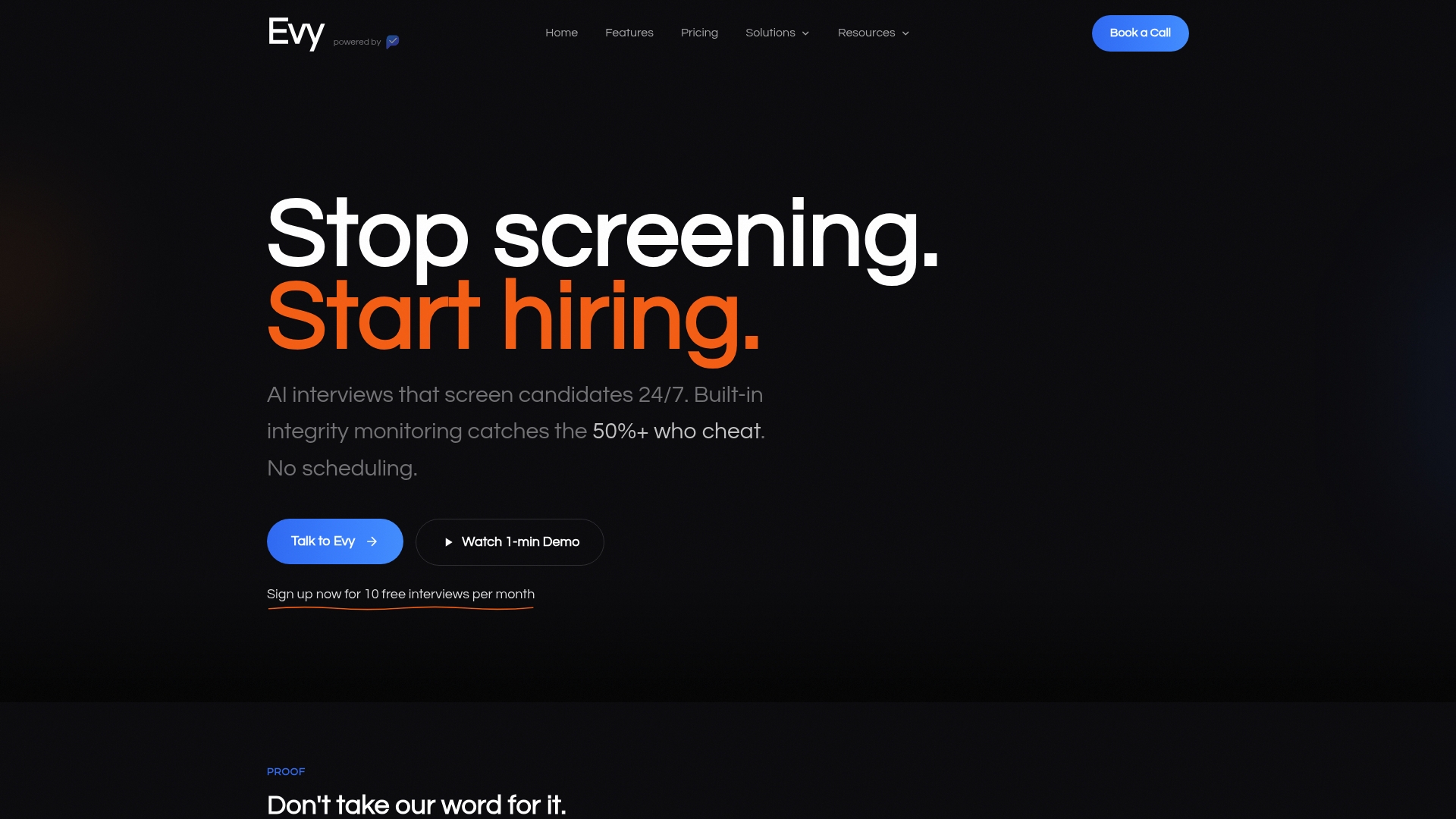
Evy is built specifically around that problem. As the only AI interview platform with real-time eye tracking, Evy detects when candidates are reading from AI-generated scripts or receiving outside assistance during recording. Where other platforms measure what candidates say, Evy monitors how they engage, flagging attention patterns that differ from natural, unassisted thinking. For hiring teams that have invested in async screening and need confidence that the responses they're reviewing are genuine, Evy adds a layer of verification that transcript scoring alone cannot provide.
If you're running async interviews at scale and finding that polished responses don't always translate to strong hires, Evy for HR teams is worth a closer look. It screens 24/7, surfaces honest candidates, and integrates into the workflows you already use.
Key Takeaways
Async interview platforms reduce early-stage screening time by up to 80%, compressing screening from several days to under 24 hours, as confirmed by published research. | Bias reduction | Standardized questions give every candidate identical prompts, removing a key source of evaluator inconsistency. | | Hybrid process design | Best practices recommend pairing async screening with at least one live stage for fairness and decision quality. | | Platform selection criteria | ATS integration, data privacy compliance, and candidate-facing ease of use are the three factors that most affect adoption success. | | Evy's integrity layer | Evy adds real-time eye tracking to async interviews, detecting AI-assisted responses that transcript analysis alone misses. |