
 By Adrian Pascual•Hiring insight•Published
The Role of Structured Questions in Interviews
Structured interview questions are defined as a standardized set of job-relevant questions asked in the same order to every candidate, scored against predetermined criteria. The role of structured questions in interviews is to replace subjective judgment with documented, comparable evidence. Organizations like Google and the U.S. Office of Personnel Management have adopted this method precisely because research confirms it works. Structured interviews score predictive validity between 0.42 and 0.51, compared to roughly 0.38 for unstructured formats. That gap translates directly into better hires and fewer costly mistakes.
What is the role of structured questions in interviews?
Structured questions serve one primary function: they give every candidate the same fair opportunity to demonstrate competence against the same standard. Without that uniformity, interviewers end up comparing apples to oranges. One candidate gets asked about conflict resolution; another gets asked about their hobbies. The resulting data is nearly impossible to compare objectively.
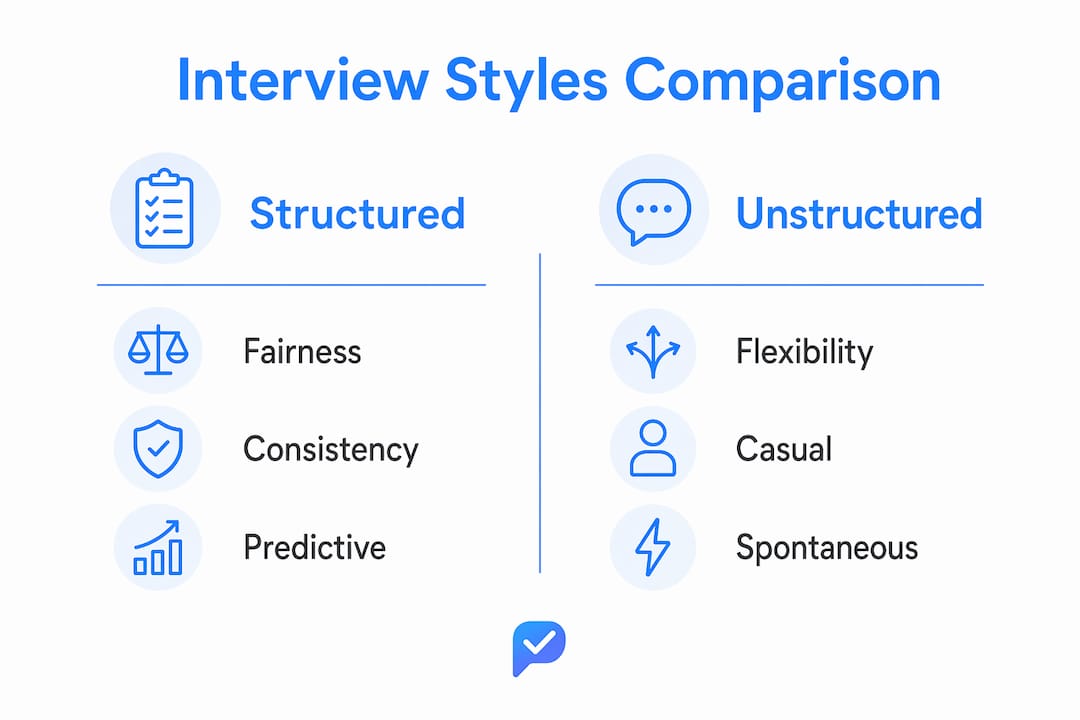
The industry term for this practice is the structured interview, sometimes called a standardized interview. It differs from the informal, conversational approach most hiring managers default to when they have not been trained otherwise. Using standardized questions and scoring rubrics grounds hiring decisions in documented evidence rather than subjective impressions. That shift matters enormously when you are defending a hiring decision to a compliance team or a disappointed internal candidate.

Google, one of the most studied hiring organizations in the world, built its entire people operations framework around this principle. The U.S. Office of Personnel Management mandates structured techniques for federal hiring to meet legal defensibility requirements. These are not small experiments. They are large-scale validations of a method that consistently outperforms the alternative.
How are structured interview questions designed and scored?
Effective question design starts with a job analysis. You identify the core competencies the role requires, then build every question to assess one of those competencies directly. A question that does not map to a defined competency does not belong in the interview.
Two question types dominate structured interviews:
- Behavioral questions ask candidates to describe past experiences. The classic format is "Tell me about a time when you had to manage a competing deadline." Past behavior is one of the strongest predictors of future performance because it requires candidates to draw on real situations rather than hypothetical ideals.
- Hypothetical questions present a job-relevant scenario and ask how the candidate would respond. For example: "If a key client escalated a complaint during a product launch, how would you handle it?" These are useful when candidates lack direct experience in a specific area.
Behavioral questions focus on past experiences, while hypothetical questions test reasoning and judgment in simulated conditions. Both types belong in a well-designed question set, and both require a scoring rubric to be useful.
Scoring rubrics, specifically behaviorally anchored rating scales (BARS), define what a poor, borderline, solid, or outstanding answer looks like for each question. BARS with clear answer definitions improve consistency across interviewers because they remove ambiguity from the evaluation. Without them, two interviewers can hear the same answer and score it differently based on personal bias.
Each interviewer scores independently before any group discussion. This sequencing is not optional. Discussing scores before independent recording allows dominant voices in the room to anchor everyone else's judgment.
Pro Tip: Limit your question set to 8–12 well-designed questions. Approximately 8 to 12 questions represent the optimal balance between signal quality and interviewer fatigue. More questions rarely add predictive value and often reduce the quality of scoring.
What benefits do structured interview questions deliver compared to unstructured interviews?
The evidence for structured interviews over unstructured ones is not subtle. The predictive validity difference is measurable, the bias reduction is documented, and the efficiency gains are concrete.
"The unstructured 'let's just chat' method heavily relies on subjective impressions, often causing hiring decisions to hinge on initial moments rather than sustained competence evaluation." — Structured Interviews: How to Run Them and Why They Work
Unstructured interviews often rely on first impressions formed within the first three minutes of a conversation. The halo effect then takes over, where a strong opening colors every subsequent answer. Structured scoring eliminates that distortion by anchoring evaluation to specific, pre-defined criteria.
Structured interviews improve fairness and transparency for candidates, which also supports diversity, equity, and inclusion goals. When every candidate answers the same questions and is scored on the same scale, the process becomes defensible and auditable. That matters for compliance, and it matters for building a workforce that reflects genuine merit.
| Dimension | Structured interviews | Unstructured interviews |
|---|---|---|
| Predictive validity | 0.42–0.51 | ~0.38 |
| Bias exposure | Low (standardized scoring) | High (gut-feel, halo effect) |
| Candidate comparability | Direct, documented | Difficult, subjective |
| Legal defensibility | Strong | Weak |
| Time per interview | Reduced (Google saves ~40 min) | Variable, often longer |
Google saves approximately 40 minutes per interview by using pre-made questions and rubrics, while achieving equal or better predictive validity than multiple unstructured sessions. That efficiency gain compounds across hundreds of hires per year. For a mid-size company running 500 interviews annually, that is over 300 hours of interviewer time recovered.
How to conduct structured interviews effectively
Implementation requires more than writing a list of questions. The process has distinct stages, and skipping any one of them undermines the whole system.
- Define competencies. Start with a job analysis. Identify 4–6 core competencies the role demands, such as communication, problem-solving, or stakeholder management. Every question you write must trace back to one of these. Use your interview preparation checklist to map competencies before drafting questions.
- Build your question set. Write 2–3 questions per competency. Mix behavioral and hypothetical formats. Review each question to confirm it is job-relevant and free of legally problematic content.
- Develop scoring rubrics. For each question, define what a 1, 3, and 5 score looks like in concrete behavioral terms. Vague rubrics produce inconsistent scores. Specific rubrics produce reliable data.
- Train your interviewers. Interviewer training and calibration are non-negotiable steps. Interviewers who have not practiced using BARS will default to their own internal standards, which defeats the purpose.
- Run calibration sessions. Before the hiring cycle begins, have interviewers score the same sample answer independently, then compare results. Significant scoring gaps reveal calibration problems you can correct before they affect real candidates.
- Maintain question order. Ask every candidate the same questions in the same sequence. Deviating from the order introduces variability that compromises comparability.
To implement structured interviews effectively, you define job-relevant competencies, use the same core questions in the same order, and score answers independently before any group discussion. That sequence is the backbone of the method.
Pro Tip: Build in flexibility for follow-up probes. Structured does not mean robotic. You can ask a candidate to clarify or expand on an answer without departing from the question set. The key is that the core questions and scoring criteria stay fixed.
Examples of structured interview questions and scoring approaches
Concrete examples make the abstract practical. Below are sample questions mapped to common competencies, along with a simplified BARS illustration.
Competency: Communication Behavioral question: "Describe a situation where you had to explain a complex issue to a non-technical audience. What approach did you take, and what was the outcome?"
Competency: Problem-solving Hypothetical question: "Imagine you discover a critical error in a report one hour before it goes to senior leadership. Walk me through how you would handle it."
Competency: Collaboration Behavioral question: "Tell me about a time when you disagreed with a team member's approach. How did you resolve it?"
For technical roles, question design requires additional precision. Reviewing types of questions for technical roles helps you build competency-mapped sets that go beyond generic problem-solving prompts.
Sample BARS for the communication question
| Score | Definition |
|---|---|
| 1 (Poor) | Candidate describes no specific situation or relies entirely on generalities. |
| 3 (Solid) | Candidate describes a real situation with a clear method and a measurable outcome. |
| 5 (Outstanding) | Candidate demonstrates audience analysis, adapts communication style, and quantifies impact. |
Detailed note-taking during each answer supports accurate scoring after the interview. Notes should capture specific phrases, examples, and observable behaviors, not overall impressions. When multiple interviewers compare notes, specific observations produce more reliable consensus than general feelings about a candidate.
- Record direct quotes where possible.
- Note what the candidate did, not just what they said they would do.
- Flag any answers that require a follow-up probe for clarification.
Key takeaways
Structured interview questions are the single most reliable method for making hiring decisions based on evidence rather than impression.
| Point | Details |
|---|---|
| Predictive validity advantage | Structured interviews score 0.42–0.51 validity, outperforming unstructured methods at ~0.38. |
| Bias reduction | Standardized scoring eliminates halo effects and gut-feel decisions that distort unstructured interviews. |
| Efficiency gains | Google saves ~40 minutes per interview using pre-made questions and rubrics without sacrificing quality. |
| Implementation sequence | Define competencies, build question sets, develop BARS, train interviewers, and calibrate before hiring begins. |
| Documentation value | Detailed scoring records support legal defensibility and DEI compliance across the hiring process. |
Why I think most hiring teams underestimate the scoring step
After working with hiring teams across industries, the pattern I see most often is this: organizations invest real effort in writing good questions, then treat the scoring rubric as an afterthought. They write "1 to 5" on a sheet and assume interviewers will figure out the rest. They do not.
The scoring step is where structured interviews either deliver on their promise or quietly fail. Two interviewers can hear the same answer and, without a shared definition of what a "4" looks like, score it a 2 and a 5 respectively. That gap does not reflect candidate performance. It reflects rubric failure.
What I have found actually works is spending as much time on rubric design as on question design. Write out the anchor behaviors for at least three score levels per question. Then run a calibration session before the first real interview. The calibration session is not bureaucratic overhead. It is the moment when your team builds a shared language for evaluation.
The other thing hiring managers frequently overlook is the debrief sequence. Scores should be recorded independently and submitted before anyone speaks. The moment one interviewer shares their score out loud, anchoring bias sets in and the remaining scores shift toward that number. Protect the independence of each score, and your aggregate data becomes genuinely useful.
Structured questions also create a fairer experience for candidates. When every person in the pool answers the same questions and is measured against the same standard, the process signals that the organization takes fairness seriously. That perception matters for employer brand, especially among candidates who have experienced biased processes elsewhere.
— Hudson
How Evy supports structured interview implementation
Structured interview techniques require consistency at every stage, from question delivery to scoring. Evy's AI interview platform is built to support exactly that. Evy delivers structured question sets to candidates at scale, 24/7, while its real-time eye tracking detects when candidates are using AI assistance to answer questions. That means your scoring data reflects genuine candidate competence, not coached or AI-generated responses. Explore Evy's interview features to see how consistent scoring, bias reduction, and honest candidate evaluation work together in a single platform. For teams scaling hiring without scaling interviewer hours, Evy provides the infrastructure to do it fairly.
FAQ
What is the role of structured questions in interviews?
Structured questions provide a uniform, job-relevant assessment framework that allows every candidate to be evaluated against the same criteria. This produces comparable, documented data that supports fair and defensible hiring decisions.
How do structured and unstructured interviews differ?
Structured interviews use predetermined questions, fixed order, and standardized scoring rubrics. Unstructured interviews rely on open conversation and subjective judgment, which introduces bias through first impressions and the halo effect.
What types of questions work best in structured interviews?
Behavioral questions and hypothetical questions are the two primary formats. Behavioral questions draw on past experience; hypothetical questions test reasoning in job-relevant scenarios. Both require scoring rubrics to produce reliable evaluations.
How many questions should a structured interview include?
Research supports 8 to 12 well-designed questions as the optimal range. Fewer questions reduce coverage of key competencies; more questions increase interviewer fatigue and reduce scoring quality.
How do structured interviews support diversity and inclusion goals?
Structured interviews bring transparency and fairness to hiring by applying the same standard to every candidate. That consistency reduces the influence of unconscious bias and supports compliance with diversity, equity, and inclusion requirements.