
 By Adrian Pascual•Hiring insight•Published
The Role of AI in Talent Acquisition: 2026 Guide
AI in talent acquisition is defined as the application of machine learning, natural language processing, and predictive analytics to automate and improve how organizations find, evaluate, and hire candidates. The role of AI in talent acquisition has moved well beyond resume parsing. Today, platforms built on AI handle candidate screening, interview scheduling, communication, and even early-stage assessment at a scale no human team can match. Deloitte's 2026 analysis describes this shift as intentional AI design embedded directly into talent acquisition operating models, not bolted on as an afterthought. For HR professionals and talent acquisition specialists, understanding how these systems work, where they create risk, and how to govern them is now a core competency.
What are the key AI technologies used in talent acquisition?
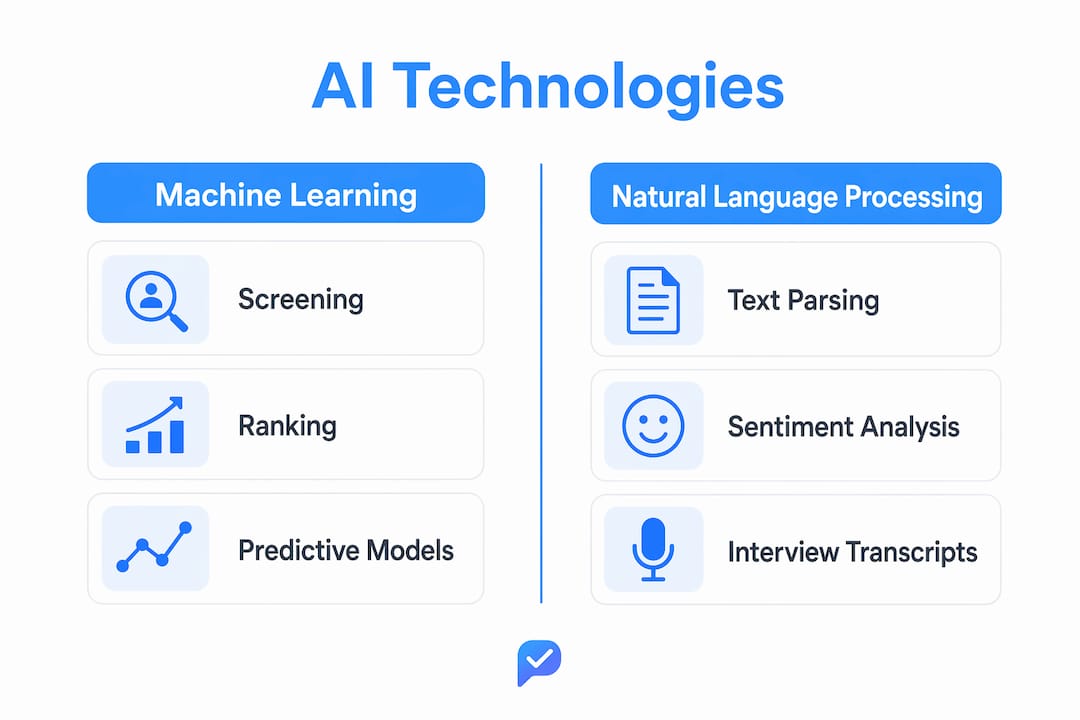
Machine learning and NLP are the two dominant AI techniques applied across talent acquisition today. They power everything from resume classification to candidate ranking and interview analysis. Understanding how each method works helps you evaluate vendor claims and design workflows that actually hold up.
Machine learning for screening and ranking

Supervised machine learning trains on historical hiring data to predict which candidates are most likely to succeed in a role. The model learns patterns from past hires and applies them to new applicants, ranking resumes without a recruiter reading each one. Unsupervised ML clusters candidates by skill profile, surfacing talent that might not match a job description keyword-for-keyword but shares traits with high performers. Both approaches reduce the time recruiters spend on initial screening.
Natural language processing for unstructured data
NLP converts unstructured text, such as cover letters, LinkedIn profiles, and interview transcripts, into structured data a model can evaluate. It identifies skills, experience signals, and even sentiment in candidate responses. Chatbots powered by NLP handle candidate questions, collect application data, and schedule interviews around the clock. This is where AI creates the most visible improvement in candidate experience, because responses are immediate and consistent.
Predictive modeling and neural networks
Classification models and neural networks go further, predicting job suitability scores based on combinations of factors no human reviewer would weigh consistently. These models assess patterns across hundreds of variables simultaneously. The risk is that they can also encode historical bias if the training data reflects past discriminatory hiring. That is why model validation is not optional.
Pro Tip: When evaluating AI screening tools, ask vendors for adverse impact testing results on their models before you sign a contract. A model that performs well on accuracy metrics can still produce discriminatory outcomes across demographic groups.
How does AI change the recruiter's role and improve candidate experience?
The recruiter's role is shifting from administrative coordinator to strategic decision orchestrator. Korn Ferry's 2026 analysis describes this as a Human + AI future where AI handles processing tasks and humans focus on judgment, relationship-building, and cultural assessment. This is not a reduction in the recruiter's importance. It is a redefinition of where their expertise creates the most value.
Here is how that shift plays out in practice:
- Recruiters review AI outputs, not raw applications. Instead of reading 300 resumes, a recruiter reviews a ranked shortlist with AI-generated summaries. They spend their time evaluating the top candidates rather than filtering out unqualified ones.
- AI handles scheduling and communication. Automated systems send interview invitations, collect availability, and send reminders. Recruiters reclaim hours previously lost to calendar coordination.
- Human judgment covers what AI cannot. Cultural fit, leadership potential, and contextual intelligence require a human conversation. AI flags candidates worth that conversation. It does not replace it.
- Candidate experience improves through consistency. AI-driven communication means every applicant receives timely updates. Candidates who are not selected still get a response, which protects employer brand.
- Recruiters use data dashboards to spot funnel problems. AI surfaces drop-off rates, time-to-stage metrics, and offer acceptance patterns. Recruiters can identify where the process is losing good candidates and fix it.
The concern worth naming here is that candidates can feel processed rather than seen when AI handles too much of the interaction. Human touchpoints at key moments, particularly after assessment stages, preserve the sense that a real person is paying attention. That balance is what separates a good AI-assisted process from one that damages candidate trust.
Pro Tip: Map your candidate journey and identify the three moments where a human interaction matters most. Protect those touchpoints even as you automate everything around them.
What are the ethical, fairness, and governance considerations in AI hiring?
Ethical governance is the most consequential challenge in artificial intelligence hiring. AI systems can reduce bias, but they can also encode and scale it. The difference depends entirely on how the system is designed, validated, and monitored.
Bias reduction and fairness metrics
Responsible AI frameworks like ML-BAMS improve fairness metrics by over 20% while maintaining predictive accuracy. That result comes from integrating human oversight into the model's decision loop, not from removing humans entirely. Demographic parity, equal opportunity, and calibration are the three fairness metrics HR teams should require vendors to report. A model that passes accuracy benchmarks but fails demographic parity is not ready for production use.
Regulatory requirements
The EU AI Act Article 26 requires human oversight and meaningful explanations for any AI decision that affects a job applicant. Organizations using AI for candidate shortlisting or scoring must be able to explain why a candidate was ranked or excluded. Candidates must be notified that AI is involved in their assessment. These are not optional disclosures. They are legal obligations for organizations operating in or hiring from EU markets.
Governance framework comparison
| Governance element | Minimum requirement | Best practice |
|---|---|---|
| Bias testing | Pre-deployment adverse impact test | Continuous monitoring with quarterly reviews |
| Human oversight | Recruiter review of final shortlist | Override authority at every AI decision point |
| Candidate transparency | Disclosure that AI is used | Explanation of how AI influenced the outcome |
| Audit cycle | Annual third-party audit | Ongoing funnel instrumentation plus annual audit |
| Documentation | Model accuracy records | Full decision logs with fairness impact data |
Practical ethical AI governance rests on four pillars: fairness, transparency, accountability, and privacy. Each pillar requires specific monitoring practices. Fairness requires adverse impact testing. Transparency requires candidate notification and explainability. Accountability requires documented human review workflows. Privacy requires data minimization and retention limits. Organizations that treat these as compliance checkboxes rather than operational standards will face both legal and reputational exposure.
The AI screening risks guide from Evy covers sociotechnical design measures that help teams build governance into their workflows from the start, not after a problem surfaces.
How to implement AI into your talent acquisition process effectively?
Effective implementation of AI in recruiting requires treating it as structural infrastructure, not a software subscription. Deloitte's 2026 findings confirm that organizations achieving measurable gains in hiring velocity and cost-per-hire are those that embed AI into their operating models by design. Organizations that add AI tools on top of broken processes get faster broken processes.
The following practices define what effective implementation looks like:
- Design human review workflows with override authority. Every AI decision point needs a documented process for a recruiter to review, challenge, and override the output. This is both a governance requirement and a practical safeguard against model errors.
- Instrument your recruitment funnel from day one. Track conversion rates at each stage, time-to-stage, and candidate drop-off by demographic group. This data is how you detect fairness drift before it becomes a legal problem.
- Run annual third-party audits. Internal teams cannot objectively assess their own AI systems. External audits catch bias patterns and model degradation that internal monitoring misses.
- Require adverse impact testing before deployment. Validate that the model does not produce discriminatory outcomes across gender, race, age, or disability status. Document the results and revisit them after any model update.
- Train recruiters on AI literacy, not just AI tools. Recruiters who understand how a model makes decisions are better equipped to spot errors and advocate for candidates who were incorrectly ranked.
HR leadership plays a decisive role here. HBR's 2026 analysis of human-AI organizations identifies HR leaders as the critical bridge between technology adoption and organizational trust. Leaders who communicate clearly about how AI is used, what decisions it influences, and how candidates can seek reconsideration build the internal and external confidence that makes AI adoption sustainable.
The 2026 practical guide from Evy offers a detailed look at how live AI output dashboards change recruiter workflows and what integration checkpoints matter most.
Pro Tip: Before selecting an AI recruiting platform, map every decision point in your current process and identify which ones require human judgment by policy or law. Build those constraints into your vendor requirements before you evaluate features.
Key takeaways
AI in talent acquisition delivers the greatest impact when it is embedded as governed infrastructure with clear human oversight at every decision point, not deployed as a standalone tool.
| Point | Details |
|---|---|
| AI automates screening at scale | Machine learning and NLP handle resume ranking, scheduling, and candidate communication without manual effort. |
| Recruiter roles shift to strategy | Recruiters move from processing applications to evaluating AI outputs and assessing cultural fit. |
| Fairness requires active governance | Adverse impact testing, demographic parity monitoring, and annual audits prevent bias from scaling. |
| Regulatory compliance is mandatory | EU AI Act Article 26 requires human oversight and candidate transparency for AI-driven hiring decisions. |
| Implementation must be structural | Embedding AI into operating models, not adding it as a tool, produces measurable gains in hiring quality and speed. |
What I've learned about AI and the recruiter's real job
The conversation about AI in recruiting tends to split into two camps. One side treats AI as the solution to every hiring problem. The other treats it as an existential threat to the profession. Neither position holds up under scrutiny.
What I've seen consistently is that AI exposes the quality of a team's existing process. If your job descriptions are vague, your AI model will rank candidates inconsistently. If your historical hiring data reflects past bias, your model will reproduce it at scale. The technology does not fix organizational problems. It amplifies whatever is already there.
The teams that get real value from AI are the ones that treat it as a decision support system, not a decision maker. They use AI to surface candidates they would have missed, flag inconsistencies in how different recruiters evaluate the same profile, and measure funnel performance with a rigor that manual tracking never allowed. But they keep humans accountable for every hire.
The ethical dimension is not separate from the business case. Organizations that deploy AI without governance frameworks face regulatory exposure, candidate trust erosion, and the reputational cost of a public bias incident. The AI governance guide from GMD Automation lays out what a credible governance structure looks like across fairness, transparency, and compliance dimensions. It is worth reading before you sign any AI vendor contract.
AI transforms what recruiters do. It does not replace why good recruiters matter.
— Hudson
How Evy supports fair and efficient AI-driven hiring
Hiring at scale with AI creates a specific problem that most platforms ignore: candidates can use AI tools to generate answers during live interviews, making assessment results unreliable.
Evy is the only AI interview platform with real-time eye tracking designed to detect when candidates are reading AI-generated responses rather than answering from genuine knowledge. This matters for HR teams that need assessment results they can trust. Evy screens candidates 24/7 at scale, surfaces honest and qualified talent, and provides the human oversight capabilities your compliance framework requires. For teams building an AI-assisted hiring process that holds up under scrutiny, Evy's interview integrity features are worth a close look.
FAQ
What is the role of AI in talent acquisition?
AI in talent acquisition automates candidate screening, ranking, scheduling, and communication using machine learning and NLP. It also supports decision-making through predictive analytics and job suitability scoring.
How does AI reduce bad hires?
AI reduces bad hires by applying consistent evaluation criteria across all candidates and surfacing patterns in candidate data that predict job performance. Human oversight at the final decision stage further reduces the risk of poor selection.
What are the biggest ethical risks of AI in hiring?
The biggest risks are algorithmic bias, lack of transparency, and inadequate human oversight. Responsible AI frameworks like ML-BAMS and compliance with regulations like EU AI Act Article 26 address these risks through fairness testing and mandatory explainability.
How does AI change what recruiters actually do?
Recruiters shift from manual screening to reviewing AI-generated shortlists and focusing on cultural fit, candidate experience, and strategic hiring decisions. The evolving recruiter role requires stronger judgment skills, not fewer.
Do organizations need to tell candidates when AI is used in hiring?
Under EU AI Act Article 26, organizations must notify candidates when AI influences shortlisting or scoring decisions and must provide meaningful explanations of those decisions on request.