
 By Adrian Pascual•Hiring insight•Published
How to Ask Legal Pre-Employment Screening Questions
Legal pre-employment screening questions are defined as inquiries that evaluate a candidate's qualifications, work authorization, and job-related competencies without touching on federally protected characteristics. Getting this right is not optional. The Equal Employment Opportunity Commission (EEOC), the Fair Credit Reporting Act (FCRA), and a growing network of state and local laws create a compliance framework that every HR professional and hiring manager must understand before asking a single screening question. Violating these rules exposes your organization to discrimination claims, FCRA lawsuits, and reputational damage. This guide walks through exactly which questions are permissible, how ban-the-box laws affect your process, and what procedural steps protect you when conducting background checks.
How to ask legal pre-employment screening questions
The clearest line in employment screening law runs between job-related questions and questions that reveal protected characteristics. The EEOC enforces Title VII of the Civil Rights Act, the Americans with Disabilities Act (ADA), and the Age Discrimination in Employment Act (ADEA), all of which prohibit questions that could expose a candidate's race, religion, national origin, sex, disability, or age before a hiring decision is made.
Permissible questions focus on what a candidate can do and whether they are authorized to do it:
- "Are you legally authorized to work in the United States?"
- "Can you perform the essential functions of this role with or without reasonable accommodation?"
- "Describe your experience managing a team of 10 or more people."
- "What certifications do you hold relevant to this position?"
Questions to avoid include anything that could surface protected information, even indirectly. Asking "Where were you born?" probes national origin. "Do you have children?" signals family status discrimination. "Have you ever filed a workers' compensation claim?" touches on disability. In states including California, New York, and Illinois, asking about salary history is also prohibited because it can perpetuate pay inequity tied to gender.
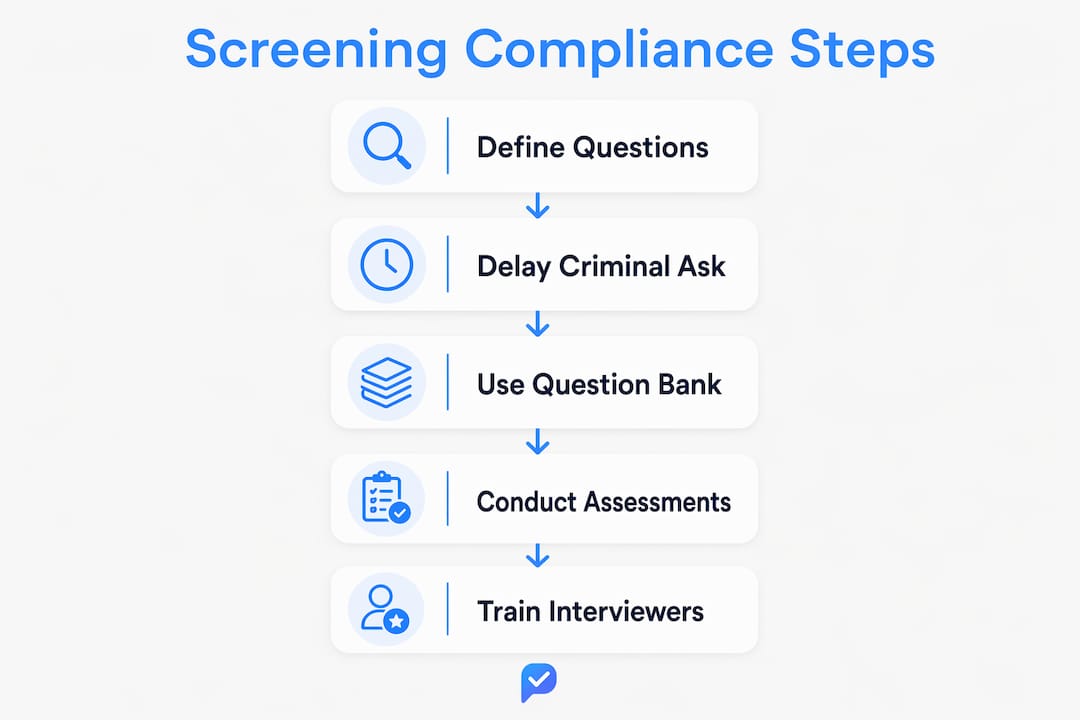
The substitution principle is the most practical tool here. Instead of "How old are you?", ask "Are you at least 18 years of age?" Instead of "What religion do you practice?", ask "Are you available to work on weekends and holidays?" The job requirement stays intact; the protected characteristic disappears from the conversation.
Pro Tip: Create a standardized question bank reviewed by employment counsel before each hiring cycle. Consistency across candidates is your strongest defense against disparate treatment claims.

What ban-the-box laws mean for criminal history questions
Over 37 states and 150+ cities have enacted ban-the-box or fair chance hiring policies that prohibit employers from asking about criminal history on job applications or during initial interviews. This is one of the fastest-moving areas of employment screening law, and the variation between jurisdictions is significant.
The core principle is timing. Criminal history questions must be delayed until after an initial interview or, in many jurisdictions, until after a conditional offer of employment has been extended. The logic is straightforward: a candidate should have the opportunity to demonstrate their qualifications before a conviction record enters the evaluation.
The table below illustrates how three major states approach this timing requirement:
| Jurisdiction | When criminal history is permitted | Scope |
|---|---|---|
| California | After conditional offer only | All employers with 5+ employees |
| Illinois | After conditional offer only | Employers with 15+ employees |
| Texas | No statewide ban-the-box for private employers | Local ordinances may apply |
California's Fair Chance Act goes further than most, requiring employers to conduct an individualized assessment before withdrawing an offer based on criminal history. Texas has no statewide private-sector law, but cities like Austin have local ordinances that apply to city contractors. Illinois follows the Job Opportunities for Qualified Applicants Act, which covers most private employers with 15 or more employees.
The practical implication for HR teams is that a single application form cannot serve every jurisdiction. Organizations hiring across multiple states need location-specific application templates and a clear internal policy on when criminal history enters the screening workflow.
Pro Tip: Remove the criminal history checkbox from your standard application entirely. Replace it with a conditional offer addendum that triggers background check consent only after the interview stage. This single change puts you in compliance with the majority of ban-the-box jurisdictions at once.
What FCRA compliance requires when you run background checks
The Fair Credit Reporting Act governs every background check conducted through a third-party Consumer Reporting Agency (CRA). The procedural requirements are specific, and adverse action procedural mistakes cause the majority of costly FCRA violations and class action lawsuits. The steps are not complicated, but they must be followed in order.
- Provide a standalone disclosure. Before ordering a background check, give the candidate a written disclosure that a consumer report may be obtained. Consent forms must be standalone documents without added text. Including a liability waiver or an arbitration clause in the same document invalidates the authorization and creates an immediate FCRA violation.
- Obtain written authorization. The candidate must sign a separate written authorization before you order the report. Electronic signatures are acceptable under the E-SIGN Act.
- Review the report and make a preliminary decision. If the report contains information that may lead you to withdraw a job offer, do not act immediately.
- Send a pre-adverse action notice. Provide the candidate with a copy of the background report, a copy of the FCRA Summary of Rights, and written notice that you are considering an adverse decision. This gives the candidate an opportunity to dispute inaccurate information.
- Wait before taking final action. The FCRA requires a waiting period of at least 5 business days as an industry standard. Philadelphia mandates 10 business days. Use this window to review any dispute the candidate raises.
- Send the final adverse action notice. If you proceed with the decision, notify the candidate in writing, identify the CRA that provided the report, and confirm their right to obtain a free copy of the report within 60 days.
"Skipping or compressing the adverse action process is the single most common FCRA mistake HR teams make. Statutory damages range from $100 to $1,000 per violation, and class actions multiply that exposure fast." — FCRA compliance guidance, 2026
Federal law also limits the reporting window for certain records. Arrest records older than 7 years cannot be reported for positions paying under $75,000 annually. States including California and Massachusetts apply a 7-year lookback limit on criminal convictions as well. At least 13 states restrict employer use of credit check data, so verify your state's rules before ordering a credit report on a candidate.
How to conduct individualized assessments for criminal history
A blanket policy that disqualifies any candidate with a criminal record is legally risky and factually counterproductive. The EEOC's guidance and supporting case law are clear: employers should avoid blanket bans on criminal history and instead conduct individualized assessments that weigh the specific circumstances of each case.
The framework most compliance professionals use is built around three factors, sometimes called the Green factors after the EEOC's foundational guidance:
- Nature and gravity of the offense. A fraud conviction is more relevant to a finance role than to a warehouse position. The severity of the crime and whether it involved violence, dishonesty, or harm to others all factor into the assessment.
- Time elapsed since the offense or completion of sentence. A conviction from 15 years ago with no subsequent record carries far less weight than a recent offense. Recency matters, and rehabilitation evidence should be considered.
- Nature of the job. The assessment must connect the offense directly to the duties of the specific role. A driving-related conviction is highly relevant for a delivery driver and largely irrelevant for a remote data analyst.
Documenting this reasoning is not optional. Employers must apply individualized assessments consistently and document their reasoning to defend against discrimination claims. If you withdraw an offer from one candidate based on a 10-year-old misdemeanor, you must be prepared to show that you applied the same standard to every candidate in a comparable situation. Inconsistent application is the fastest path to a disparate impact claim under Title VII.
Best practices for building a compliant screening program
Compliance in hiring is not a one-time checklist. Legislative shifts make manual tracking risky, and the volume of jurisdictional variation across 37+ states and hundreds of cities makes human error nearly inevitable without systematic support.
The most effective programs combine three elements. First, use a verified Consumer Reporting Agency rather than a database-only search. Database-only background checks are unreliable because they pull from unverified sources and frequently contain errors that expose employers to legal risk. A reputable CRA provides verified, legally compliant reports and carries its own FCRA obligations.
Second, automate your disclosure and adverse action timelines. Compliance technology tracks consent acknowledgments, waiting periods, and jurisdiction-specific deadlines across your entire candidate pipeline. Evy's screening automation capabilities address exactly this need, reducing the gap between policy intent and actual execution.
Third, train every hiring manager who conducts interviews. Legal pre-employment inquiry guidelines only work if the people asking questions understand the boundaries. A recruiter who asks "So, where are you originally from?" during small talk can create liability just as easily as a formal application question can. Training should cover EEOC protected categories, state-specific prohibitions, and the specific question bank your organization has approved.
Pro Tip: When reviewing social media profiles as part of screening, use a third-party reviewer rather than having the hiring manager conduct the search directly. Direct access exposes the decision-maker to protected information, making discrimination claims significantly harder to defend.
Evy's AI-powered screening platform also helps reduce bias at the interview stage by standardizing question delivery and capturing consistent data across all candidates, which supports the documentation requirements that individualized assessments demand.
Key takeaways
Compliant pre-employment screening requires combining legally permissible questions, FCRA procedural discipline, ban-the-box timing rules, and individualized criminal history assessments into a single, consistently applied program.
| Point | Details |
|---|---|
| Stick to job-related questions | Avoid any inquiry that reveals race, religion, national origin, age, disability, or family status. |
| Follow ban-the-box timing | Delay criminal history questions until after interview or conditional offer in 37+ states and 150+ cities. |
| Execute FCRA steps in order | Standalone disclosure, written authorization, pre-adverse notice, waiting period, and final notice are all required. |
| Apply individualized assessments | Evaluate nature, time elapsed, and job relevance for every criminal record before withdrawing an offer. |
| Automate compliance tracking | Use verified CRAs and technology tools to manage jurisdiction-specific deadlines and reduce human error. |
Why screening compliance deserves more attention than most HR teams give it
Most compliance failures I see are not the result of bad intentions. They come from HR teams that built their screening process five years ago and have not revisited it since. Ban-the-box laws have expanded dramatically. FCRA litigation has increased. State-level restrictions on credit checks and salary history have multiplied. The program that was legally sound in 2021 may have three or four active violations today.
The piece that surprises hiring managers most is how much exposure lives in the interview itself, not just the background check. A well-designed application form means nothing if a hiring manager asks a candidate about their family plans during a phone screen. The legal risk does not sit only in the formal paperwork. It lives in every conversation a candidate has with your team.
The individualized assessment requirement is also underestimated. I have worked with organizations that had a written policy requiring case-by-case review of criminal history, but no documentation to show it was ever applied. A policy that exists only on paper provides almost no legal protection. The documentation is the defense.
The organizations that handle this well treat screening compliance the same way they treat financial controls: regular audits, clear ownership, and technology that enforces process rather than relying on individual memory. That approach does not require a large legal budget. It requires discipline and the right tools.
— Hudson
How Evy supports compliant pre-employment screening
Evy is built for HR teams that need to screen candidates at scale without sacrificing legal compliance or evaluation quality. The platform standardizes interview question delivery, ensuring every candidate receives the same legally reviewed questions in the same sequence. This consistency directly supports the documentation requirements that FCRA and EEOC individualized assessments demand. Evy's real-time eye tracking also identifies candidates who may be using AI assistance during screening interviews, protecting the integrity of your candidate data. For teams managing hiring across multiple jurisdictions, Evy's compliance-focused features reduce the manual overhead of tracking ban-the-box rules, adverse action timelines, and state-specific restrictions. See how Evy helps your team hire faster and stay compliant.
FAQ
What questions are illegal to ask in a pre-employment interview?
Questions that reveal or probe protected characteristics under EEOC guidelines are prohibited. This includes inquiries about age, race, religion, national origin, disability, pregnancy, marital status, and in many states, salary history.
When can employers ask about criminal history?
In jurisdictions with ban-the-box laws, criminal history questions are permitted only after an initial interview or conditional job offer. As of 2026, over 37 states and 150+ cities have these timing restrictions in place.
What is the FCRA adverse action process?
The FCRA requires employers to send a pre-adverse action notice with the background report and Summary of Rights, wait at least 5 business days (10 in Philadelphia), and then send a final adverse action notice if the decision stands.
Can employers check social media during pre-employment screening?
Employers can review publicly available social media, but having the hiring manager conduct the search directly creates legal risk by exposing them to protected information. Third-party review is the recommended practice.
What is an individualized assessment for criminal history?
An individualized assessment evaluates the nature and gravity of the offense, the time elapsed since the conviction, and the direct relevance of the offense to the specific job duties. The EEOC requires this approach to avoid discriminatory blanket exclusions.