
 By Adrian Pascual•Hiring insight•Published
Evy Alternatives for Recruiters: Anti-Cheat AI Platforms
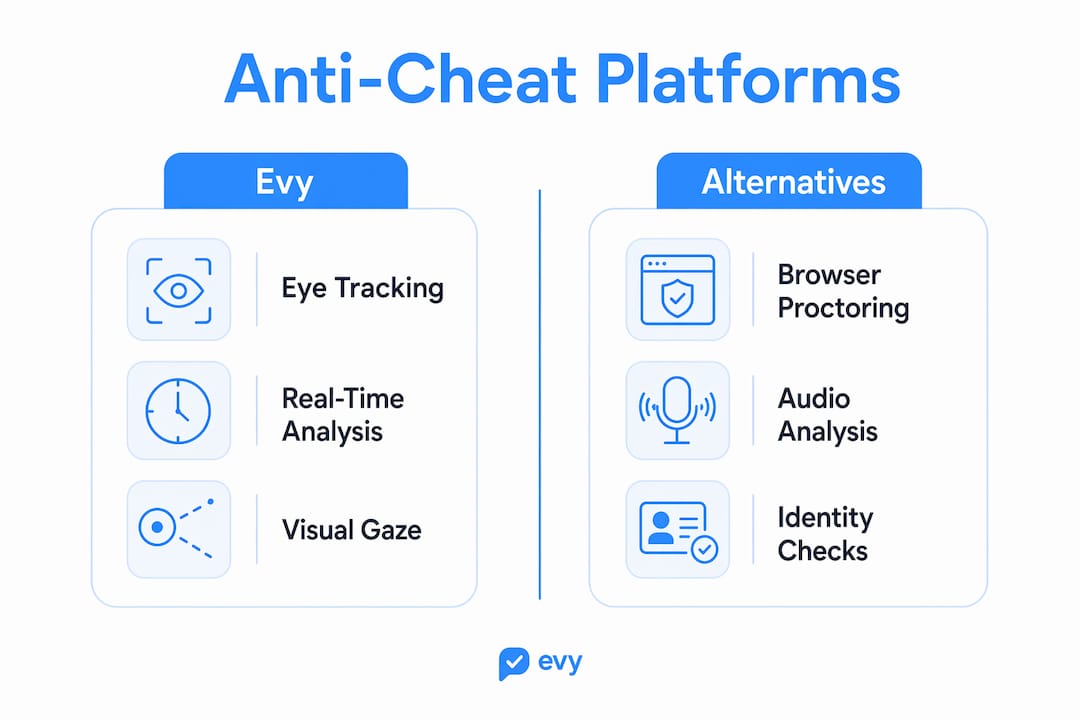
If you need an alternative to Evy's real-time eye tracking approach, the strongest options for U.S. hiring teams are Eightfold AI, Glider AI, HireVue, Zeko AI, Modern Hire, and Harver. Each takes a different angle on interview integrity, and the right choice depends on your hiring volume, role complexity, and compliance requirements.
- Eightfold AI — best for enterprise teams that need SOC 2 / ISO-certified fraud detection with identity verification via ID.me or CLEAR
- Glider AI — best for high-volume hourly hiring where end-to-end identity checks and conversational AI must run in a single pipeline
- HireVue — best for large enterprises already invested in structured video interviewing with browser-based proctoring
- Zeko AI — best for technical and assessment-heavy roles requiring deep proctoring across pre-test, live, and post-test phases
- Modern Hire — best for compliance-sensitive programs that need audit logs and structured scoring alongside video
- Harver — best for high-volume screening where behavioral and situational assessments carry more weight than live proctoring
Single-sentence recommendation: If real-time gaze analysis is not your primary requirement, choose a platform that combines conversational reasoning checks with browser proctoring and native ATS integration, then validate it with a 30–90 day pilot before full deployment.
Table of Contents
- How do Evy and its alternatives compare on anti-cheat features?
- Profiles: what each platform actually offers
- How to choose the right Evy alternative for your program
- How to run a 30–90 day pilot to validate anti-cheat effectiveness
- When to stay with Evy and when an alternative fits better
- Key Takeaways
- The trade-offs recruiters rarely talk about
- Evy screens at scale with the only real-time eye tracking in the market
How do Evy and its alternatives compare on anti-cheat features?
| Platform | Anti-Cheat Approach | Identity Verification | Interview Types | ATS / SSO | 24/7 Screening | Compliance Notes | Deployment |
|---|---|---|---|---|---|---|---|
| Evy | Real-time eye tracking + standard signals | Browser signals | One-way, conversational AI | Yes | Yes | US data residency; SOC 2 | Days |
| Eightfold AI | Tab switching, camera manipulation, duplicate voice detection | ID.me, CLEAR | One-way, live, conversational AI | Yes | Yes | SOC 2, ISO certified | Weeks |
| Glider AI | Conversational AI + identity checks bundled | Built-in ID verification | One-way, conversational AI | Yes | Yes | SOC 2; US available | Days–weeks |
| HireVue | Browser proctoring, audio analysis | Face match | One-way, live | Yes | Yes | ADA/EEOC guidance published | Weeks |
| Zeko AI | 28+ integrity checks across pre/live/post | Browser signals | One-way, assessment | Yes | Yes | US available | Days |
| Modern Hire | Audio analysis, transcript scoring | Face match | One-way, live | Yes | Yes | Audit logs; EEOC-aligned | Weeks |
| Harver | Behavioral + situational assessments | Limited | Assessment, one-way | Yes | Yes | CCPA-aware | Days |
Pro Tip: When a vendor claims high detection accuracy, ask specifically for false-positive and false-negative rates from a real deployment, not a controlled demo. Request a sample flagged recording and walk through how their system explains the flag. Vendors who cannot produce this data are not ready for enterprise procurement.
Profiles: what each platform actually offers
Evy
Evy's differentiator is real-time eye tracking, which monitors gaze patterns during a response to detect attention shifts consistent with reading from an off-screen source. It supports one-way and conversational AI interviews, runs 24/7 at scale, and is built for integrity-sensitive remote hiring. The platform is best suited to organizations where detecting AI-assisted answer reading is a primary concern, not just a secondary signal. Deployment is fast, typically within days. The trade-off is that eye tracking alone does not cover every cheating vector, so teams with complex technical roles may want to layer additional assessment tools.
Eightfold AI
Eightfold AI's AI Interviewer tracks tab switching, camera manipulation, and duplicate voice signals, and integrates identity verification through partners like ID.me and CLEAR. Published product highlights cite time-to-fill reduction and SOC 2 and ISO certifications, which matters for enterprise legal and security reviews. It supports one-way, live, and conversational AI interview formats. The platform fits large enterprises that need a compliance-ready, multi-signal fraud detection layer alongside structured interviewing. Integration complexity can extend deployment to several weeks.

Glider AI
Glider AI unifies identity verification, skills validation, and conversational AI interviews in a single pipeline, which reduces the risk of verification gaps between screening stages. It is purpose-built for hourly and frontline hiring at volume, where speed and consistency matter as much as detection depth. Talent integrity is strongest when verification and assessment are standardized across the full pipeline rather than stitched together from separate tools. For high-volume programs, that unified approach is a meaningful operational advantage.
Pro Tip: For IT and technical roles, prioritize platforms that evaluate role-based reasoning, not just keyword matching. Reasoning-based checks are harder for AI-generated answers to pass because they require the candidate to explain their logic, not just produce a plausible-sounding response. See how interview prep tools affect candidate-side detection for context.
HireVue
HireVue uses browser proctoring and audio analysis alongside structured video interviews. It has published ADA and EEOC guidance, which gives compliance teams a documented starting point. The platform is best for large enterprises already running structured video interviewing who want to add proctoring without switching core infrastructure. Deployment typically takes a few weeks due to configuration and ATS alignment.
Zeko AI
Zeko AI's 360-degree proctoring covers more than 28 integrity checks spanning pre-test, real-time, and post-test analysis. That depth makes it a strong fit for technical assessments and certification-style screenings where a single missed signal could compromise result validity. The breadth of checks does introduce more candidate friction than lighter proctoring approaches, so candidate experience scores in pilots tend to run lower.
Modern Hire
Modern Hire combines audio analysis, transcript scoring, and structured video with audit logs designed for EEOC-aligned hiring programs. It suits compliance-sensitive industries, including financial services and healthcare, where every hiring decision needs a documented rationale. The platform's reporting depth is a strength; its configuration complexity can slow initial deployment.
Harver
Harver focuses on behavioral and situational assessments rather than live proctoring, making it a better fit for roles where job-fit prediction matters more than real-time integrity monitoring. It handles high-volume screening efficiently and integrates with major ATS platforms. Teams that need strong proctoring signals alongside assessment should plan to supplement Harver with a dedicated integrity layer.
How to choose the right Evy alternative for your program
Work through these criteria before shortlisting vendors:
- Anti-cheat technique fit. Eye tracking (Evy) catches gaze-based cheating. Browser proctoring catches tab switching and screen sharing. Conversational reasoning checks catch AI-synthesized answers. Most high-stakes programs need at least two of these layers.
- ATS and SSO compatibility. Confirm native connectors for your ATS (Workday, Greenhouse, Lever, iCIMS) before the demo. Middleware workarounds add maintenance risk.
- Accessibility and ADA support. Any platform used in U.S. hiring must have documented ADA accommodation workflows. Ask for the written policy, not just a verbal assurance.
- Data residency and compliance. For CCPA-covered candidates or HIPAA-adjacent roles, confirm that candidate data stays within U.S. infrastructure and that the vendor can provide a data processing agreement.
- Pricing model fit. Per-screen pricing works for variable-volume programs; seat-based or enterprise licensing suits teams with predictable annual volume. Get a total-cost-of-ownership estimate that includes implementation and support.
- Vendor support and training. Ask how flagged interviews are reviewed, who provides recruiter training, and what the SLA is for disputed flags.
Questions to ask in every vendor demo: What is your documented false-positive rate in a live deployment? Can you show a sample audit log? How do you handle a candidate who disputes a flag? What is your data residency architecture for U.S. candidates?
Red flags that should stop procurement: no documented accuracy metrics from real deployments, no U.S. data residency controls, no audit logs, and no structured pilot support. A vendor unwilling to share a flagged recording for review is not ready for enterprise use. The platform choice you make here affects both hire quality and legal exposure.
Pro Tip: Review Evy's interview security guidance before vendor demos. It gives you a practical framework for evaluating anti-cheat claims against real operational conditions.
How to run a 30–90 day pilot to validate anti-cheat effectiveness
- Define scope. Select two to three job families with similar volume and complexity. Avoid piloting on your highest-stakes roles until baseline performance is established.
- Configure conservatively. Start with sensitivity settings at the vendor's recommended default. Aggressive settings increase false positives and damage candidate experience before you have calibration data.
- Run parallel testing. Screen a control group with your current process and the pilot group with the new platform. Keep role and volume consistent between groups.
- Collect structured feedback. Survey candidates on completion rate, perceived fairness, and technical friction. Survey recruiters on review time and flag clarity.
- Measure at the 30-day gate. If false-positive rates exceed your acceptable ceiling or candidate drop-off rises materially, adjust sensitivity before continuing.
- Evaluate at 90 days. Compare time-to-shortlist, recruiter review time per candidate, and offer-acceptance rates between groups.
| Metric | What to measure | Acceptable threshold |
|---|---|---|
| Detection rate | Flagged interviews / total interviews | Baseline from vendor; track trend |
| False-positive estimate | Cleared flags after recruiter review | Set ceiling before pilot starts |
| Interview completion rate | Completed / started | Monitor for drop-off vs. control |
| Time-to-shortlist | Days from screen open to shortlist | Compare to pre-pilot baseline |
| Recruiter review time | Minutes per flagged interview | Should decrease as calibration improves |
Pro Tip: Calibrate sensitivity in the first two weeks by reviewing every flag manually. This gives you a real false-positive baseline and helps recruiters learn what a genuine integrity signal looks like versus a technical artifact. Overreliance on automated flags without human review is the most common pilot failure mode.
When to stay with Evy and when an alternative fits better
Choose Evy when:
- Real-time gaze analysis is a material requirement for your role type (remote proctored exams, high-stakes professional screening)
- You need fast deployment (days, not weeks) with 24/7 screening at scale
- Eye tracking is the specific signal your legal or security team has approved for use
Choose an alternative when:
- You need end-to-end ATS-native integration with multi-signal fraud detection across pre-test, live, and post-test phases (Zeko AI, Eightfold AI)
- Your program is high-volume hourly hiring where unified identity verification and conversational AI in one pipeline reduces operational risk (Glider AI)
- Compliance documentation, audit logs, and structured scoring are the primary procurement requirements (Modern Hire, HireVue)
- Role-based reasoning checks matter more than gaze analysis for your candidate population (Eightfold AI, Glider AI)
Augmentation signal: If Evy covers your core integrity need but your ATS integration is complex or you need deeper assessment coverage for technical roles, consider pairing Evy with a dedicated skills assessment platform rather than replacing it. For AI and cybersecurity roles, role-based reasoning validation is worth adding regardless of which proctoring platform you use.
Key Takeaways
The most effective anti-cheat interview strategy combines at least two detection layers (eye tracking, browser proctoring, or conversational reasoning checks) with native ATS integration and a structured 30–90 day pilot before full deployment.
| Point | Details |
|---|---|
| Match technique to role type | Eye tracking suits remote proctored exams; reasoning checks catch AI-synthesized answers in conversational formats. |
| Demand accuracy data upfront | Ask every vendor for false-positive and false-negative rates from live deployments, not controlled demos. |
| Run a parallel pilot | Test the new platform against your current process on matched job families before committing to full rollout. |
| Confirm compliance before signing | U.S. data residency, ADA accommodation workflows, and audit logs are non-negotiable for enterprise procurement. |
| Evy's eye-tracking differentiator | Evy is the only platform with real-time eye tracking; choose it when gaze-based detection is a primary integrity requirement. |
The trade-offs recruiters rarely talk about
Anti-cheat platforms are sold on detection capability, but the operational reality is more nuanced. The signal that catches the most cheating is rarely the one that causes the least candidate friction, and that tension does not resolve itself automatically.
In practice, the teams that get the most value from these platforms are the ones that treat anti-cheat flags as one input in a human review process, not as a pass/fail gate. A flagged interview that a recruiter reviews in two minutes and clears is a healthy workflow. A flagged interview that automatically disqualifies a candidate without review is a legal and reputational risk, regardless of which platform generated the flag.
The other underappreciated variable is recruiter training. Platforms that surface detailed flag explanations (gaze deviation, tab switch count, audio anomaly) are only useful if recruiters understand what those signals mean and what they do not mean. A candidate with a slow internet connection may trigger browser signals that look identical to deliberate cheating. Without calibration and training, false positives accumulate and erode recruiter trust in the system.
The platforms that perform best in long-term deployments are the ones with strong pilot support, clear flag explanation interfaces, and vendors willing to share real accuracy data. That is a shorter list than the vendor landscape suggests.
Pro Tip: Train recruiters to treat anti-cheat flags as a prompt to ask a follow-up question in the next interview stage, not as a disqualification trigger. That one process change reduces false-positive harm and keeps your hiring legally defensible.
Evy screens at scale with the only real-time eye tracking in the market
Most anti-cheat platforms tell you a candidate switched tabs or paused unusually. Evy tells you where they were looking and when, in real time, during the answer. That distinction matters most for high-stakes remote roles, proctored professional screenings, and any program where AI-assisted answer reading is the specific threat you are trying to close.
Evy runs 24/7, scales to any hiring volume without adding recruiter hours, and surfaces honest, qualified candidates by combining gaze analysis with standard integrity signals in a single platform. For teams that have evaluated browser proctoring and conversational AI checks and still need a stronger integrity signal, eye tracking is the layer those platforms cannot replicate. See exactly how it works on the Evy features page, where you can also request a demo or review case studies from active deployments.