
 By Adrian Pascual•Hiring insight•Published
Job Fit Assessment: A Practical Guide for Hiring Managers
A job fit assessment is a systematic, data-driven process used during hiring to evaluate how well a candidate's skills, personality, values, and work preferences align with a specific role, team, and organization, with the goal of predicting performance, satisfaction, and longer-term retention. For hiring teams, the most important first step is grounding every assessment in a formal job analysis before selecting any instrument.
Three immediate priorities for any hiring team:
- Ownership: HR leads the design and validation; hiring managers provide role-specific criteria and score structured interviews.
- Start with job analysis: Define the competencies, values, and working conditions the role actually requires before choosing a tool. This is the single most defensible step you can take.
- Fairness from the start: Use standardized administration and structured scoring for every candidate to reduce bias and protect against adverse-impact claims.
Key Takeaways
Job fit assessments predict performance, satisfaction, and retention most reliably when they are grounded in job analysis, use multiple instruments, and apply standardized scoring across every candidate.
| Point | Details |
|---|---|
| Ground every assessment in job analysis | Map KSAOs to instruments before selecting any tool; this is the single most defensible step. |
| Use multiple fit dimensions | Person–job, person–organization, and person–group fit each predict different outcomes; no single instrument covers all three. |
| Sequence assessments for efficiency | Administer self-report fit surveys early for self-selection; reserve work samples and structured interviews for later stages. |
| Monitor for adverse impact | Track pass rates by demographic group each hiring cycle and apply the 4/5ths rule to protect against EEOC claims. |
| Evy supports scale and integrity | Evy's real-time eye tracking, audit logs, and ATS integration keep remote fit assessment data clean and legally defensible. |
Table of Contents
- What does a job fit assessment actually measure?
- Why fit matters: the business case and the evidence
- Common instruments used in job fit assessments
- Where fit assessments belong in the hiring process
- Designing valid and legally defensible assessments
- How to interpret fit scores and act on results
- What the research says about limits and common misuses
- Operational controls for scaling remote assessments
- Quick checklist for a defensible fit assessment program
- The case for starting smaller than you think
- Evy brings integrity and scale to fit assessment programs
- Sources
What does a job fit assessment actually measure?
Job fit is not a single dimension. Person–environment (PE) fit research identifies several distinct types, each predicting different outcomes and requiring different measurement approaches.
Person–job (PJ) fit splits into two sub-types. Demand–abilities fit asks whether the candidate's capabilities match what the role demands. Needs–supplies fit asks whether the role's rewards, autonomy, and working conditions match what the candidate needs to thrive. PJ fit is the strongest predictor of task performance and day-to-day job satisfaction.
Person–organization (PO) fit measures alignment between a candidate's values and the organization's culture, mission, and norms. It predicts organizational commitment and intent to stay more strongly than it predicts task performance. This distinction matters when you are deciding which fit type to weight most heavily.
Person–group fit captures compatibility with the immediate work unit: communication styles, collaboration norms, and team dynamics. It is especially relevant for roles that depend on close cross-functional coordination.
Person–vocation fit reflects alignment between a candidate's broader career interests and the occupational field itself. It tends to be most predictive of long-term career engagement rather than short-term role performance.
Scholarly reviews note that fit operates across hierarchical levels: misfit at one level can sometimes be offset by strong fit at another, but higher-level fit (vocation, organization) generally sets the ceiling for lower-level fit.
| Fit Type | Primary Outcomes Predicted | Best Used For |
|---|---|---|
| Person–job (demand–abilities) | Task performance, time-to-productivity | Technical, skill-specific roles |
| Person–job (needs–supplies) | Job satisfaction, burnout prevention | Roles with distinct autonomy/reward structures |
| Person–organization | Commitment, retention, intent to stay | Culture-sensitive or leadership roles |
| Person–group | Team cohesion, collaboration quality | Cross-functional or team-dependent roles |
| Person–vocation | Long-term career engagement | Early-career or career-change hires |
Why fit matters: the business case and the evidence
The business case for job fit evaluation is well-supported by federal research. A Merit Systems Protection Board (MSPB) analysis found strong correlations between person–job fit and workplace attitudes: approximately .56 with job satisfaction, .47 with organizational commitment, and −.46 with intent to quit. Those are not marginal signals. A correlation of .56 with job satisfaction is large enough to show up clearly in retention data, performance appraisals, and absenteeism rates.
Statistic to use in internal stakeholder conversations: Person–job fit correlates strongly with job satisfaction and negatively with intent to quit, according to MSPB federal workforce research.
For hiring teams, the practical benefits translate into three measurable areas:
- Retention: Candidates who fit the role's demands and the organization's values are less likely to leave within the first year, reducing replacement costs.
- Performance appraisals: Employees in high-fit roles tend to receive stronger performance ratings, particularly on task-specific competencies.
- Time-to-productivity: When a hire's skills and working style match the role's actual requirements, the ramp-up period is shorter. Technology can also help here: analysis of how assessment and screening technology supports retention shows that structured, data-driven hiring reduces early attrition.
Fit is also bidirectional. Organizations that change pay structures, remote-work policies, or team configurations should reevaluate which fit dimensions matter most and whether their current instruments still measure the right things.
Common instruments used in job fit assessments
OPM guidance identifies several instruments used in job fit assessment programs, each mapping to different fit dimensions and carrying distinct trade-offs. A multi-method approach consistently outperforms reliance on any single tool.

| Method | What It Measures | Strengths | Key Risks |
|---|---|---|---|
| Self-report fit survey | PO fit, values alignment, needs–supplies | Low cost, early self-selection | Social desirability bias, fakeability |
| Structured interview | PJ fit, competencies, culture alignment | High validity when scored consistently | Interviewer bias if scoring is unstructured |
| Cognitive ability test | Demand–abilities fit, learning potential | Strong predictor of task performance | Adverse impact risk for some demographic groups |
| Work sample / simulation | Demand–abilities fit, task performance | High face validity, job-relevant | Resource-intensive to design and administer |
| Situational judgment test (SJT) | PO fit, judgment, soft skills | Moderate validity, scalable | Requires careful item development |
| Personality inventory | PJ and PO fit, work style | Broad coverage of traits | Weak standalone predictor; best combined |
For a broader view of how these instruments fit into a full screening workflow, see types of pre-employment assessments.
Sample items that illustrate what valid instrument prompts look like:
- Self-report fit survey: "Rate how well this statement describes your ideal work environment: 'I prefer working independently on clearly defined tasks rather than collaborating on open-ended projects.'" (Needs–supplies fit)
- Structured interview: "Describe a situation where you had to deliver results under a tight deadline with limited resources. What did you do, and what was the outcome?" (Demand–abilities fit, scored on a behaviorally anchored rating scale)
- Work sample: Provide a candidate with a realistic data set and ask them to produce a short analysis memo within 30 minutes. (Task performance, demand–abilities)
- SJT: "Your team disagrees on the best approach to a client deliverable. You have 24 hours to submit. What do you do?" (PO fit, judgment under pressure)
- Cognitive ability test: A timed series of logical reasoning problems calibrated to the role's complexity level. (Learning potential, demand–abilities)
Where fit assessments belong in the hiring process
Sequencing matters as much as instrument selection. Running a resource-intensive work sample before you have screened for basic role alignment wastes everyone's time. OPM notes that job-fit measures are often administered early precisely because they function as self-selection tools: when candidates receive feedback that the role is unlikely to meet their needs, many withdraw voluntarily, reducing downstream screening costs.
A practical hiring flow for most roles:
- Job posting with realistic job preview — Describe actual working conditions, team norms, and performance expectations so candidates can self-select before applying.
- Self-report fit survey (screen-in/screen-out) — Administer early, online. Use results to provide tailored feedback and let poor-fit candidates exit gracefully.
- Cognitive or skills test — After basic fit is confirmed, assess the demand–abilities dimension with a timed, role-relevant test.
- Work sample or SJT — For roles where task performance is the primary hiring criterion, a structured work sample at this stage adds strong predictive validity.
- Structured interview — Use behaviorally anchored rating scales. Combine interview scores with earlier assessment results using a pre-agreed weighting formula.
- Reference check and final fit review — Validate key competencies and confirm organizational fit signals from earlier stages.
For screen-out use cases (high-volume roles), place the self-report survey and a brief cognitive screen at stages 1 and 2 to reduce the applicant pool before investing in interviews. For screen-in use cases (specialized or senior roles), use assessments to confirm fit rather than eliminate candidates, and weight the structured interview more heavily.
Designing valid and legally defensible assessments
Validity is not a one-time checkbox. It is an ongoing documentation practice. Standardized administration — giving every candidate the same tasks under the same conditions — is the foundation of both defensibility and comparability.
Core validation steps:
- Conduct a formal job analysis before selecting any instrument. Identify the knowledge, skills, abilities, and other characteristics (KSAOs) the role requires, and map each instrument to specific KSAOs.
- Set role-level criteria for what constitutes a passing or competitive score, based on job analysis findings rather than arbitrary thresholds.
- Standardize administration: same instructions, same time limits, same scoring rubrics for every candidate.
- Document scoring rules in writing before the first candidate completes the assessment.
- Pursue criterion-related validation where feasible: correlate assessment scores with actual job performance data from current employees in similar roles.
- Monitor for adverse impact by tracking pass rates across demographic groups and comparing them against the 4/5ths rule under EEOC Uniform Guidelines.
- Maintain records of job analysis documentation, validation studies, scoring rubrics, and adverse-impact analyses. These are your legal defense if a hiring decision is challenged.
For anti-bias controls, structured scoring and blinded review reduce affinity bias. Using diverse norm groups when interpreting personality inventories prevents culturally skewed benchmarks. Reviewing your screening process for bias at each stage is a practical step most teams can implement without a full psychometric overhaul.
Pro Tip: Run an annual adverse-impact analysis on your assessment data. Compare pass rates by race, gender, and age against the 4/5ths rule. If any group passes at less than 80% of the rate of the highest-passing group, investigate the instrument's validity for that population before the next hiring cycle.
How to interpret fit scores and act on results
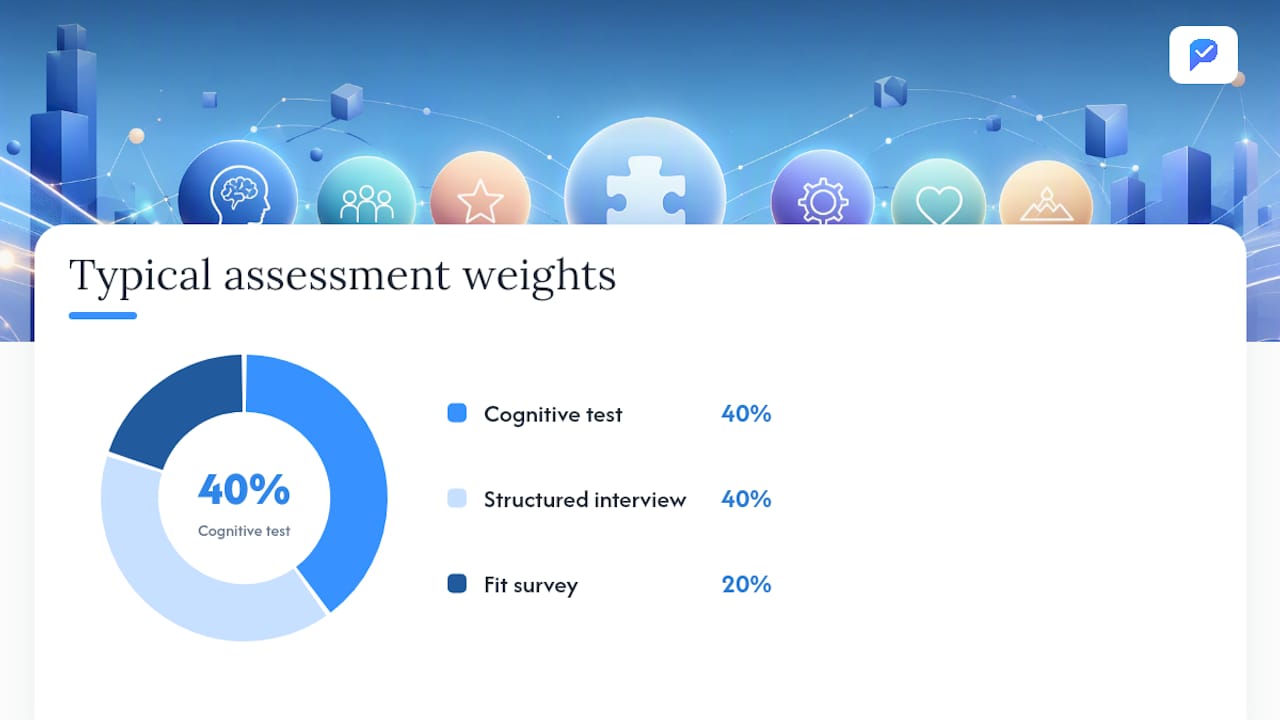
A fit score is a relative signal, not an absolute verdict. Treat it as one input in a weighted decision, not a standalone hiring criterion.
Practical decision rules for score interpretation:
- Banding: Group candidates into score bands (e.g., high, moderate, low fit) rather than ranking by exact score. Small score differences within a band are rarely meaningful given measurement error.
- Minimum thresholds: Set a minimum acceptable score for screen-out decisions, derived from job analysis and validation data, not from gut feel.
- Weighted scoring: Assign pre-agreed weights to each assessment component. A common approach: cognitive/skills test (40%), structured interview (40%), fit survey (20%). Adjust weights based on which dimensions your validation data shows are most predictive for the role.
- Combining sources: Never make a hire or reject decision based on a fit survey alone. Cross-reference with structured interview scores, work sample results, and reference checks.
Post-hire, fit scores have real operational value. Onboarding plans can be tailored to address needs–supplies gaps identified during assessment. A candidate who scored high on demand–abilities fit but lower on PO fit may need more deliberate cultural integration support in the first 90 days. Reassess fit dimensions at 6 and 12 months using structured performance conversations to validate whether your instruments predicted actual outcomes.
What the research says about limits and common misuses
The evidence for job fit assessments is strong in aggregate, but it comes with important caveats. PE fit research distinguishes between perceived fit (how well candidates believe they fit) and calculated or objective fit (the actual match between measured attributes and role requirements). Perceived fit tends to predict attitudes like commitment and satisfaction more strongly. Calculated fit is often more relevant to task performance. Using only self-report surveys captures the first but misses the second.
Key limitation: Self-report fit surveys measure how candidates perceive their fit, not necessarily how well their actual skills and values match the role's objective requirements. Combining perceived and calculated measures gives a more complete picture.
Common misuses that undermine program validity:
- Using "fit" as a proxy for cultural homogeneity. Assessing cultural alignment must be protected against bias. Without structured scoring and validated instruments, fit assessments can become a mechanism for replicating the existing workforce rather than selecting for genuine role-relevant attributes. This is both a legal risk and a diversity risk.
- Over-relying on a single instrument. A personality inventory alone, or a self-report survey alone, does not provide sufficient evidence for a hiring decision. Multi-method approaches are more defensible and more accurate.
- Skipping job analysis. Instruments selected without a job analysis foundation are difficult to validate and harder to defend legally.
- Failing to revalidate after organizational change. When pay structures, remote-work policies, or team configurations shift, the fit dimensions that mattered previously may no longer be the most predictive.
Document limitations explicitly in internal validation reports and communicate them honestly in candidate-facing materials. Candidates who understand what an assessment measures and why are more likely to engage authentically.
Operational controls for scaling remote assessments
Scaling fit assessments across a distributed hiring pipeline introduces integrity risks that in-person administration does not. Screening automation can address many of these, but only when paired with deliberate anti-cheat and audit controls.
Operational checklist for remote delivery:
- Candidate authentication: Verify identity at the start of each session using a government-issued ID check or a knowledge-based authentication step.
- Secure delivery: Use a platform that prevents copy-paste, screen sharing, and tab switching during timed assessments.
- Behavioral analytics: Eye-tracking and attention-pattern analysis can flag candidates who may be reading from off-screen sources or receiving real-time AI assistance. Gaze patterns during a structured response look meaningfully different from someone who is consulting external material.
- Transcript review: For video or conversational assessments, automated transcript analysis can surface response patterns inconsistent with the candidate's stated experience level.
- Audit logs: Maintain time-stamped records of every assessment session, including flagged anomalies, for legal defensibility.
- Accessibility accommodations: Document and apply accommodations (extended time, screen reader compatibility) consistently across all candidates to comply with ADA requirements.
Pro Tip: Before deploying any behavioral analytics or eye-tracking feature, review your candidate disclosure language. U.S. privacy considerations require that candidates be informed about data collection methods before the session begins. A one-paragraph disclosure in the assessment instructions is standard practice and reduces legal exposure.
For teams evaluating how AI-assisted screening fits into a broader workflow, AI candidate screening comparisons offer a useful framework for weighing the trade-offs.
Quick checklist for a defensible fit assessment program
Use this as an operational audit tool when implementing or reviewing your program:
- Job analysis completed: KSAOs documented and mapped to each instrument before selection.
- Instruments selected by fit type: Each tool maps to a specific fit dimension (PJ, PO, person–group) with a clear rationale.
- Validation plan in place: Criterion-related or content validation study planned or completed; results documented.
- Standardized administration: Same instructions, time limits, and conditions for every candidate.
- Structured scoring: Behaviorally anchored rating scales or rubrics in place before the first candidate is assessed.
- Anti-bias controls active: Blinded review where feasible; diverse norm groups used for personality instruments.
- Adverse-impact monitoring: Pass rates tracked by demographic group; 4/5ths rule applied each hiring cycle.
- Candidate communication: Clear, plain-language explanation of what the assessment measures and how results are used.
- Audit trail maintained: Session logs, scoring records, and validation documentation stored and accessible.
- Revalidation scheduled: Trigger for reassessment defined (e.g., after significant organizational change or after 2 years of use).
The case for starting smaller than you think
Most teams that struggle with fit assessment programs try to build everything at once: a full battery of instruments, a custom validation study, and a new ATS integration, all before the first candidate completes a single screen. That approach stalls.
A more effective path is to pilot one fit dimension on one role family, measure whether assessment scores correlate with 90-day performance ratings, and use that data to build internal credibility before expanding. Hiring manager buy-in follows evidence, not theory. When a manager sees that candidates who scored in the high-fit band on a structured interview are still in the role at 12 months while low-fit hires have churned, the conversation about expanding the program becomes much easier.
The operational strengths worth prioritizing early are anti-cheat controls and audit logging. Remote assessments without integrity controls produce data that is difficult to defend, both internally and legally. Starting with a platform that captures behavioral signals, maintains session-level audit trails, and integrates with your ATS means your pilot data is clean enough to build a validation case from day one.
Evy brings integrity and scale to fit assessment programs
Hiring teams that need to screen at volume face a real tension: the more candidates you assess, the harder it is to maintain the integrity controls that make fit data defensible. Evy resolves that tension directly. The platform combines adaptive conversational interviewing with real-time eye tracking to detect AI-assisted cheating, automated scoring that combines resume signals with live response data, and a full audit trail for every session.
For teams building or scaling a job fit assessment program, Evy's anti-cheat interview features cover the operational controls that matter most: candidate authentication, behavioral analytics, transcript review, ATS integration, and compliance-ready reporting dashboards. Every session is logged, scored, and documented in a format that supports both internal validation work and legal defensibility. See how Evy works and run your first screened cohort with full audit coverage.
Sources
These are the primary sources hiring teams should consult when designing, validating, or auditing a job fit assessment program:
- The Importance of Job Fit for Federal Agencies and Employees (MSPB research brief)
- What Is Job Fit and How Should It Impact Your Hiring? | Indeed
- Job-Fit Measures | U.S. Office of Personnel Management
- Job fit assessments are a recruiter's super power | Rasmussen University