
 By Adrian Pascual•Hiring insight•Published
Eye Tracking Accuracy in Remote Interviews: HR Guide
Eye tracking can flag suspicious gaze behavior during remote interviews, but it cannot reliably detect cheating on its own. Used as one signal inside a multimodal pipeline with mandatory human review, it adds real value. Used as a standalone disqualifier, it will generate false positives that harm candidates and expose your organization to legal risk.
Before you evaluate any vendor, do three things:
- Require event-level true positive rate (TPR) and false positive rate (FPR) data, not frame-level percentages.
- Confirm that no candidate is auto-rejected based on gaze flags alone.
- Ask for demographic stratification in the vendor's test results.
Key Takeaways
Eye tracking adds measurable signal to remote interview integrity, but only when it is one layer in a multimodal pipeline with mandatory human review before any adverse action.
| Point | Details |
|---|---|
| Demand event-level metrics | Require TPR, FPR, and confidence intervals at the event level, not frame-level percentages. |
| Lab accuracy does not equal field accuracy | Controlled studies reached up to 74% binary accuracy; webcam pipelines typically report 64–80% under varying conditions. |
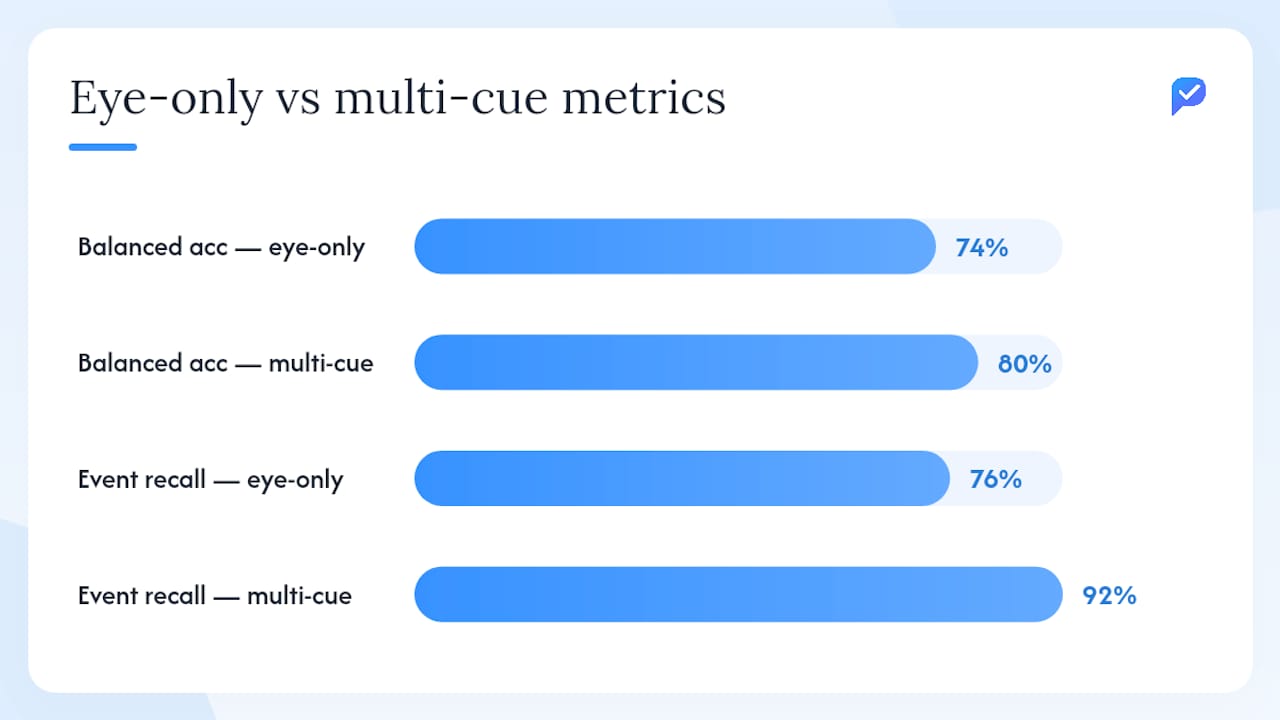
| Multi-cue systems outperform eye-only | Combining face-mesh, phone detection, and gaze improved event-level recall from 76% to 92% in prototype testing. |
| Human review is non-negotiable | No candidate should be disqualified based solely on an automated gaze flag; document every reviewer decision. |
| Evy provides a structured pilot path | Evy offers a device-matrix test, adversarial scenarios, and annotated samples so HR can validate performance before signing. |
Table of Contents
- What does eye tracking accuracy actually mean for HR screening?
- What the research actually shows about gaze-based cheating detection
- What failure modes should HR teams anticipate?
- Vendor evaluation checklist: what to require before procurement
- How to operationalize eye-tracking flags responsibly
- Minimum contract language for procurement teams
- How Evy approaches real-time gaze detection and auditability
- An honest perspective on eye tracking in hiring
- Evy helps HR teams screen with confidence
- Sources
What does eye tracking accuracy actually mean for HR screening?
In hiring contexts, "eye tracking accuracy" refers to a system's real-time ability to correctly detect and localize a candidate's gaze, then reliably flag attention patterns that suggest cheating. That is a different problem from the spatial precision metrics used in research hardware. What matters operationally is whether the system catches actual cheating events while keeping false alarms low enough to manage.
Two measurement levels matter here. Frame-level metrics measure whether the system correctly classifies individual video frames. Event-level metrics measure whether the system correctly identifies a discrete cheating incident (a sustained gaze shift, a phone pickup, a second-person entry) within a defined time window. That is the number that predicts your human-review burden.
The metrics HR teams should require from every vendor:
- TPR (true positive rate / sensitivity): share of actual cheating events the system catches. Demand this at the event level, not the frame level.
- FPR (false positive rate): share of honest-candidate events incorrectly flagged. Even a 5% FPR at scale means dozens of wrongly flagged candidates per cohort.
- Precision: of all flagged events, how many were real. Low precision means reviewers spend most of their time clearing innocent candidates.
- Balanced accuracy: the average of TPR and true negative rate, useful when cheating events are rare (the typical class imbalance in real hiring).
- Confidence intervals: a point estimate without a confidence interval is not evidence. Insist on sample size and interval width.
- Class baselines: what does random chance predict? A system that flags 10% of candidates when the base rate is 2% needs explanation.
Pro Tip: Ask vendors to specify the operating threshold they used when reporting metrics. A threshold tuned for high recall will inflate TPR while also inflating FPR. You want to see the full precision-recall curve, not a single cherry-picked operating point.
What the research actually shows about gaze-based cheating detection
The honest summary: controlled lab results are promising but do not transfer directly to webcam-based hiring screens. A lab study using dedicated eye-tracking hardware (Eyelink 1000 and Pupil Neon) found XGBoost models reached up to 74% binary accuracy distinguishing concealment from disclosure, and only 49% on a three-class task. Saccade count, duration, amplitude, and maximum pupil size drove most of the predictive signal. Those are controlled conditions with chin rests and high-sample-rate trackers. Webcam setups degrade that signal substantially.
Prototype systems built for real-time webcam screening tell a more nuanced story. A 2026 prototype combining YOLOv8s, InsightFace, and a gaze module ran at approximately 10 FPS on consumer hardware with strong object-detection metrics (mAP@50 of 0.9918), but its gaze component was validated only through observational testing, with no formal blink or gaze-deviation rate reporting. That gap is exactly what HR should demand vendors close.
Multi-cue pipelines outperform eye-only systems. A lightweight pipeline combining MediaPipe face-mesh landmarks, YOLOv8-nano phone detection, and a Random Forest classifier reported approximately 80% balanced accuracy and improved event-level recall from 76% to 92% when signals were combined. Separately, a video-only pipeline targeting another-person, device, and absence categories achieved an F1 of 0.88 on its test set, without relying on gaze at all. The implication for HR: gaze is a useful signal, not a sufficient one.
What failure modes should HR teams anticipate?
Real-world deployments introduce conditions that controlled studies never test. The most common failure modes fall into four categories.
Environmental factors are the most frequent source of false positives. Poor lighting, webcam angles below eye level, reflective eyeglasses, and low-resolution streams all degrade gaze localization. A candidate in a home office with a window behind them can generate gaze-deviation flags that have nothing to do with cheating.
Population variation is a fairness risk. Cultural norms around eye contact differ significantly across communities. Neurodivergent candidates, including those with ADHD or autism spectrum conditions, often display gaze patterns that diverge from neurotypical baselines. Age-related changes in saccade velocity and pupil response add further variation. A practitioner analysis of HireVue's facial-analysis discontinuation found that facial features contributed minimally to job-performance prediction, and that bias risks were a central reason for discontinuation. Gaze signals carry the same demographic risk if used without fairness testing.
Adversarial behaviors are harder to catch than vendors typically acknowledge. A candidate using a second monitor positioned just outside the webcam's field of view, reading from a phone held below frame, or using coached eye-motion patterns to mimic natural thinking will often evade detection. Understanding why candidates cheat video interviews helps HR teams anticipate these surfaces and ask vendors the right questions.
Model limitations include overfitting to small or homogeneous training datasets, lack of held-out independent test sets, and accuracy figures measured on the same distribution the model was trained on.
Pro Tip: Ask vendors to show you annotated video examples of both true positives and false positives from their test set. A vendor who cannot produce these has not done the work.
Vendor evaluation checklist: what to require before procurement
Use this framework when running a pilot or reviewing an RFP response.
- Event-level TPR and FPR with confidence intervals, measured on a held-out independent test set, not the training distribution.
- Demographic stratification: results broken out by age group, gender, and ethnicity at minimum.
- Operating threshold documentation: the threshold used when reporting metrics, plus the full precision-recall curve.
- Device and resolution matrix: performance on 720p and 1080p webcams, tested in daylight and low-light conditions.
- Adversarial robustness tests: second-monitor overlays, phone-in-frame, multiple faces, and scripted reading versus natural thinking.
- Latency profile: event detection latency on candidate-grade hardware (not a vendor's lab machine).
- Human-review workflow: documented process for routing flagged events to a reviewer before any adverse action.
- Raw logs and audit trail: timestamped event logs, reviewer comments, and export capability.
Pro Tip: Run the vendor's system on a sample of your own past interviews before signing. Internal replay tests reveal failure modes that vendor-supplied demos never show.
How to operationalize eye-tracking flags responsibly
Deploying gaze-based detection without the right policy controls creates legal and reputational exposure. The interview security practices that hold up under scrutiny share a few common features.
Consent and notice must be explicit. Candidates should receive written notice before the interview that their session will be recorded, that gaze and attention signals will be analyzed, how long data will be retained, and how they can appeal a flag. Vague "AI-assisted" disclosures are not sufficient.
Human review is non-negotiable before adverse action. Assign a named reviewer to each flagged event, set a review SLA (48 hours is a reasonable starting point), and document the reviewer's decision and rationale. No candidate should be disqualified based solely on an automated flag. Guidance on spotting dishonest interview responses can help reviewers calibrate their judgment.
Data minimization matters for eye tracking privacy. Retain only the event logs and annotated clips needed for the review period, and define a deletion schedule in the contract.
Pro Tip: Before full rollout, run a small internal A/B pilot: send one cohort through the eye-tracking-enabled flow and a matched cohort through your standard screen. Collect candidate experience feedback from both groups and compare reviewer workload.
Minimum contract language for procurement teams
These asks protect your organization and create accountability for the vendor.
- Technical SLA: maximum event-detection latency, uptime guarantee, and a supported webcam/resolution matrix with written commitments.
- Testing deliverables: independent third-party benchmark report, annotated hold-out test set, and representative video samples of true and false positives.
- Audit rights: access to raw event logs, timestamps, and reviewer comments for the duration of the contract plus a defined post-termination period.
- Bias testing clause: mandatory demographic-bias tests at least annually, with remediation commitments if parity gaps exceed agreed thresholds.
- Human-review requirement: contractual language stating that no adverse hiring action may be taken based solely on automated gaze flags.
- Termination trigger: right to terminate without penalty if the vendor discloses material accuracy failures not reflected in pre-contract benchmarks.
Pro Tip: Include a clause requiring the vendor to notify you within 30 days of any model update that materially changes TPR, FPR, or demographic parity metrics. Model drift after deployment is a real risk.
How Evy approaches real-time gaze detection and auditability
Evy's platform combines real-time gaze and attention localization with event-level flagging, a human-review queue, full session logs, and ATS integration. Rather than treating a single gaze deviation as a disqualifier, Evy surfaces flagged events to a reviewer with the relevant clip and timestamp, keeping humans in the decision loop. The platform's AI interviewer framework is built around structured, anti-bias interview flows that separate behavioral signals from scoring.
Evy supports periodic bias testing across demographic groups, configurable data retention, and an appeal path for candidates. For HR teams running a pilot, Evy can provide a device matrix test, scripted adversarial test scenarios, and annotated sample outputs so you can validate performance against your own candidate population before committing.
Pro Tip: When you request a pilot with Evy, ask specifically for the test harness documentation: the device matrix, the adversarial test scripts, and the annotation schema used to label flagged events. That documentation tells you more about system maturity than any demo.
An honest perspective on eye tracking in hiring
The most common mistake HR teams make with gaze-based detection is treating a high accuracy headline as a deployment decision.
The research is clear that multi-cue systems outperform eye-only heuristics, and that human review is not a nice addition but a structural requirement. What the research does not tell you is how your specific candidate population, your webcam hardware distribution, and your job category will interact with a vendor's model. That is why the pilot protocol and the contract language matter as much as the accuracy figures.
Gaze signals are genuinely informative. A candidate reading horizontally from a script looks different from someone thinking through a problem. But that signal is probabilistic, not diagnostic. The teams that use it well treat it as one input that raises a question, not one that answers it.
Evy helps HR teams screen with confidence
Screening at scale without sacrificing integrity is the core problem Evy was built to solve. Where other platforms surface a flag and leave your team to figure out what to do next, Evy routes every gaze and attention event to a structured human-review queue, complete with the clip, the timestamp, and the context a reviewer needs to make a defensible decision.
Evy's AI interview platform includes real-time eye tracking, adaptive conversational interviewing, automated scoring, ATS integration, and full audit logs. For HR teams ready to evaluate the technology seriously, Evy offers a pilot package that includes a device-matrix test, scripted adversarial scenarios, and annotated sample outputs. Request a pilot at Evy to see the test harness and vendor metrics before you commit.
Sources
These sources underpin the accuracy ranges, prototype results, and policy guidance cited in this article. Each is linked to its original publication for independent verification.
- Eye Movements as Indicators of Deception: A Machine Learning Approach
- Intelligent proctoring system integrating YOLOv8s, InsightFace and gaze tracking (2026)
- Lightweight real-time cheating detection using MediaPipe + YOLOv8 + Random Forest (2025 prototype)
- Cheating analysis pipeline for online interviews and exams (arXiv preprint)
- AI Interview Eye Tracking Explained: What Video Interviews Actually Analyze - AceRound Blog