
 By Adrian Pascual•Hiring insight•Published
Compare Candidates Objectively: A Hiring Manager's Scorecard Guide
The fastest, most defensible way to compare candidates objectively in hiring is a job-linked, weighted scorecard applied consistently across standardized assessments — structured interviews, work-sample tests, and validated screening tools — with all candidates scored in batch after assessments are complete. This approach works because it ties every evaluation criterion directly to the job, keeps scoring standards identical across reviewers, and produces a documented audit trail that holds up under legal scrutiny. The immediate step: build one shared template before your panel reviews a single resume.
Here is what that process looks like in practice:
- Define KSAOs (knowledge, skills, abilities, and other characteristics) before reviewing any applicant
- Select assessment methods that map to those KSAOs
- Build a single weighted scorecard all reviewers use
- Score candidates in batch, not one by one as they finish
- Hold a calibration meeting to align the panel and document decisions
- Run a basic adverse-impact check before extending an offer
Key Takeaways
A job-linked, weighted scorecard applied across structured assessments is the single most defensible method to compare candidates objectively in hiring — and it requires both a documented process and a calibration step to hold up under scrutiny.
| Point | Details |
|---|---|
| Start with KSAOs | Define role competencies and weights in writing before reviewing any application. |
| Use multiple assessment methods | Pair structured interviews with work samples or tests; combined methods improve predictive accuracy. |
| Score in batch, not sequentially | Reviewing all candidates after assessments are complete reduces recency bias and keeps comparisons fair. |
| Calibrate the panel | Hold a structured meeting to resolve score divergences and log rationales before any offer is made. |
| Evy automates the process | Evy's structured interview flows, weighted scorecards, and audit logs make objective comparison scalable and auditable. |
Table of Contents
- Does your hiring process actually meet objectivity standards?
- How do you define what "good" looks like for the role?
- Which assessment methods actually measure what you need?
- How do you build a weighted scorecard that makes comparisons fair?
- How do you run assessments, score consistently, and align the panel?
- What does U.S. law require when you compare job applicants?
- The part of objective hiring most teams get wrong
- Evy makes structured, auditable screening practical at scale
- Sources
Does your hiring process actually meet objectivity standards?
Before building anything new, confirm your current process clears these minimum thresholds:
- KSAOs defined in writing before the first resume is reviewed
- Assessment methods chosen for job-relatedness, not convenience (structured interview, work sample, or validated test)
- One shared weighted scorecard distributed to every reviewer before assessments begin
- Batch scoring — all candidates evaluated after all data are collected, not sequentially
- Panel calibration meeting scheduled and documented
- Adverse-impact check planned after the hire decision
- Validation evidence on file for any standardized test or AI-based screen
Pro Tip: Before your next search opens, document your scoring criteria in a Qualification Assessment Plan. UC Santa Cruz's Talent Acquisition team recommends this approach — specifying which qualifications can be judged from application materials and which require in-person assessment — so the panel evaluates consistently from day one.
How do you define what "good" looks like for the role?
Every objective comparison starts with a job analysis. Without one, reviewers default to gut feel, and gut feel is where bias lives.
A job analysis identifies the core duties of the role, then derives the KSAOs required to perform them. The APA's guidance on personnel selection is clear: there is no universally preferred assessment method, and the right choice depends entirely on which KSAOs the job demands. That means the job analysis is not optional — it is the foundation every other decision rests on.
Once you have your KSAOs, split them into two groups. The first group can be judged from application materials: years of relevant experience, required credentials, demonstrated domain knowledge from a portfolio or writing sample. The second group requires direct assessment: communication under pressure, problem-solving approach, cultural fit signals. Assign preliminary weights to each criterion and flag any knockout qualifiers — requirements so fundamental that a candidate who lacks them cannot advance regardless of other scores.
Example KSAOs for a Customer Success Manager role:
- Knowledge: SaaS product lifecycle, CRM platforms (e.g., Salesforce), escalation procedures
- Skills: Written and verbal communication, data analysis, cross-functional coordination
- Abilities: Conflict resolution, prioritization under competing demands
- Other characteristics: Reliability, client empathy, coachability
Document all of this in a Qualification Assessment Plan before the panel sees a single application. That document becomes the shared reference that keeps every reviewer evaluating the same job.
Which assessment methods actually measure what you need?
Choosing the right mix of assessments is where many hiring teams lose objectivity. The OPM's assessment strategy guidance recommends using multiple methods because each captures different aspects of job performance — a single-method approach creates false negatives that a complementary tool would have caught.
The five methods with the strongest empirical track record are structured interviews, work-sample tests, job-knowledge tests, cognitive ability tests, and empirically keyed biodata. Each maps to different KSAOs:
- Structured interviews — communication, judgment, behavioral patterns
- Work-sample tests — technical skills, output quality, task-specific ability
- Job-knowledge tests — domain expertise, procedural knowledge
- Cognitive ability tests — problem-solving, learning speed, reasoning
- Biodata — reliability, career trajectory, relevant life experience
The trade-offs are real. Cognitive ability tests carry higher adverse-impact risk and require careful validation. Work samples are resource-intensive but highly predictive. Structured interviews, when designed with standardized questions and benchmark answers, reduce bias and produce comparable responses across the candidate pool.
A multi-hurdle design, endorsed by the Department of Defense's hiring guide, sequences these methods by cost: run inexpensive automated screens first, then reserve labor-intensive assessments for finalists. This protects your team's time and keeps the process proportionate. For technical roles, AI-assisted screening can handle the first-pass volume efficiently before structured interviews begin.
Pro Tip: Pair a structured interview with at least one work sample or job-knowledge test. Combining complementary methods increases predictive validity beyond what either achieves alone — the evidence consistently supports multi-method approaches over any single tool.
How do you build a weighted scorecard that makes comparisons fair?
A selection matrix is the practical mechanism that makes side-by-side candidate comparison possible. The University of Texas HR team describes it as a tool that makes direct, fair comparisons easier for panels by mapping applicants against vacancy qualifications in a structured grid.

Scorecard mechanics
Each row represents a KSAO or assessment criterion. Each column holds a candidate's score on that criterion. A weight column converts raw scores into weighted totals, and the final row sums those totals for a comparable aggregate.
Weight ranges typically run within a broad spectrum per criterion, with the highest weights assigned to the KSAOs most predictive of job performance. Knockout criteria sit outside the weighted system: a candidate who fails a knockout does not advance, regardless of their aggregate score.
Worked example: two candidates for a Customer Success Manager role
When scores are close — within 0.25 points in this example — the tie-break rule should be pre-defined: revert to the highest-weighted criterion, then convene the panel.
Export the completed matrix as a CSV or PDF immediately after scoring. That file becomes your auditable record, timestamped and version-controlled, which matters if a hiring decision is ever questioned.
How do you run assessments, score consistently, and align the panel?
Administering assessments and scoring them are two separate phases, and conflating them is one of the most common sources of inconsistency.
Assessment administration: Run all candidates through the same assessment sequence. Do not score anyone until all candidates have completed the relevant stage. Sequential scoring — reviewing Candidate A the day after their interview, then Candidate B a week later — introduces recency bias and makes the comparison unfair before the scorecard is even opened.
Scoring with rubric anchors: Every structured interview question should carry benchmark answers at each score level. A score of 5 means the candidate did X, Y, and Z. A score of 3 means they addressed X but missed Y. Without these anchors, two reviewers applying the same scorecard can still diverge significantly. Reducing that divergence is the goal of interviewer subjectivity controls.
Calibration meeting agenda:
- Each reviewer submits independent scores before the meeting — no discussion beforehand
- Facilitator surfaces any score where reviewers diverged by two or more points
- Panel discusses the specific evidence behind each divergent score, not general impressions
- Panel agrees on a final score for each disputed criterion and logs the rationale
- Borderline candidates are ranked using the pre-defined tie-break rule
- Final decisions are documented with a brief written rationale for each candidate
Pro Tip: Assign a neutral facilitator for calibration meetings — someone who did not conduct interviews. They can flag when discussion drifts from evidence to impression, which is where groupthink enters.
What does U.S. law require when you compare job applicants?
Legal defensibility is not a separate concern from objectivity — it is the same concern, stated differently. The EEOC's guidance on employment tests and selection procedures requires that selection procedures be job-related and properly validated. If a tool disproportionately screens out a protected group, the employer must investigate less discriminatory alternatives.
That requirement applies to every tool in your process: structured interview questions, cognitive ability tests, AI-based screens, and automated scoring systems. Validation means demonstrating that the tool predicts job performance — not just that it feels predictive.
Practical bias checks to run:
- Adverse-impact analysis: After each hiring cycle, calculate pass rates by demographic group. A ratio below 80% for any protected group (the "four-fifths rule") signals a potential disparate-impact problem requiring investigation.
- Subgroup score reviews: Compare mean scores across demographic groups on each assessment. Consistent gaps on a single criterion may indicate the criterion is measuring something other than job-relevant ability.
- Blind resume screening: Remove names, graduation years, and other demographic signals before the initial application review to reduce affinity bias at the top of the funnel.
Operational controls that support auditability include documented validation evidence for each assessment tool, timestamped scoring records, interviewer training logs, and written candidate communication confirming the process. The EEOC also specifies which interview questions are impermissible — reviewing that list with your panel before each search is a low-cost safeguard.
Evy's platform operationalizes several of these controls directly: structured interview flows enforce consistent question delivery, automated scorecards log reviewer inputs with timestamps, and audit dashboards surface scoring patterns that may warrant a closer look. For teams managing AI screening risks and fairness, having those controls built into the platform rather than maintained manually reduces compliance exposure considerably.
The part of objective hiring most teams get wrong
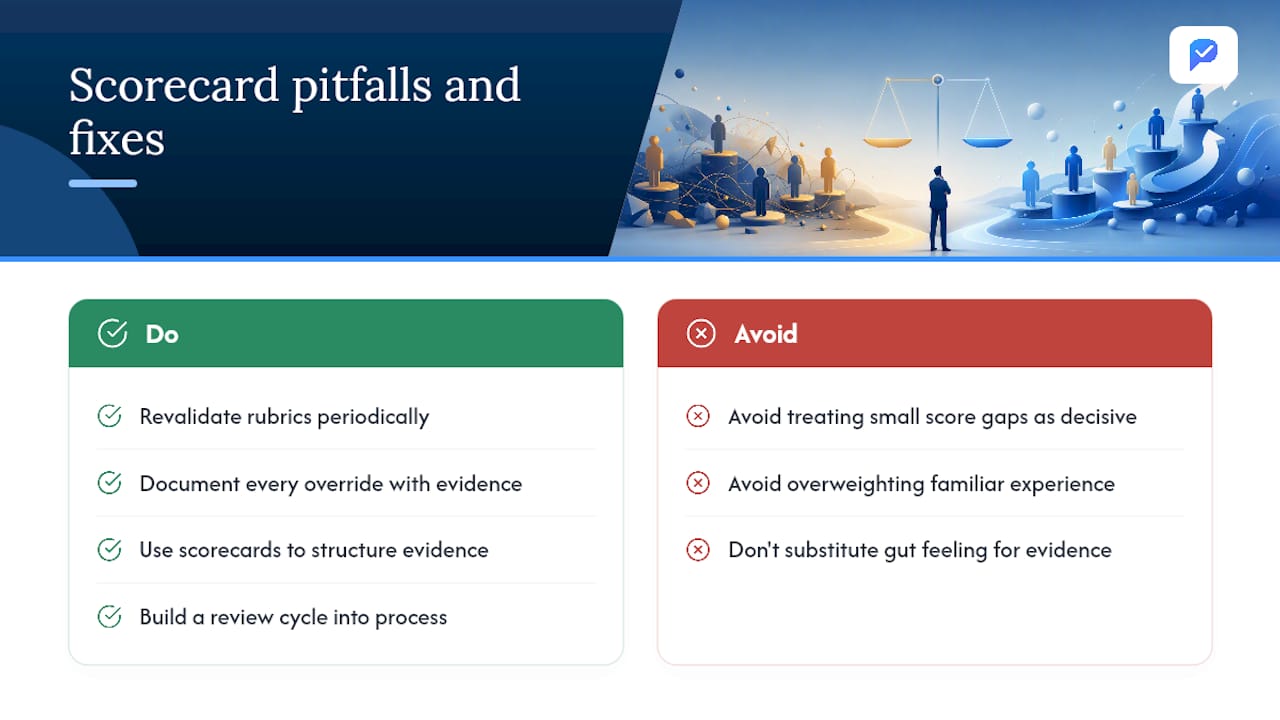
Most hiring teams implement a scorecard and then quietly override it. Not because they are careless — because the scorecard produces a result that feels wrong, and they trust their instincts over the data. That tension is worth taking seriously rather than dismissing.
Scorecards are not prophecy. They are structured evidence summaries. A candidate who scores 3.55 is not definitively worse than one who scores 3.75 — the difference may fall within the normal measurement error of your assessment tools. Treating a 0.2-point gap as decisive when your rubric anchors are loosely defined is false precision. The scorecard's value is in forcing explicit, comparable evidence — not in producing a number that removes human judgment entirely.
The more common failure, though, runs the other direction: over-weighting familiar experience. A candidate whose resume mirrors the hiring manager's own career path will feel like a stronger fit before a single question is asked. That feeling is not evidence. It is pattern recognition shaped by the evaluator's own history, and it systematically disadvantages candidates from non-traditional backgrounds.
Periodic revalidation matters here. If your assessment tools were designed three years ago for a role that has since changed, the weights and criteria may no longer reflect what the job actually requires. The DoD guide's emphasis on continuous monitoring of assessment quality applies equally to private-sector teams: build a review cycle into your process, not just a one-time setup.
When you do override the scorecard, document it. Write down what evidence drove the exception and why it outweighed the quantitative result. That documentation protects the organization legally and, over time, reveals whether your overrides are improving outcomes or repeating the same biases the scorecard was built to prevent.
Evy makes structured, auditable screening practical at scale
Running a weighted scorecard process manually across dozens of candidates is feasible for a single search. At scale — multiple open roles, distributed hiring teams, high-volume pipelines — the manual version breaks down. Scoring consistency drifts, calibration meetings get skipped, and audit trails become spreadsheets nobody can find six months later.
Evy is built to operationalize exactly the process this guide describes. Structured interview flows deliver standardized questions to every candidate in the same sequence. Adaptive conversational interviewing captures nuanced responses while maintaining consistency. Automated scorecards aggregate resume signals and live interview responses into a single weighted score, with every reviewer input timestamped and logged. Real-time eye tracking adds a layer most platforms cannot offer: detecting when candidates are reading AI-generated responses rather than answering from genuine knowledge, which protects the integrity of your assessment data.
ATS integrations mean your scored candidates flow directly into your existing workflow, and bias-reduction controls keep the structured process intact even when hiring volume spikes. For HR teams evaluating HR software options that support fair, documented hiring, Evy sits at the intersection of compliance and operational efficiency. See how it works for your team at Evy.
Sources
The following primary sources informed this guide and are worth consulting directly for validation requirements, legal compliance, and deeper assessment methodology:
- Employment Tests and Selection Procedures | U.S. Equal Employment Opportunity Commission
- Designing an assessment strategy | U.S. Office of Personnel Management
- Personnel selection procedures | American Psychological Association
- Gov
- Screening guidance | UC Santa Cruz Talent Acquisition
This article is general information, not a substitute for advice from a qualified lawyer. Consult a qualified legal professional about your own circumstances before acting on anything here.